What we know about the ‘first phase’ Gaza peace deal

US President Donald Trump said that Israel and Hamas agreed on the first phase of the Gaza peace agreement.
This came two years and two days after Israel launched military action in Gaza in response to an October 7, 2023 attack in which Hamas-led gunmen killed nearly 1,200 people and took 251 hostage.
The Hamas-run health ministry announced that at least 67,183 people, including 20,179 children, have been killed in Israel’s military operations in Gaza since then.
Here’s what we know about the deal and what remains unclear:
What was announced?
The US president said that after intense negotiations in Egypt, Israel and Hamas agreed on the first phase of the US peace plan.
Announcing the agreement on social media, Trump said, “This means that all hostages will be released very soon and Israel will withdraw its soldiers to an agreed-upon line.”
Describing these as “the first steps towards eternal peace”, Trump said that “all parties” would be treated fairly.
Israeli Prime Minister Benjamin Netanyahu called it “a great day for Israel” and said his government would meet on Thursday to ratify the deal and “bring all our beloved hostages home.”
Confirming the announcement, Hamas said it would “end the war in Gaza, ensure the complete withdrawal of occupation forces, allow the entry of humanitarian aid and carry out a prisoner exchange.”
Israel and Hamas do not speak to each other directly; The talks were mediated by Trump’s Middle East envoy Steve Witkoff, Trump’s son-in-law Jared Kushner and mediators from Egypt, Qatar and Türkiye.
What happens next?
The Israeli government will vote on the agreement on Thursday.
A senior White House official told the BBC’s US partner CBS News that Israel should withdraw its troops from Gaza to the agreed line if they were to officially approve it. The withdrawal will likely occur within 24 hours, the official said.
Once this happens, a 72-hour period will begin within which Hamas must release living hostages.
The senior White House official said the release of the hostages would likely begin on Monday.
What don’t we know?
What has been announced so far is only the beginning of Trump’s 20-point peace plan, which Israel has accepted and Hamas has partially accepted.
However, the announcements did not include some thorny issues that both parties could not reach a solution to.
Remarkably, there are no details about the disarmament of Hamas, a key plank in Trump’s plan. Hamas has previously refused to lay down its weapons and said it would do so only if a Palestinian state was established.
The future governance of Gaza is also a sticking point. Trump’s 20-point plan states that Hamas will have no future role in the Strip and proposes that Hamas be temporarily led by a “technocratic, apolitical Palestinian committee” before being handed over to the Palestinian Authority.
Although Netanyahu agreed to Trump’s plan last week, he appeared to have turned down the participation of the Palestinian Authority.
This point is also likely to be disputed by ultranationalists within Netanyahu’s ruling coalition, many of whom want to rebuild Jewish settlements in Gaza.
In response, Hamas said it still expected to have some role in governing Gaza.
Additionally, a Palestinian source told the BBC that, as of Wednesday night, Hamas had not yet received the final list of Palestinian prisoners that Israel plans to release in exchange for hostages in Gaza.
In the 20-item plan, it is stated that 250 prisoners sentenced to life imprisonment, as well as 1,700 Gazans detained after October 7, 2023, will be released.
What was the reaction?
 Reuters
Relatives of the Israeli hostages welcomed the agreement.
Eli Sharabi, whose wife and children were killed and whose brother Yossi’s body is in the hands of Hamas, shared: “Great joy, I can’t wait to see everyone at home.”
The hostage’s mother, Nemrut Cohen, shared: “My child, you are coming home.”
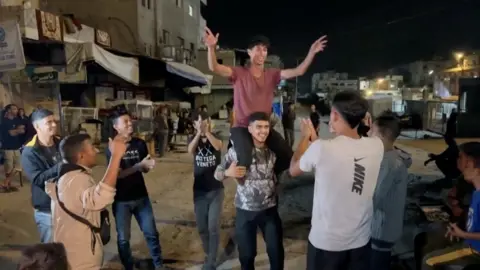
Meanwhile, celebrations began in Gaza after the announcement. Abdul Majeed abd Rabbo, from the city of Khan Younis in southern Gaza, was quoted by Reuters as saying, “Thank God for the ceasefire, the end of bloodshed and killings.”
“I am not the only one who is happy, the whole Gaza Strip is happy, all the Arab people, the whole world is happy with the ceasefire, the end of the bloodshed.”

 Reuters
World leaders called on the parties to comply with the agreement.
“The suffering must end,” United Nations Secretary-General António Guterres said, adding that the UN would support the “full implementation” of the agreement and increase aid distribution and reconstruction efforts in Gaza.
British Prime Minister Sir Keir Starmer welcomed the news, saying: “This is a moment of deep relief that will be felt around the world, but especially for the hostages, their families and the civilian population of Gaza who have endured unimaginable suffering over the last two years.”
Australian Prime Minister Anthony Albanese called the agreement “a much-needed step towards peace” and called on the parties to “respect the terms of the plan”.
Lawmakers in the United States have expressed cautious optimism.
“This is a first step, and all parties must ensure that it leads to a permanent end to this war,” Democratic Senator Chris Coons wrote in an X post. he said.
Republican James Risch, chairman of the Senate Foreign Relations Committee, called it a welcome agreement and said he was “looking forward to learning” [its] detail”.
With reporting by Rushdi Abualouf and Lucy Manning


