Inside the cloud king’s race to close the Big Tech gap

Even though Amazon has a massive cloud infrastructure through Amazon Web Services (AWS), investors were not very excited about the company. But that view changed after the company reported strong September quarter profits.
A deal with OpenAI and an increase in capital spending signaled Amazon’s return to the AI race. Artificial intelligence is just one of Amazon’s many concerns. Also important is how he manages his giant retail operations amid regulatory pressures.
capture the market
Over the past few years, post-covid and during the AI boom, Amazon has been unusual among the Big Five tech companies, but for the wrong reasons. Over the past five years, Amazon shares have gained 51% in value, while the market value of its peers has doubled or tripled.
As demand for Nvidia’s graphics processing units (GPUs) soared and Microsoft made headlines with its OpenAI partnership, investors were concerned that AWS, the cloud leader and parent division of Amazon, was struggling to scale.
Amazon was spending heavily on artificial intelligence infrastructure, but was losing its share to Microsoft and Google. In the second quarter of 2025, AWS’s profit margins fell sharply.
The picture changed after Amazon’s third quarter earnings on October 30, 2025. The results beat expectations and shares rose 13% in after-hours trading.
“There was definitely concern that AWS would lose market share to Microsoft Azure and Google Cloud,” said Jed Ellerbroek of Argent Capital. Reuters. “But now AWS is on board too.” Over the past five days, Amazon was the only Big Five stock to rise, while the others fell.
AWS revival
AWS grew its revenues in the September quarter to $33 billion, up 20.2% from $27.5 billion in the third quarter of 2024. It beat the segment’s 19% growth in the third quarter of 2024 and beat Wall Street’s 18.1% forecast. The results increased AWS’s annual run rate to $132 billion.
During the earnings call, CEO Andy Jassy emphasized that the division was “growing at a pace we haven’t seen since 2022” and attributed this to “strong demand in artificial intelligence and machine learning.”
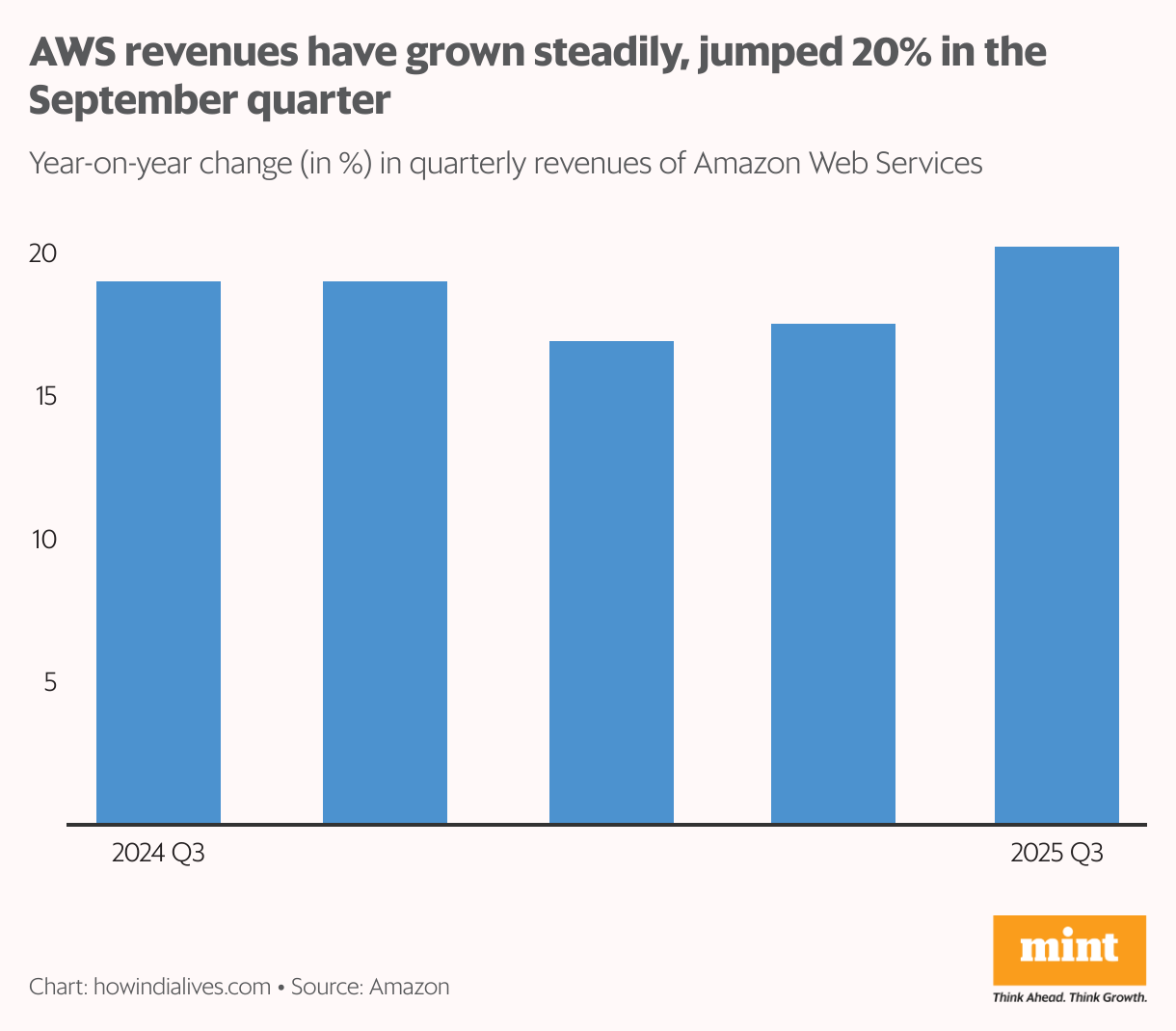
It allayed investors’ concerns that AWS, which holds about 31% of global cloud infrastructure according to recent Synergy Research data, may have difficulty managing scale.
It could also benefit from other changes in the market, such as friction between Microsoft and its long-time partner OpenAI. Earlier this week, Amazon signed a $38 billion cloud deal with OpenAI.
The deal could increase the $200 billion backlog by about 20% in the fourth quarter, according to BMO Capital Markets. It also gave AWS a clearer path to regain market share lost to Microsoft and Alphabet.
capital push
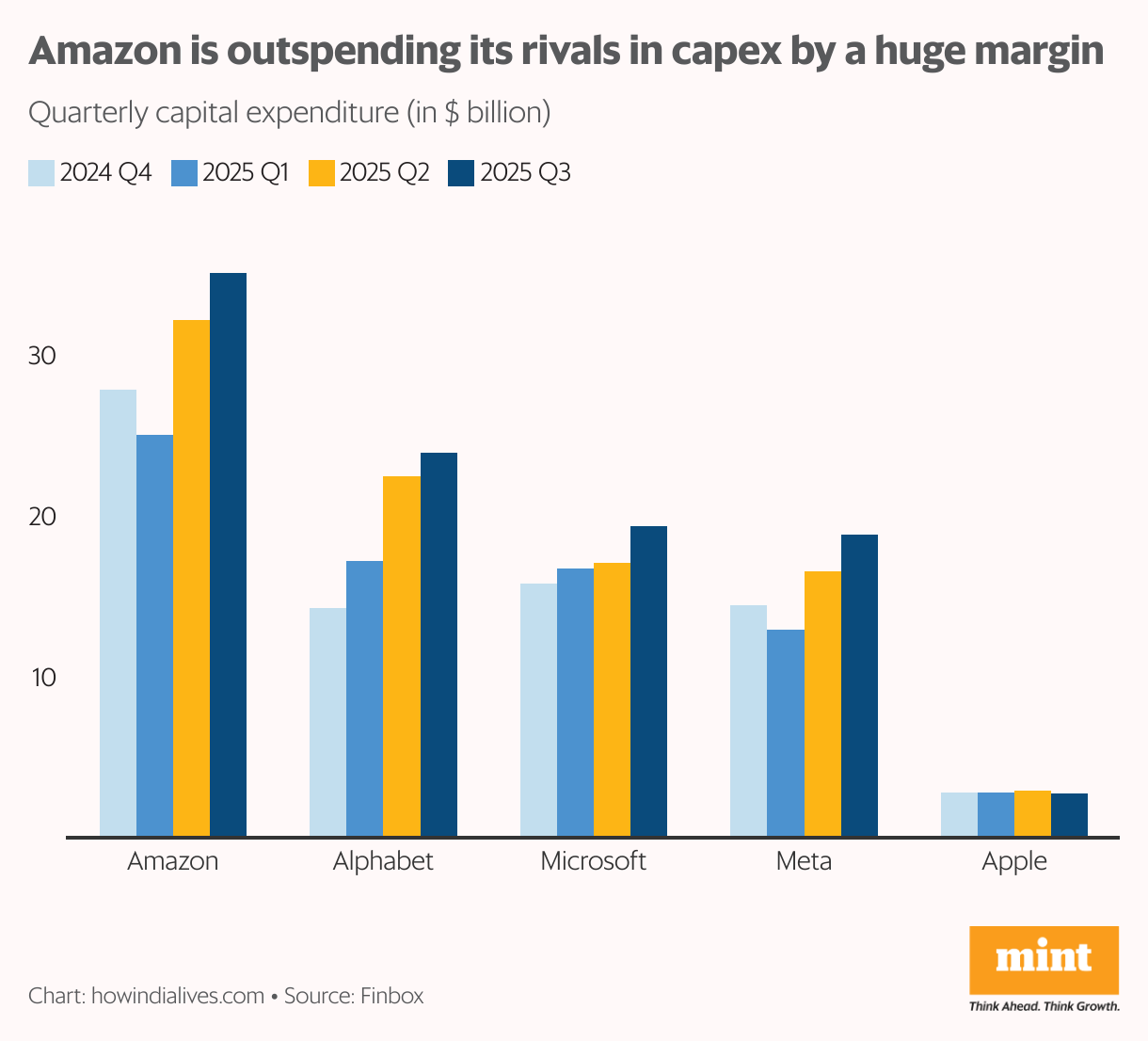
To maintain growth, Amazon needs to maintain capital expenditures. In the third quarter of 2025, capital expense reached $35.1 billion, or 19.5% of revenue, up from 14.8% in the fourth quarter of 2024. This rate increased steadily: 16.1% in the first quarter of 2025 and 19.2% in the 2nd quarter.
Most of the funds are going to AWS data centers that support AI workloads, and it raised its capital spending forecast for the full year to about $125 billion. Spending is expected to increase further in 2026.
This level of investment places Amazon among the biggest spenders in the tech sector. But higher investments in AI infrastructure increase financial distress.
Throughout its history, Amazon has sought to grow through efficiency, which is reflected in its founder’s philosophy: Your margin is my opportunity. A significant portion of its budget is directed to in-house technologies like Trainium chips, reducing reliance on third-party GPUs.
Amazon says its chips offer 30-40% better price-performance than similar GPUs. Customers like Anthropic are using hundreds of thousands of Trainium2 chips for models like Claude. Adoption is growing but still lags behind Nvidia.
Workforce rebalance
Last quarter, Amazon reported $1.8 billion in pre-tax charges for severance pay related to planned layoffs; This reflects one of the largest corporate restructurings in recent years. The layoffs, affecting approximately 14,000 employees, were announced shortly before earnings were released.
During the earnings call, Jassy said the outages were not caused by artificial intelligence. “If you grow as fast as we have for several years, the size of the businesses, the number of people, the number of locations, the types of businesses you’re in, you have a lot more people than you ever had before, and you end up having a lot more layers,” he said.
“Sometimes, without realizing it, you can weaken the ownership of the people doing the actual work, and that can slow you down.”
While Jassy emphasizes culture, in the broader context there is a shift towards automation in Amazon operations. The company aims to automate 75% of its fulfillment network and has deployed more than a million robots worldwide.
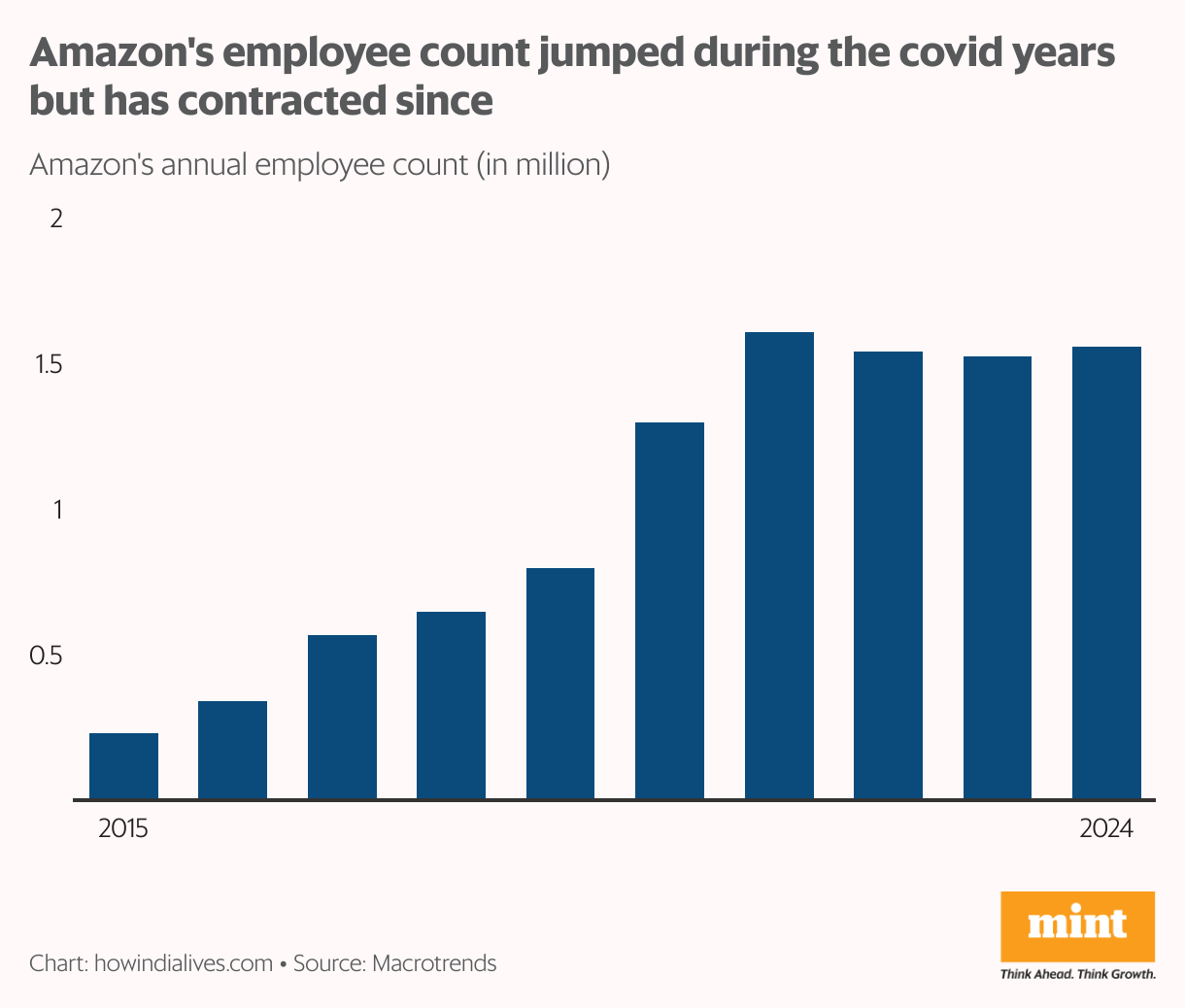
These investments suggest the gradual substitution of capital for labor. Amazon’s workforce reaches 1.56 million in 2024; roughly unchanged from two years ago despite higher sales and production, but down from 1.6 million in 2021.
Store strategy
Fixing over-hiring during covid isn’t the only reset Amazon is making. Amazon is scaling back its direct grocery shopping experiment in brick-and-mortar retail. The company said it would close all 14 Amazon Fresh stores in the UK, signaling that it was abandoning a model that was not gaining traction.
The focus is shifting to Whole Foods, where Amazon plans to expand locations and experiment with a smaller ‘everyday store’ format designed for urban markets. It is also directing its grocery efforts toward logistics, with an emphasis on same-day delivery of perishable items through Amazon.com.
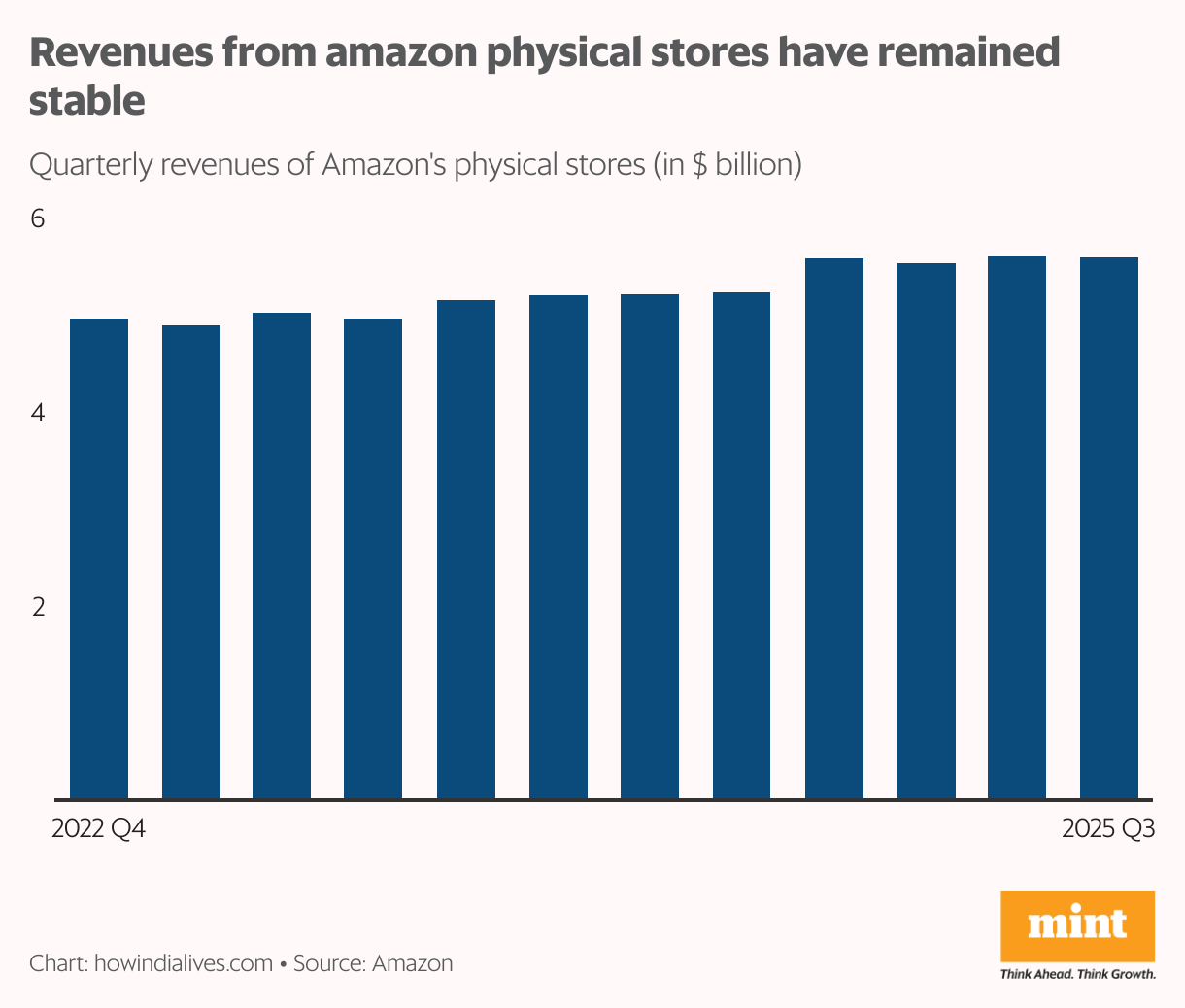
This service currently reaches 1,000 US cities and coverage is expected to double by the end of 2025. Brick-and-mortar store revenue remained steady at approximately $5.6 billion per quarter.
While Amazon experiments and expands its business, it also regularly faces regulatory and legal hurdles. The Federal Trade Commission (FTC) settled its complaint about Prime subscriptions with a $2.5 billion charge that included $1 billion in penalties and $1.5 billion in refunds.
A separate antitrust lawsuit filed by the FTC and 18 states is pending, with a hearing expected in 2027. All of these challenges will test the sustainability of Amazon’s business bets.
www.howindialives.com is a database and search engine for publicly available data


