Can Bhavish Aggarwal turn Ola Electric around?

Taken by surprise, analysts were quick to seek an explanation. “[You] are Ebitda positive, as…guided last time, but it appears to have come at the cost of sacrificing volume. Could you help us understand what gives you comfort that this trade-off is sustainable and strategically sound,” asked Arun Kejriwal, founder of Kejriwal Research and Investment Services.
In a lengthy response, Aggarwal justified the lowered guidance and played up the company’s improvement in gross margins and operating costs. In the short term, he indicated that Ola Electric was focusing on getting all its ducks in a row. And over the long term, he insisted, this would help the company dominate the electric vehicle (EV) industry.
Aggarwal also revealed that Ola Electric wanted to focus on a new business segment: battery energy storage systems (BESS). The company expects to generate about ₹1,000 crore in revenue from the battery energy storage business in financial year 2027. That would be about 22% of its ₹4,514 crore revenue in fiscal year 2025 (FY25).
“Although the battery business guidance appears promising, the road to achieving that is still hazy as there are established players in the segment,” an analyst from a global brokerage firm said.
Analyst pessimism is reflected in the stock price, with Ola Electric shares plummeting 24% over the last month against a 3% rise in the Nifty Auto.
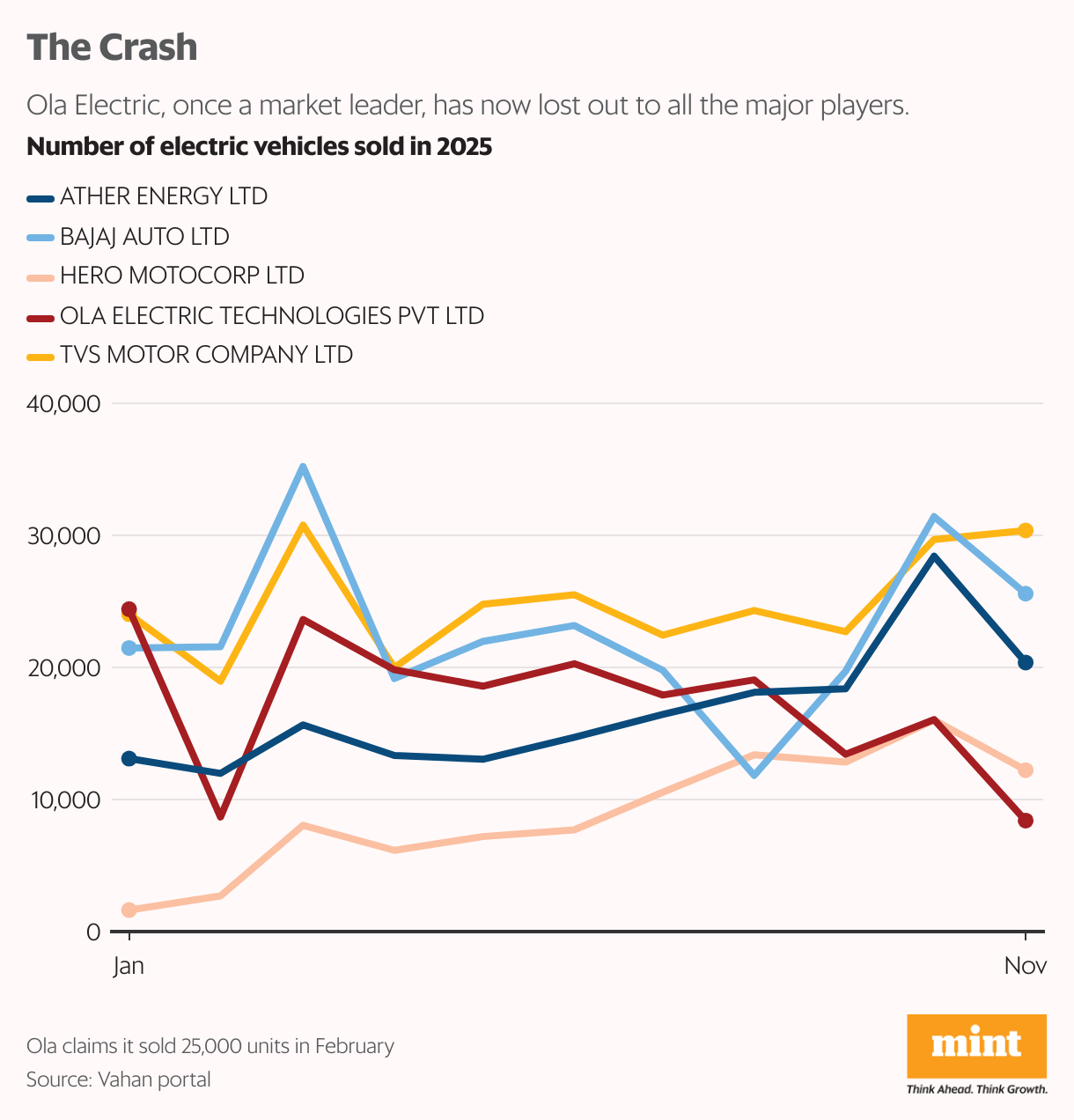
In the September quarter, the company’s loss narrowed to ₹418 crore from ₹495 crore in the year-ago period but revenue crashed 43% to ₹690 crore. The government’s Vahan portal showed that its vehicle registrations had nearly halved during the quarter to 50,372 units, trailing cross-town rival Ather Energy Ltd and legacy companies TVS Motor Co. Ltd and Bajaj Auto Ltd.
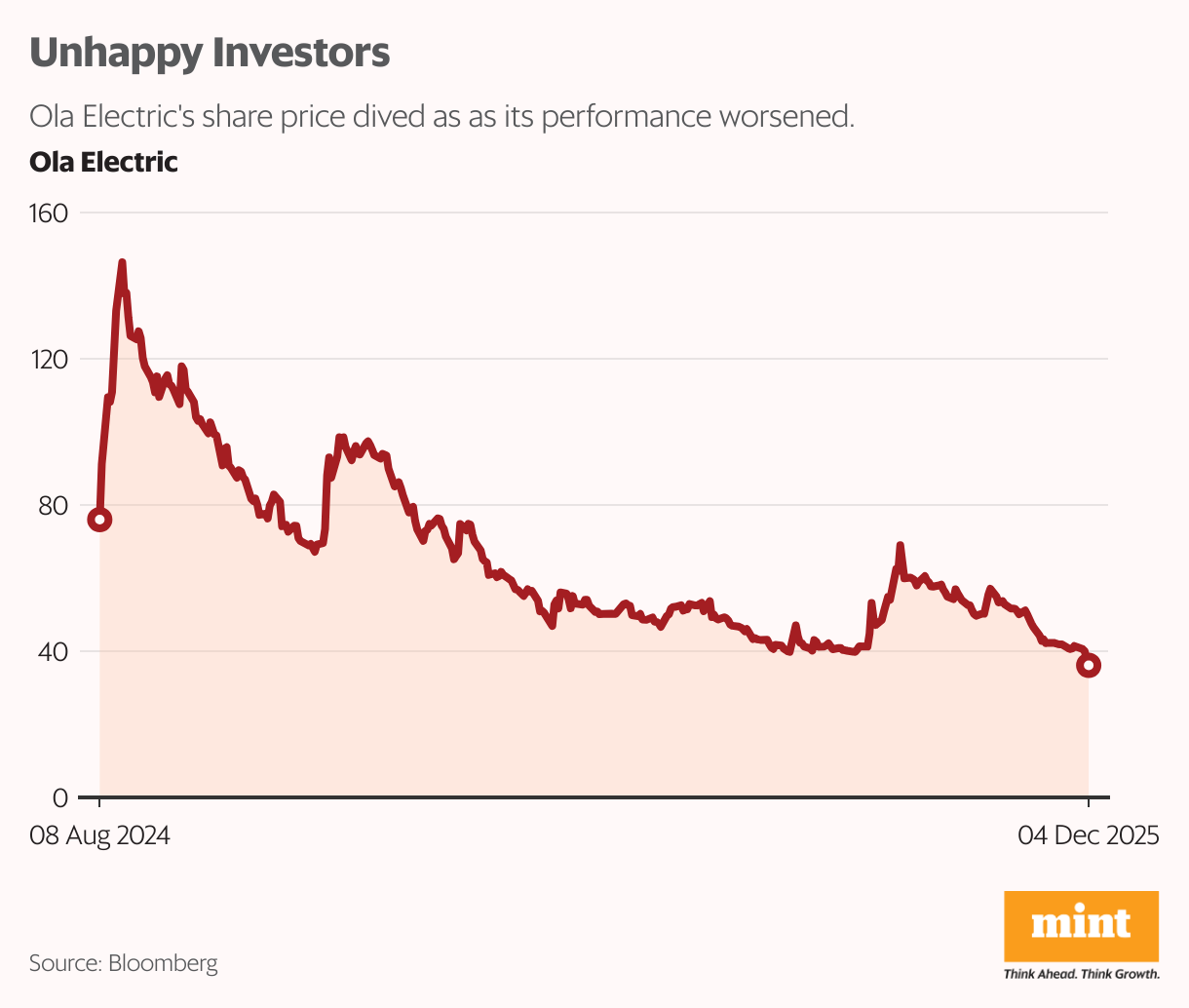
Investors are not enthused by the performance. Since listing at ₹76 per share and soaring to nearly ₹150, Ola Electric’s shares now trade at ₹35. Meanwhile, Ather’s shares have surged more than 120% since it listed in May, riding on its steady performance.
The only silver lining for the business came from the fact that the two-wheeler business turned Ebitda margin profitable for the first time. That, too, was aided by the fact that the company did not allocate ₹106 crore in expenses to either the auto or cell business, putting it under the unallocated expense section instead.
Ebitda is short for earnings before interest, taxes, depreciation and amortization.
In response to queries from Mint on the company’s dismal outlook, an Ola Electric spokesperson said, “FY26 has been a deliberate year of recalibration. We consciously prioritised profitability and sustainable growth over volume-led expansion.” That statement echoed the spin Aggarwal offered analysts during the earnings call.
The spokesperson added, “This transition phase includes revamping our front-end retail network, strengthening service delivery, and scaling our Gigafactory infrastructure to prepare for the next phase of growth across both auto and energy.”
Ola Electric’s sales have continued to plunge in the ongoing quarter despite the festive season. It sold just 16,050 and 8,400 units in October and November and was relegated to fifth position in the pecking order.
With the sales slump continuing and revenue slipping, the company has been forced to announce two fundraises this year despite having raised ₹6,145 crore from its initial public offering (IPO) last year. It has announced a ₹1,700 crore fundraise through issuance of non-convertible bonds and ₹1,500 crore through the equity route in the last seven months.
Industry executives and experts believe a path to recovery exists for Aggarwal provided two things work: the ramp-up of advanced scooter products and utilization of the cell gigafactory.
The Gen 3 gambit
Ola Electric journey began in 2017 when the company was founded by Aggarwal propped up by his ride-hailing business, Ola Cabs. Within two years, it became a unicorn after raising $250 million from SoftBank and set out to disrupt the automotive industry.
In 2020, Ola acquired Netherlands based Etergo BV and gained access to e-scooter technology.
The first scooters started selling in December 2021, from its generation-1 platform. This was upgraded to generation 2 in August 2023. The Gen 1 and Gen 2 scooters helped the company quickly achieve leadership with sales surging to 330,000 in FY24 from around 153,000 in the previous financial year.
But owners started reporting serious defects and the company struggled to address their servicing requests. Thousands of complaints surfaced against the Gen 1 and Gen 2 scooters, forcing the Central Consumer Protection Authority (CCPA) to issue a show cause notice to the company in October 2024. The investigation is still ongoing.
To stem the service issues, the company launched its Gen 3 platform last year and rolled out vehicles based on the platform from this January.
“On Gen 3, we actually feel our quality metrics are by far industry leading,” Aggarwal said during an earnings call on 29 May.
During the 6 November call, Aggarwal told analysts that Ola Electric had stopped the sale of Gen 2 products to consumers and was solely focusing on Gen 3, with more than 90% of its sales in the second quarter of FY26 coming from the platform.
This solved part of the problem, but Ola Electric still has lakhs of vehicles running on old platforms with consumer experiences clearly weighing down sales of the relatively better Gen 3 model.
“The perception about Ola Electric continues to suffer due to persisting product issues. These arise only when the product quality is not up to the mark,” said Deepesh Rathore, former head of product strategy at Ola Electric and founder of consultancy firm Insight EV. He opined that the company would not see a revival in volume growth until enough investments had been made to solve niggling issues in its scooters, across generations.
Meanwhile, Ola Electric has already teased the launch of its Gen 4 platform, which is expected to arrive in 2026.
Gigafactory edge
In June 2023, Ola began construction of its gigafactory in Krishnagiri, Tamil Nadu, after it became the first entity to get approval for subsidies under the production-linked incentive cell scheme for 20GWh capacity.
When the company went public in 2024, it specifically allocated ₹1,227 crore out of the total fundraise for the purpose of increasing the capacity of its gigafactory to 6.4 GWh from 5 GWh.
The gigafactory, the first in the country, has started producing cells for Ola’s electric vehicles, and some believe cells are Aggarwal’s biggest edge right now.
In October, the company launched Ola Shakti, marking its entry into battery energy storage systems, as it looked to diversify from its auto business.
In October, the company launched Ola Shakti, marking its entry into BESS, as it looked to diversify from its auto business. Ola Shakti will sell home inverters in a bid to tap the vast market currently held by Luminous, Exide, Microtek and Livguard.
“Over the coming quarters, our revenue mix will broaden beyond automotive into residential and commercial BESS, creating a more balanced company. But the core focus remains on preparing for the next wave of accelerated EV (electric vehicle) adoption,” the Ola spokesperson said.
The company plans to sell lithium-ion cell home inverters priced between ₹50,000 and ₹2 lakh. According to its projections, the business will fetch ₹100 crore in revenue in the January-March quarter when it starts selling the product.
Ola is also guiding for revenue of ₹1,000 crore from the BESS business in the next financial year, suggesting a big play in the energy sector.
To achieve this feat, the company will have to sell around 80,000 units if the average price is taken at ₹1.25 lakh per unit. But the company is confident, noting that demand is huge.
“India’s grid-scale BESS market has grown rapidly—from ~33 GWh of tendered capacity in CY24 to estimated 51 GWh in CY25, driven by SECI and state DISCOMs (distribution companies). All current deployments rely on imported Chinese systems,” Ola Electric said in its shareholder letter on 6 November.
“…the market it addresses is the current inverter market, which is largely lead acid or even the diesel generator used in homes, used in SMEs or small commercial establishments,” Aggarwal said during the 6 November earnings call.

View Full Image
Amidst all this, Ola Electric has been sending confusing signals. On 14 July, the company said it would not be expanding the capacity of its cell plant beyond 5 GWh at least till FY29 as it believed the capacity would be enough to meet demand for its EV scooters. But on the 6 November call, it said the 20 GWh capacity would be ready by the end of FY27. The sudden change indicates the slump in the auto business may have forced it to rethink its plans.
Experts suggest that for any company looking to have a play in the battery sector, it is crucial to have a diversified business to hit profitability.
According to Harshvardhan Sharma, group head at Nomura Research Institute, the inflection point for cell businesses to reach profitability is around 4 GWh. “Beyond 4 GWh, incremental capacity drives marginal cost reductions of 8-10% per GWh as scale efficiencies in procurement, process automation, and energy utilization kick in,” Sharma said, suggesting that the company needs to look beyond the EV sector.
“Players that approach this as a broader energy systems business, rather than a pure EV supply chain play, will achieve more stable Ebitda profiles,” he added.
Problems aplenty
Another big worry for Aggarwal is Ola Electric’s debt overhang. The company has debt obligations coming up in the next few years. It has to pay a total of ₹2,114 crore in debt and interest obligations until 2029-30, according to its disclosures.
Aggarwal’s problems are compounded by the fact that other Ola group entities face similar pressures, with Ola Consumer being the most notable one.
The pressure on the ride-hailing business is being seen in its workforce count, which more than halved to 376 by August from 886 in April 2024, according to the Employees’ Provident Fund Organisation database.
Compounding matters, credit rating agency Moody’s downgraded Ola Consumer parent’s ANI Technologies’ credit rating citing its weak operational performance. “The downgrade to Caa1 and negative outlook reflects the ongoing weakness in Ola’s operating performance that is eroding liquidity and raising the risk of a covenant breach in the coming months,” Sweta Patodia, assistant vice president and analyst at Moody’s Ratings, said in a 7 November note.
The downgrade to Caa1 and negative outlook reflects the ongoing weakness in Ola’s operating performance… (—) Sweta Patodia, Moody’s
The only silver lining for the business came from the fact that the two-wheeler business turned Ebitda margin profitable for the first time. That, too, was aided by the fact that the company did not allocate ₹106 crore in expenses to either the auto or cell business, putting it under the unallocated expense section instead.
Aggarwal has been pledging his own shares in Ola Electric to raise money for the privately held venture, with 10% of his 30% holding in Ola Electric now pledged with lenders.
According to Insight EV’s Rathore, what Ola Electric needs most is professional management as the promoter of the company has to focus on multiple businesses. “This would help them address the challenges in a more focused manner.”
While the Ola spokesperson did not address questions on whether its business segments currently need a professional setup, they said that the company’s strategy would soon start showing results. Ola Electric is strongly positioned for the next cycle of industry growth thanks to its diversified growth engines in the automotive and energy sectors, the spokesperson emphasized.
What Ola Electric needs most is professional management as the promoter of the company has to focus on multiple businesses.
“Our vertical integration strategy is now scaling at pace. India’s first giga-scale cell plant is operational with 2.5 GWh capacity, moving to 5.9 GWh by March 2026,” the spokesperson said. “Vehicles powered by Ola’s 4680 Bharat cells are already on the road, and the entire automotive portfolio will transition to these cells over the next three to four quarters.”
The spin aside, it remains to be seen if Aggarwal can arrest the current decline and script a turnaround. Those who invested in Ola Electric’s IPO will expect nothing less.


