UK shoppers eye bargains as grocery price inflation drops

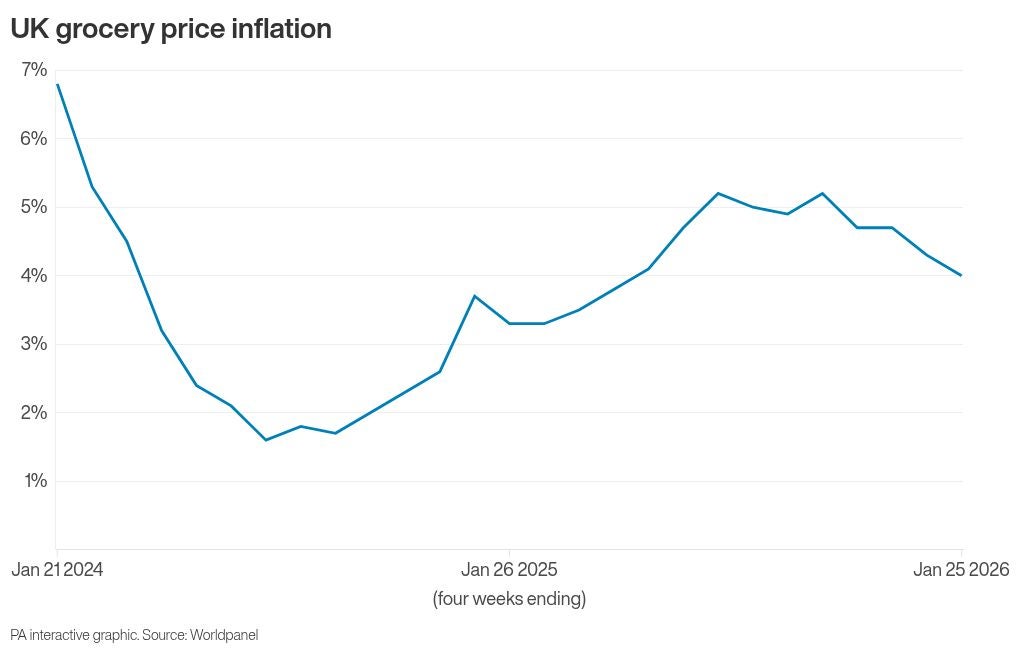
Grocery price inflation fell to 4 percent in January, reaching its lowest level since April, providing some relief to households.
The 4.3 percent decline in December coincides with a record 52.2 percent of grocery sales being made up of supermarket own-label goods, according to market research firm Worldpanel by Numerator.
Spending on promotional products also increased by 10.9 percent on an annual basis, recording the fastest growth since October 2024.
Full-priced product sales were also up just 1.7 percent over the equivalent four-week period last year.
Fraser McKevitt, head of retail and consumer analytics at Worldpanel, said: “For most shoppers, January was all about resetting household budgets, and this year was no exception.
“As grocery sales continue to rise and inflation falls to its lowest level in months, value remains top of mind for most, with own brand hitting a record high and accounting for more than half of all grocery spending.”
According to a survey conducted for Worldpanel, almost a quarter (23 percent) of January shoppers are looking for high-protein foods and 26 percent are looking for high-fiber products.
Cottage cheese sales increased 50 percent annually and were purchased by 2.8 million households; This figure is approximately 600,000 more than last year.
While fresh fruit and legumes sales increased by 6 percent on an annual basis, fresh fish sales increased by 5 percent, poultry sales increased by 3 percent and chilled yoghurt sales increased by 4 percent.
So-called functional drinks, marketed as providing health benefits such as energy, gut health or improving mood, were purchased by 11 per cent of households, up 13 per cent on last year.
Mr McKevitt said: “In a month when consumers are often trying to rein in their spending, it is remarkable how many people are still willing to pay a premium for wellness, with functional drinks costing almost four times as much as typical soft drinks at £4.69 per litre.”
Lidl has become the fastest-growing physical retailer, with sales rising 10.1 per cent in the 12 weeks to January 25 compared to the same period last year.
Sales at Ocado increased by 14.1 per cent, taking the online grocer’s market share to 2.1 per cent.
Sainsbury’s saw a 5.3 per cent increase in checkout spend, while Tesco saw a 4.4 per cent increase in sales, capturing 28.7 per cent of the market.
Waitrose had the fastest increase in average spend per trip among grocers but its market share remained stable at 4.7 per cent.
Grocery sales at M&S increased by 6.9 per cent compared to the same quarter last year.
Asda’s sales fell 3.7 per cent on the previous year, while the Co-op’s sales were 1.6 per cent lower.


