Inside El Mencho’s last hideout: Blood, bullets and cartel luxury
TAPALPA, Mexico — Mexico’s most wanted man was hiding next to a golf club.
When Mexican special forces soldiers attacked the hideout of cartel boss Nemesio Rubén Oseguera Cervantes, known as “El Mencho,” they descended on his luxurious compound in the mountains outside Guadalajara.
A cluster of seven luxury cabins perched on a steep hillside dotted with pine trees, the location offered seclusion and allowed Oseguera’s security team to spot approaching visitors from miles away.
The only way in is via a long, narrow and bumpy road. To maintain the element of surprise, Mexican commandos approached from above in helicopters supported by surveillance from U.S. Predator drones.
-
Share via:
In the raid last weekend, the 59-year-old leader of the Jalisco New Generation cartel died after an hours-long gunfight. El Mencho’s small army of bodyguards. This also led to a wave of reprisal attacks across the country. Mexican officials said at least 25 National Guard soldiers and 34 suspected cartel members were killed, as well as two government employees and at least one civilian.
The Times visited Tapalpa and gained access to El Mencho’s compound, Cabañas La Loma, in the wake of the chaos. The property was littered with debris and evidence, offering a rare window into the lifestyle and final moments of a fugitive ringleader.


1. An image of the Catholic saint San Judas Tadeo on the floor of a building in the Cabañas La Loma complex in Tapalpa. 2. Empty casings from a .50-caliber gun are signs of a gunfight that broke out as Mexican special forces descended on “El Mencho”‘s hideout.
The remnants of the battle were visible almost immediately. A white Ford pickup parked at the bottom of the hill had a visible blood stain on the tailgate. Nearby, various pieces of designer clothing were discarded on the ground, including a tactical belt containing pouches to hold gun magazines and a pair of Christian Dior briefs.
The raid, which began in the early morning hours of February 22, reportedly took place after an all-night party hosted by El Mencho, and traces of the celebrations were everywhere. A bunch of half-charred green onions on a grill outside one of the small cabins indicates that the arrival of the Mexican commandos coincided with a carne asada meal. There was also food left on the kitchen counters in other cabins: half-eaten snack packs, fruits and vegetables that had rotted after a week without refrigeration.
Several large bullet impacts, likely from a high-powered, .50-caliber gun, were visible on the exterior stucco wall.
Two larger huts at the top of the hillside appeared to be where El Mencho lived. The door of one was lined with cigar-sized shell casings from a .50-caliber rifle and smaller spent brass from assault rifles. Pieces of terracotta tiles broken as a result of the bullets hitting the roof and splinters from the hit wooden beams were scattered around. A large hole was blown in the glass of a large arched window.

Aerial view of the vacation rental property where “El Mencho” was hidden in the western Mexican state of Jalisco.
The living room wall of one of the cabins was decorated with exotic animal heads, including a zebra. The horned head of the stuffed gazelle had been knocked off its mount and left on the couch. In one of the bedrooms there was a zebra skin rug on the floor.
A bedroom window in another cabin was shattered and an opened pack of Skittles was strewn across the bedspread, along with several .50-caliber shell casings on the floor.

A broken window reflects in the bathroom of the complex in Tapalpa, Jalisco, where the cartel leader known as El Mencho lives.
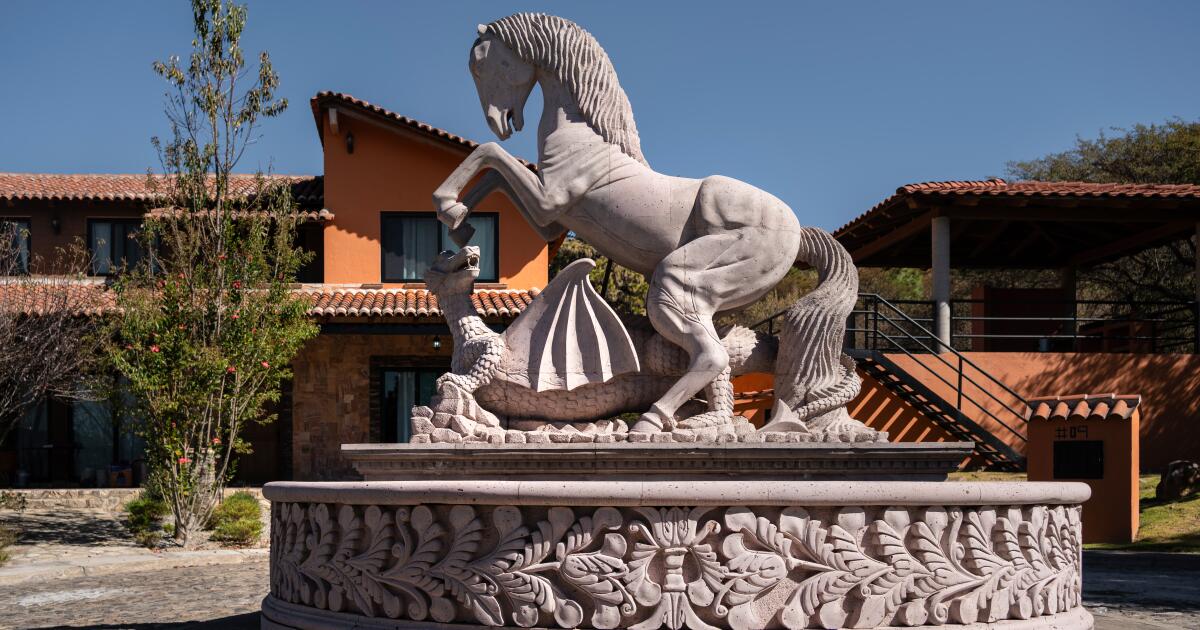
At the crossroads in front of the main house was an elaborate statue of a stallion trampling a dragon. A black Ford Raptor SUV was parked in the parking lot; It was understood that the doors were equipped with armor and dark colored glass. A box for Ferragamo sunglasses sat on the passenger seat.
The house was full of documents. The documents included appraisals of properties in various states and a list of horses and the farms where they were stabled.
Gone, too, are handwritten ledger pages detailing the spending of the cartel’s various regional bosses. One listed the name “Yogurt” at the top; this is an apparent reference to the nickname of Abraham Jesús Ambriz Cano, the top CJNG commander in the state of Michoacán.
According to the ledger page, Yogurt’s payroll included “10 commanders” each receiving a weekly salary of 10,000 pesos (roughly $580), nine Colombian mercenaries receiving 9,000 pesos per week, and 181 “chavos de tropa” (junior infantrymen) costing a total of 3.6 million pesos ($285,000) per month, plus food and fuel expenses. Costs listed for another CJNG commander included three “droneros” — Armed drone pilots equipped to drop explosives were earning the equivalent of about $300 a week each.

Camouflage clothing and personal belongings lie on an unmade bed inside a cabin in Tapalpa. “El Mencho” was known to employ a small army of armed men for protection.
Various medical supplies were piled on the floor of the adjacent room. Oseguera reportedly suffers from several health issues, including advanced kidney disease that requires him to undergo regular dialysis. The condition was said to limit his ability to move frequently.
El Mencho’s connection to the location had previously been documented by US authorities. US Treasury Department added this List of sanctions in 2017 because he “provided material assistance to the CJNG’s drug trafficking activities.”

A mounted gazelle head sits on the sofa in the most luxurious cabin of a complex used by Nemesio Rubén Oseguera Cervantes, leader of the Jalisco New Generation cartel.
The main houses showed various signs that young children had recently been there, including toys, clothing and notebook pages with crude drawings of an elementary school student. The site featured kid-friendly amenities like several trampolines, a playset, and a full-size basketball court.
On an adjoining property along the road were rows of cages that appeared to house fighting cocks; This is another clue that Oseguera, also known as El Señor de Los Gallos (The Lord of the Roosters), has settled nearby.
Mexican officials said that in addition to Oseguera, six more cartel agents were killed and three soldiers were injured in the operation carried out with the help of US intelligence.

A beam of light enters a room at the Cabañas La Loma complex in the mountains west of Guadalajara.
The conflict shook the small nearby town of Tapalpa, where the streets around the central square are lined with shops and restaurants catering to holidaymakers looking for a rustic escape from the city. Tapalpa has the official government designation of “Pueblo Mágico” (a magical place), given to the country’s tourist destinations.
Multiple news outlets reported that the conflict that killed El Mencho spread from the compound where he lived to the Tapalpa Country Club, just across the hill. A security guard who declined to give his name stood at the entrance to the gated community on Friday and insisted the reports were fake news.
“No pasó nada aqui,” said the guard wearing a New York Yankees hat: “Nothing happened here.”


