Jamie Dimon: JP Morgan Chase head warns of unexpected interest rate shocks as a result of Iran war

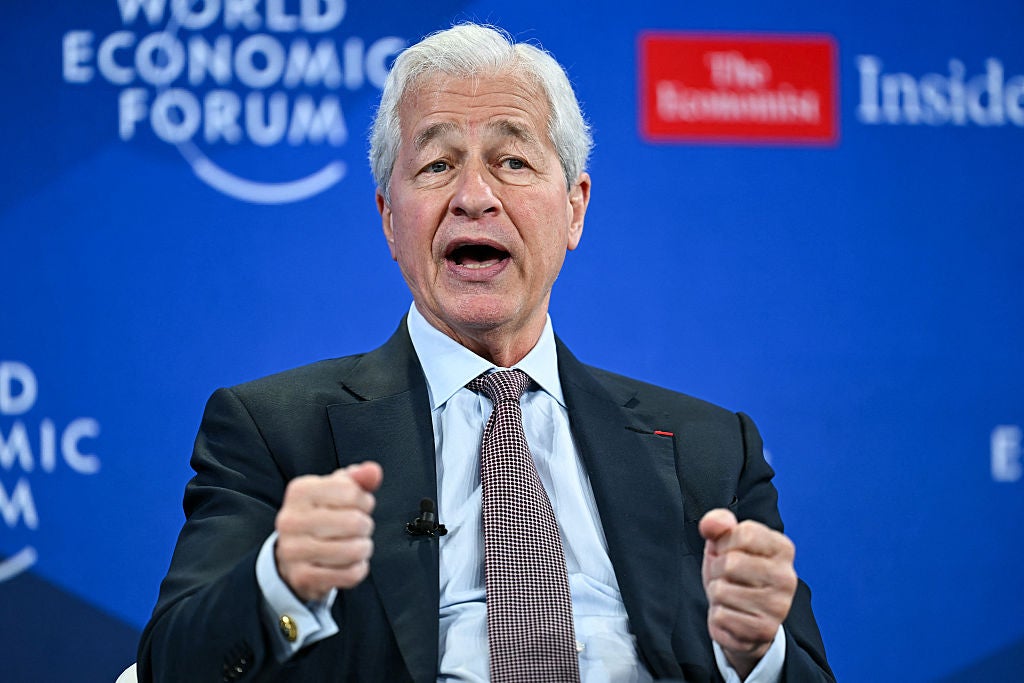
The world will face “significant” interest rate shocks as a result of Donald Trump’s war on Iran, the chairman of JPMorgan Chase has warned.
Jamie Dimon said skyrocketing oil and gas prices following Iran’s blockade of the Strait of Hormuz and attacks on regional energy infrastructure would lead to “stickier” inflation that could drive up interest rates.
Higher interest rates mean more costly borrowing for loans and investments, as well as mortgages, government borrowing costs and more. They are also associated with lower economic growth, as firms do not spend as much on new projects or hiring, and consumers spend less on non-essential items as they manage household finances due to rising essential bills.
Mr Dimon warned: “Now, due to the war in Iran, we also face the ongoing potential for significant oil and commodity price shocks as global supply chains are reshaped, which could lead to stickier inflation and ultimately higher interest rates than markets currently expect.
“Countries that are heavily dependent on imported energy are already seeing the effects of this. And it’s not just energy, but commodity products like fertilizer and helium, which are byproducts of oil and gas.”
“Given our complex global supply chains, countries are experiencing disruptions in shipbuilding, food and farming, among others.
“The outcome of current geopolitical events may well be the determining factor in how the future global economic order develops – but it still may not.”
Brent crude oil prices fell below $100 again in early April but have since rebounded. It is at $110 on Tuesday.
Get a free partial share of up to £100.
Capital is at risk.
Terms and conditions apply.
ADVERTISING
Get a free partial share of up to £100.
Capital is at risk.
Terms and conditions apply.
ADVERTISING
Last month, the Bank of England (BoE) voted 9-0 to keep interest rates at 3.75 percent due to uncertainty about the nascent war in the Middle East. The Monetary Policy Committee (PPC), which votes on such interest rate changes, will meet again on April 30, and a wide divide between economists and market interest rates is now visible.
Traders in money markets are currently betting on two rate hikes this year, but as recently as two weeks ago the odds were closer to four. But what investors bet on is not always the same as the expectation of what will actually happen.
While most major economists have so far stuck to expectations that the BoE will maintain interest rates through at least the first half of 2026, some are still pricing in a cut later in the year.
An extra problem for the MPC is that, while raising rates is the usual response to inflation, lowering interest rates is typically the antidote to poorly performing economies and rising unemployment, both of which the UK is currently facing.
Presumably, some domestically focused analysts may update their perspectives in the coming weeks, with the start of the new fiscal year and the MPC vote on the horizon, as well as a deadline for Mr. Trump to reopen the Strait to Iran that expires Tuesday night.
Long periods of high oil prices are much worse than high increases when it comes to energy prices, followed by rising expectations for inflation; Inflation is expected to reach around 4 per cent for the UK this year, but is expected to more than double that level when it comes to food prices.
Meanwhile, the Organization for Economic Co-operation and Development (OECD) predicted last week that both the BoE and the US Federal Reserve would keep interest rates at their current levels throughout this year.
The Bank of Japan is expected to raise interest rates this month, while the European Central Bank is expected to raise interest rates by as much as three times this year, with many major banks including Dimon’s JPMorgan Chase.
.jpeg)
In his annual letter to shareholders of the world’s largest bank, Mr Dimon also criticized the combative approach taken by Mr Trump, who has complained about world leaders, including Sir Keir Starmer, for not helping attack the Middle East and even suggested the US might consider leaving NATO.
The Wall Street giant said that such a move would not only weaken the United States but also make other countries vulnerable to the whims of “bad actors” over time.
“The economic weakening of the world’s democracies or the disintegration of their economic ties could have truly negative consequences. This is exactly what some of our enemies and many autocratic nations want, their declared goal,” he said.
“They want to see all of our allies become much less dependent on the United States, and therefore much more dependent on them. In this scenario, many countries will have to seek deeper economic ties with some possible bad actors; over time, they may become vassals of these countries and not be able to avoid pressure from them.”


