Rich harvest caught in procurement tangle

For weeks, farmers across Telangana have been guarding tarpaulin-covered heaps of paddy under the open sky, anxiously watching the occasional dark clouds as procurement delays stretch on.
An untimely spell of rain can soak their grain overnight while prolonged delays in procurement are draining farmers financially through mounting labour and transport costs. With the next sowing season fast approaching, many fear they may be forced into fresh debt before they are even paid for the current harvest.
In Gopalapuram village of Jammikunta mandal in Karimnagar district, 60-year-old farmer S. Shankaraiah is battling a crisis of his own. On May 5, a fire reduced his three-acre maize crop to ashes just days before harvest. The blaze also destroyed another 67 acres of standing maize in neighbouring farms.
But the loss of maize is only one part of his distress; Shankaraiah is now waiting for the procurement of 35 bags of paddy harvested from his remaining land. “The only solace is that the harvested paddy escaped the fire. We need compensation for the maize loss and faster procurement to survive these difficult times,” he says.
Nearly 150 kilometres away in Devulamma Nagaram village of Yadadri Bhuvanagiri district, 48-year-old farmer Yadamma faces a different battle. On a hot afternoon in the second week of May, she bends repeatedly to gather paddy spread over tarpaulin sheets into a tub before pouring it onto a mound. The grain had been partially soaked during rain last Sunday. Since then, Yadamma, her family members and hired workers have been drying the grain repeatedly before it can be sold at a government procurement centre.
“The signs of untimely rain scare us,” she says while lifting another tub of grain under the harsh afternoon sun.
Every evening, the family gathers the paddy into heaps and covers it with tarpaulin sheets fearing another spell of rain
It has been 28 days since several farmers in the village brought their produce to the IKP procurement centre. “We really hope it gets cleared soon,” Yadamma says.
The family pays around ₹800 per day to each worker and to reduce costs, they also pick up tubs and shovels themselves. With the next sowing season approaching, Yadamma fears they may have to borrow money for fresh investment if payments for the current crop are further delayed.
Across procurement centres run by Indira Kranthi Patham (IKP), Primary Agricultural Cooperative Societies (PACS) and other agencies in Telangana, similar scenes are unfolding as farmers wait for the procurement of paddy, maize, jowar, bengal gram and sunflower. At several centres, grain lies under the open sky for weeks, exposed to heat, dust and untimely rain.
Desperation to sell the produce, fear of crop damage and anxiety over mounting debts are among the most common concerns voiced by farmers across districts.
Record harvest, rising distress
Ironically, the distress has emerged in a season of record cultivation. Officials of the Agriculture Department say favourable conditions such as availability of irrigation water from projects, healthy groundwater levels and adequate input supply helped bring over 92.17 lakh acres under cultivation this rabi season, the highest ever in Telangana.
Paddy alone was cultivated in over 65.42 lakh acres, maize in nearly 16.37 lakh acres and jowar in more than 4.03 lakh acres. Other rabi crops such as bengal gram, groundnut, greengram, sesamum, sunflower and safflower also contributed to the record acreage.

With conducive weather and irrigation support, paddy production is estimated at around 1.6 crore tonnes with an average yield of 24 quintals per acre. Maize production is estimated at 43.49 lakh tonnes with an average yield of 26.6 quintals per acre while jowar output is estimated at 4.03 lakh tonnes with an average yield of 10 quintals per acre.
To handle the output, the State government opened 8,575 procurement centres, including around 3,500 IKP centres and 4,350 centres run by PACS, with a target of procuring 90 lakh tonnes of paddy this season.
As of May 13, around 30 lakh tonnes had been procured and ₹4,520 crore credited to farmers’ bank accounts, according to the Telangana State Civil Supplies Corporation. The State has also procured nearly 7 lakh tonnes of maize and some quantities of bengal gram and sunflower after the Centre allegedly refused to support procurement of those crops.
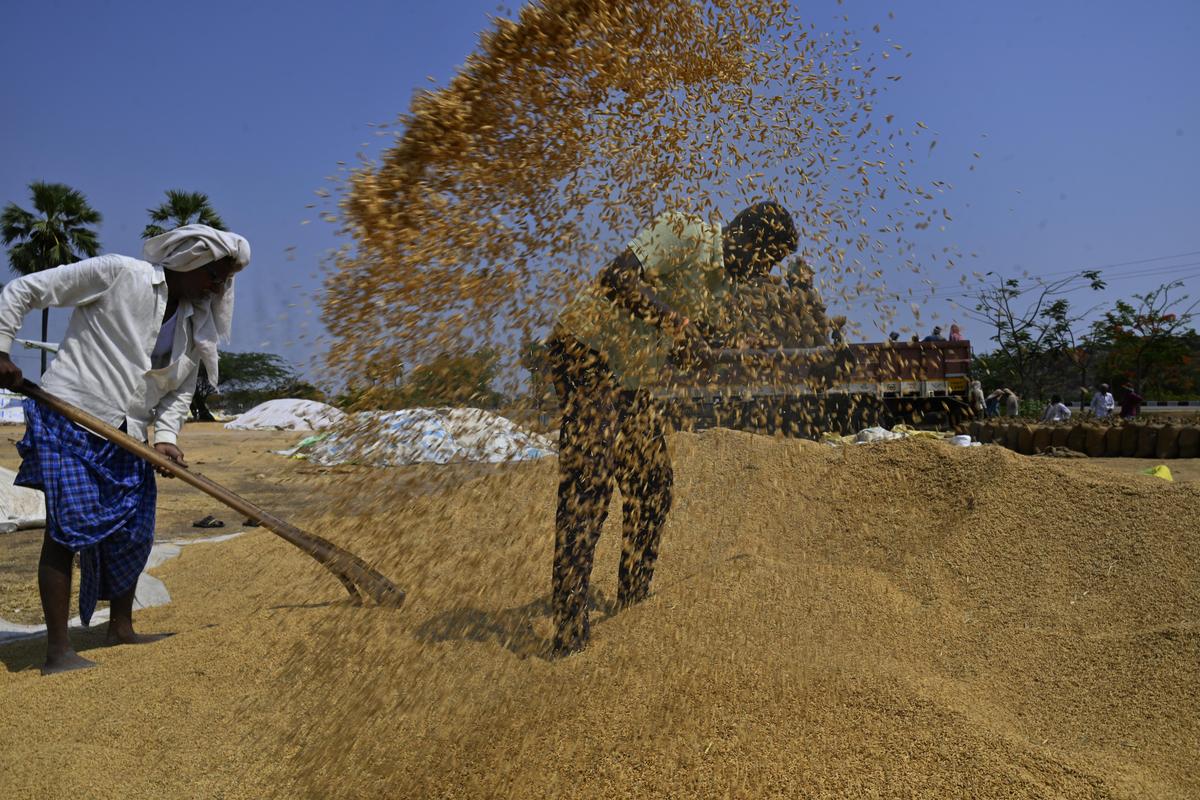
A farmer spreading the paddy for drying at the Indira Kranthi Patham (IKP) centre in Panagal, Nalgonda district, on Thursday.
| Photo Credit:
NAGARA GOPAL
Amid mounting complaints from farmers, Chief Minister A. Revanth Reddy on Tuesday reviewed issues such as shortage of gunny bags, porters and transportation bottlenecks, and directed officials to expedite procurement of paddy and maize in mission mode. He has warned that negligence at any level would not be tolerated.
The Civil Supplies Department too had identified five major bottlenecks affecting procurement and issued directions for urgent corrective measures. District Civil Supplies Officers were instructed to identify rice mills, where vehicles were stranded due to delays in unloading, and ensure immediate clearance of pending stocks.
Despite these interventions, the pace of procurement continues to trigger criticism from the Opposition parties, particularly the Bharat Rashtra Samithi and Bharatiya Janata Party, which have accused the government of slow procurement, delayed shifting of grain to mills and godowns, and late payments to farmers.
The government, however, has rejected the allegations as politically motivated. “The government is committed to procure the promised quantity of paddy and make payments in time to farmers,” says Minister for Civil Supplies N. Uttam Kumar Reddy.
According to official figures, paddy procurement in Telangana stood at 13.24 lakh tonnes in 2014-15, 8.42 lakh tonnes in 2015-16, 37.21 lakh tonnes in 2016-17, 35.74 lakh tonnes in 2017-18, 37.05 lakh tonnes in 2018-19, 64.18 lakh tonnes in 2019-20, 90.01 lakh tonnes in 2020-21, 50.9 lakh tonnes in 2021-22, 64.52 lakh tonnes in 2022-23, 48 lakh tonnes in 2023-24 and 72.42 lakh tonnes in 2024-25.
Despite the large-scale procurement exercise and competing political claims, the ground reality at many centres remains grim. At an IKP centre in Panagal of Nalgonda district, farmers wonder whether the prolonged delays are an indirect attempt to discourage paddy cultivation as part of crop diversification efforts.
“When irrigation water is available, we naturally prefer paddy cultivation. Other crops are damaged by monkeys, wild boars and deer. But if procurement delays continue like this, we are in for a lot of trouble,” says a farmer waiting for his produce to be cleared.
The procurement process itself has become a major bottleneck. After harvesting paddy, farmers transport it on tractors to procurement centres, unload it, spread it for drying and cover it with tarpaulin sheets. They then receive receipts with token numbers and wait for their turn. Once procurement begins, hamalis (porters) weigh the produce, pack it in gunny bags and load them onto lorries for transport to rice mills and eventual supply to the Food Corporation of India.
Multiple delays mar procurement
Farmers say delays occur at every stage of this chain. There are delays in arranging porters, shortages of gunny bags and lack of heavy vehicles to transport grain. Several farmers also allege that lorries remain stranded outside mills for days because rice mills fail to unload paddy immediately, further straining the availability of transport vehicles. The delays also affect preparations for the next crop season.
Farmers at Aneparthy IKP centre in Nalgonda district say the procurement yard gets flooded during heavy rain as it is located on lower ground. “Produce of only 13 farmers was cleared in two months. More than 130 farmers are still waiting. You can calculate how long it will take,” says K. Ramachandraiah, a farmer.
With Rohini Karte, the period associated with peak summer heat before the onset of pre-monsoon showers, fast approaching, farmers are worried about the prolonged exposure of grain to rain and moisture. If paddy gets soaked, they must again hire workers, shift the grain to safer places and dry it repeatedly before it becomes fit for sale. Many farmers say they spend at least ₹600 per worker every day besides paying for leased tarpaulin sheets costing around ₹20 per sheet daily.
Farmers also fear deterioration in grain quality. Moisture content can reduce the price they receive or even force them to sell below the Minimum Support Price (MSP). In some cases, grain may germinate if left wet for too long.
Many say that certain procurement centres and mills are also imposing unfair deductions. They claim produce belonging to some farmers far behind in the queue is allegedly being cleared earlier. Others allege that mills force them to overfill bags or deduct grain in the name of chaff and wastage. A gunny bag ideally contains 40 kg of paddy, but several farmers complain they are being forced to fill up to 42 kg.
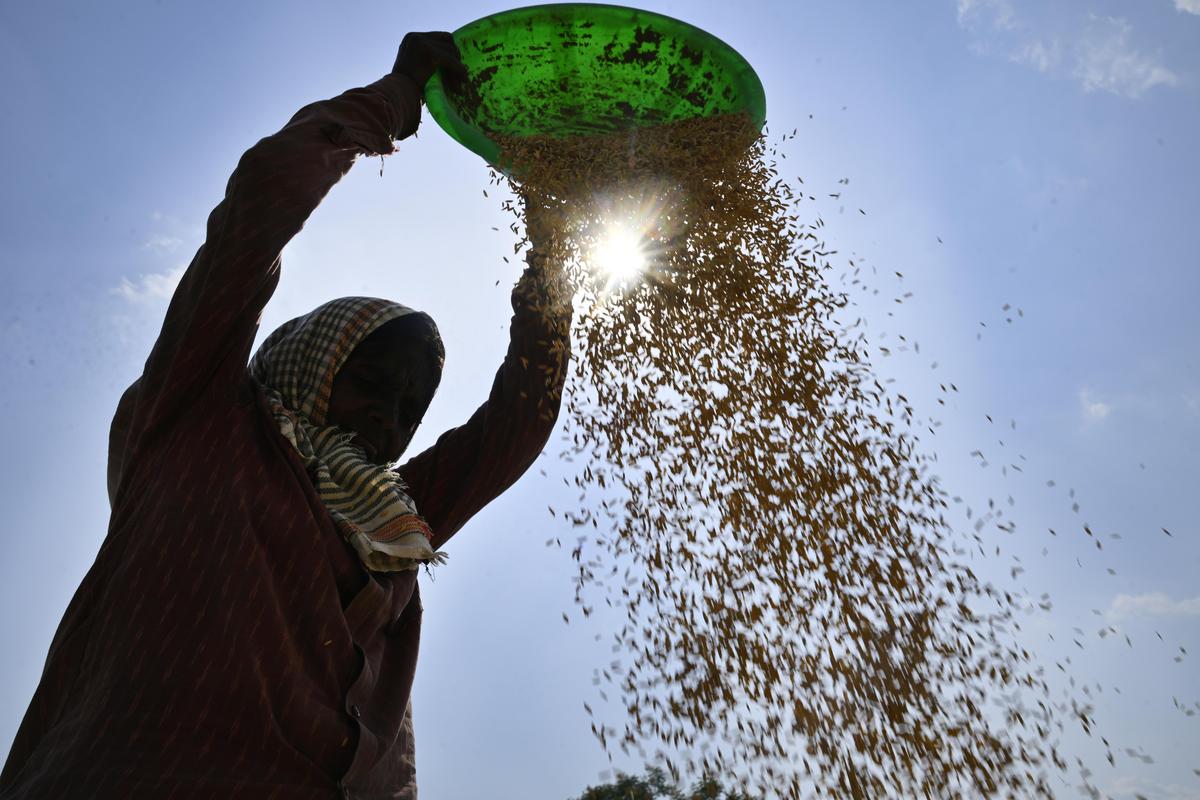
A woman farmer trying to separate paddy from chaff in Devalamma Nagaram village of Choutuppal mandal in Yadadri Bhuvanagiri district on Thursday.
| Photo Credit:
NAGARA GOPAL
K. Anjaneyulu, a farmer from Madipally village in Hasanparthy mandal of Hanumakonda district, says cultivators had been waiting for gunny bags for over 10 days. “We are visiting the procurement centre every day, but in vain as no bags are available,” he says.
Farmers also complain about non-uniform hamali charges and irregular weighing practices. Farmers’ leader Namireddy Yadagiri Reddy from Nalgonda alleges that millers are deducting nearly 35 kg per tractor-load of paddy besides resorting to irregular weighing methods. “At a time when farmers are suffering, political leaders are more focused on publicity,” he says, demanding that Ministers and legislators should inspect procurement centres on a regular basis and ensure immediate transportation of grain to mills.
In Rukmapur village of Karimnagar district, farmer Rajamallu says it has been over three weeks since he brought 300 bags of paddy to the procurement centre. “There are still no signs of lifting the stock,” he says, pointing to heaps of paddy lying under tarpaulin sheets nearby.
This distress is not limited to paddy growers. Maize farmers across the erstwhile Warangal region are grappling with a sharp fall in prices, delayed procurement and exploitation by private traders. While the MSP for maize is ₹2,400 per quintal, farmers say they are often forced to sell at around ₹2,000 or even less because of mounting labour and transportation costs.
K. Balaraju, a farmer from Mogilicherla village in Geesugonda mandal of Warangal district, says he cultivated maize on 2.3 acres but eventually sold the produce to a private trader for ₹1,920 per quintal. “I waited for 10 days at the Enumamula market yard and finally sold it to a private trader,” he says.
Balaraju also alleges that farmers are being forced to buy gunny bags at ₹30 each though the government reimburses only ₹15 per bag.
Nexus alleged
Farmer groups and Opposition leaders have accused the government of negligence in procurement, and alleged collusion between officials and millers in imposing deductions in the name of quality. Bharatiya Janata Party Kisan Morcha State president Lakshmi Narsaiah alleges that farmers are being forced to wait for weeks at procurement centres while millers exploit them through deductions. “We are spending sleepless nights due to the inordinate delay in paddy procurement,” says Srinivas, another farmer, alleging that errant millers are reducing the weight of paddy in the name of chaff and categorising quality produce as ‘B’ grade.
Several farmers also point to shortage of storage space and delays in shifting grain to mills. “We staged a rasta roko on the Karimnagar-Choppadandi highway on Tuesday to highlight our grievances,” says a young farmer, demanding urgent government intervention.


