In motels and on couches, this Florida county’s 66,000 ‘hidden homeless’ are suffocating
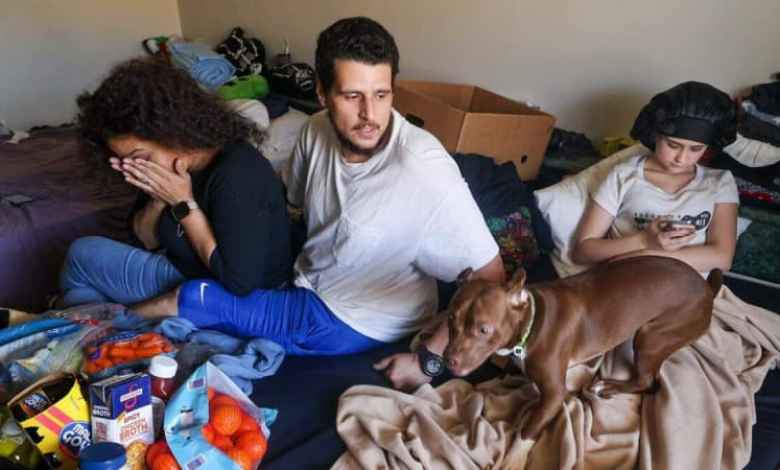
Diana Olivo emerged from the bathroom, pushing strands of curly black hair from in front of her face. It was nearly noon on a recent Wednesday, and she had dark bags under her eyes. She had slept little the previous night.
“Sorry for the mess,” she said, pulling out a white-cushioned stool. “I swear, I clean this place every day.”
This place was a motel room, perhaps 300 square feet, that Olivo, 35, shares with her partner, Michael Torres, and his three teenage kids.
The mess was five people’s worth of clothes and few other possessions, plus the fruits of a recent grocery haul. A family-sized bag of baby carrots, frozen chicken breasts, sliced turkey, mayonnaise and a mound of tangerines were all piled onto one of the unit’s two queen-sized beds. The room’s mini fridge was halfway bunk, she explained, and nearly full anyhow.
The family has lived in the motel — a walled-in pair of washed gray buildings off a highway in Hialeah — for going on six months. “Every day we worry about how we’re going to continue paying to stay,” said Torres, 41. It’s what keeps them up at night.
Olivo, Torres and his three children are, by one federal government agency’s estimation, as well as their own, homeless. But because they aren’t on the street or in a shelter, they won’t show up in official counts — which peg the county’s homeless population at roughly 3,500.
They, along with an estimated 66,000 other county residents, are part of Miami-Dade’s “hidden homeless” population, according to an analysis of U.S. Census data conducted exclusively for the Miami Herald by Molly Richard, an assistant professor of public health at the University of Rhode Island who studies homelessness. That number includes 11,000 children, according to Florida Department of Education data.
If incorporated as a city, they would rank as the seventh-largest in Miami-Dade, beating out North Miami and Coral Gables.
But they have roofs over their heads, albeit precariously, so they’re absent from the tallies that shape how homelessness is understood by the public and addressed by federal, state and local governments, argues Brian Goldstone, a reporter, author and anthropologist who documented over the course of several years the experiences of five “hidden homeless” families in his book, “There Is No Place for Us: Working and Homeless in America.”
It also keeps them locked out of critical government services “that could be decisive in their ability to get out of that situation,” he said.
Olivo and Torres’ housing troubles span years. She moved to Florida three years ago to be closer to family and hasn’t had her own place since. He had been in and out of jail, a series of short stints that interrupted life and complicated finding regular work.
It had been years since they had a steady place, but between last April and October, they thought they had found a home — a trailer, “an RV-type thing,” as Torres put it, in Homestead.
“It was small,” Torres conceded, and the well that supplied their sink and shower was polluted. “The water would come out of the faucet all red,” Olivo recalled. They showered in buckets of heated bottled water.
The trailer didn’t have working air conditioning, plus God knows what they would’ve done had a hurricane blown through, but the rent was $400 a month and “it was ours,” Torres said. “No one could take it from us.”
Until the park was condemned. That sewage-filled water was a problem, at least to local authorities, which, Torres reported, told him the kids needed to be out of there immediately or the Department of Children and Families might intervene.
“I didn’t look back,” he recalled. “I was like, ‘You’re not taking my kids.’”
But they had nowhere to go.
Before moving into the trailer, they had spent a year “doubled up” — exhausting their list of contacts as the five of them crashed on living room floors and in spare bedrooms throughout Miami Beach, where the kids went to school.
This time, “we couldn’t just keep going back to the same people, expecting them to open their arms to five of us, not just one,” Olivo said.
So they crammed into their car, where they slept for a few days, until Hermanos de la Calle, a local homeless support organization, helped them find the motel and, for a time, defray some of the cost.
Thus the family of five reentered what Goldstone calls the “shadow realm” of homelessness — a largely unrecognized but widespread and potently stressful existence of wondering Where will we sleep next week? Or even tomorrow?
That “hidden homelessness” — termed such because it typically doesn’t appear in official homeless statistics — plays out on living room floors, spare cots and couches, and in extended-stay motels across the country.
And as Olivo, Torres and his kids did, those living it often cycle in and out of “literal homelessness,” as the Department of Housing and Urban Development refers to it — sleeping outside, in a car, really anywhere that’s unfit for even short-term human habitation — depending on their ability to find shelter on any given night.
Richard’s estimate of 66,000 “hidden homeless” Miami-Dade residents includes only those who are doubled up, meaning those living temporarily in someone else’s home, likely because they cannot afford housing of their own. Those are people, along with an untold number living in motels, like Olivo, Torres and his children, that the Department of Education considers homeless.
There are nearly 11,000 such students in Miami-Dade alone, according to data from the Florida Department of Education. Maylynda, Torres’ 14-year-old daughter, is one of them.
Curled up on a bare mattress she shares with her two brothers, who are 15 and 16 years old, Maylynda scrolled absently on TikTok. She has attended four different schools over the last year, Olivo said, and the stress of moving around so frequently, of not having a stable home, has made Maylynda not want to attend school at all.
She now takes classes online, from the bed in the motel room where she spends the overwhelming bulk of her time with her dad, Olivo and their two dogs.
“Real school is in-person,” Torres said. “They don’t learn much online.”
Maylynda misses her literature class. More than anything, though, “I miss my friends.”
For esoteric reasons that essentially boil down to public education being a right and housing not, the Department of Housing and Urban Development’s definition of homelessness differs from the Department of Education’s, said Ann Oliva, CEO of the National Alliance to End Homelessness and a former HUD official. But it’s HUD that oversees the country’s homelessness assistance programs, and, as far as it’s concerned, people like Olivo and the Torreses aren’t homeless, despite them not having a fixed home.
Those living in places not meant for human habitation — streets, parks, cars, abandoned buildings, etc. — or in shelters are prioritized for services. They’re the most at-risk. They’re also the ones who local providers count when they try to tally their local homeless population.
“I don’t see someone doubled up as homeless,” said Ron Book, chair of the Homeless Trust, Miami-Dade’s homeless services agency. “I don’t know that Johnny and Mary doubled up are at the risk of necessarily being on the streets tomorrow. They managed to find a roof over their heads.”
Torres, who has previously lived doubled up, each time on the precipice of street homelessness, decidedly disagrees.
“Man, anywhere you’re living and don’t know where the next money is gonna come from to keep you there, you’re homeless,” he said.
He had worked a physically taxing construction gig the day before. His disability check is $900 a month, meaning he’s constantly looking for work to cover the extra $500 his family needs to keep their motel room.
They’ve had some close calls. Last week, the family had hastily packed up the room — not for the first time, and probably not for the last. Money was due, and they didn’t have it. Unlike tenants, who have a few days to make up unpaid rent, motel guests can be locked out of their rooms the day they don’t pay up. But a last-minute $1,400 donation had guaranteed them a home, at least for another month.
It’s a subtle distinction, the difference between how the Department of Education and HUD define and tally homelessness, but its consequences can be massive. “One way we as a nation have managed to ‘reduce homelessness,’” said Goldstone, the author, “is by defining entire segments of the total homeless population out of existence.”
And by not being defined as homeless, those “hidden” scores mired in housing instability don’t qualify, or are passed up, for potentially stabilizing housing placement and rent assistance services.
“I’ve come to think that the only thing worse than being homeless in this country is not earning the designation homeless,” Goldstone said.
Homelessness, at least to the degree that it’s an unexceptional fixture of America’s major metropolises, hasn’t been around for that long, said Brian Postlewait, president of the Florida Coalition to End Homelessness. Rather, the precariousness under which so many thousands of Miamians live is “a function of a really broken housing market system” that emerged rather recently.
“The rent is too damn high,” he said. “People in low-wage jobs just can’t afford the market. It’s a math game, and it’s not working out.”
That’s especially the case in American urban cores, like Miami’s, that have seen an influx of wealth and rapid development, added Goldstone.
“The single greatest variable today in which cities and which regions of the country will see the highest rates of homelessness is where there’s a growing chasm between what people are earning with their incomes and what it costs to have a place to live,” he said.
And in Miami, that chasm is widening. More than half — 54% — of Miami-Dade households live paycheck to paycheck, the highest rate of Florida’s large metropolitan areas, according to United Way Miami.
To get by in Miami-Dade, a family with the composition of Olivo and Torres’ — two adults, three teenagers — needs roughly $100,000 a year, or $8,277 a month, just to make ends meet, according to the Women’s Fund Miami’s Self Sufficiency Standard.
The couple doesn’t make anywhere near that. Neither is employed, despite sending out what they say is no fewer than two dozen applications each week between the two of them.
Torres blames his criminal record. Olivo, who’s spent much of the last two years taking care of the kids, thinks it might be her resume gap. She used to drive for DoorDash, but when she had to choose between paying her car insurance — a requirement for delivery platforms — and the roof over her head, she chose the latter.
On weeks when Torres was hard-pressed to find a gig, they supplemented his disability check and their food stamps — the latter, just under $300 a month for five people — by selling plasma. That’s since run dry.
“We can’t give anymore,” said Torres, bearing the crooks of his elbows, splotched purple from frequent needle pricks.
“I just need a job,” he said, massaging his temple as he sat leaning over the side of the bed. “Any job, whatever the pay, even below minimum wage. So long as it’s stable, I’d take it.”
All else equal, even if they had stable, minimum-wage jobs, it’s not clear they’d be able to rent a home anytime soon — at least not without rental assistance.
In 2024, HUD pegged a fair rent for an efficiency in Miami-Dade at $1,700. That’s a nearly 80% price increase from what it was in 2019 — $950.
Over the same period, Miami-Dade’s median income increased by only 38%, according to data from the U.S. Census Bureau.
And even if they had the money to pay rent each month, “getting into a place means three months of rent,” said Torres, referring to the first month, last month and security deposit that landlords typically require. “That’s more than $5,000, minimum.”
Ultimately, the gap between what people make and what it costs to live is a “market failure that’s inherent to the system that we have,” wherein housing is left mostly to the private market, said Kim Johnson, senior director of policy at the National Low Income Housing Coalition.
“The market exists in order to make money,” she said. It isn’t designed “to build, operate and maintain housing that is deeply affordable enough for someone experiencing homelessness or someone with the lowest income to afford.”
So then how can the tens of thousands of Miami-Dade residents that need such housing get it?
Or, put differently, “how can we alleviate the pressures on the homeless services system?” asked Oliva, of the National Association to End Homelessness.
“The only answer to that question,” she said, “is universal rental assistance, increasing supply and increasing our ability to keep the deeply affordable housing that we already have.”
On Wednesday, the Miami-Dade Homeless Trust announced that it had been awarded a grant from the national Right at Home initiative, which aims to help vulnerable households cover costs and avoid losing their homes. The Trust said it expects to roll out the program over the next six to 12 months, and that it could receive more than $5 million from the national program over the next three years to put toward prevention efforts.
And while it’s something, $5 million spread over 66,000 people works out to just over $75 per person.
Achieving sustainable affordability might require shifting the burden of the housing crisis away from the private market and reembracing a more public approach, said Johnson.
“[Quality] public housing is and always has been a really great answer to that kind of market failure,” she said, “and Congress has, for generations, really not invested in its upkeep, so now it’s at a point of deterioration.”
In other cities, well-funded public and cooperative housing has proved successful, noted Goldstone. Take Vienna, where more than 60% of the city’s 2 million residents live in city-owned or cooperative units.
Such robust investments in housing — which keep people from being pushed into homelessness, however you define it — make not just moral but financial sense, said Johnson.
A 2022 study from the American Journal of Preventive Medicine found that every dollar invested in keeping people housed generated $1.80 in savings — from reduced emergency room visits, hospital and shelter stays, and arrests.
In the meantime, helping people, particularly renters, stay in the homes they already have is critical, Oliva stressed, and local governments can do so by bolstering eviction diversion programs — Miami-Dade has one — and by ensuring renters facing eviction have a right to counsel.
All of those solutions are solid, Johnson said — but all are chronically underfunded. Until that changes, little can be done about the affordable housing crisis.
Which leaves people like Olivo, Torres and tens of thousands of other Miamians to continue languishing in temporary dwellings.
“More than anything,” Olivo said, “we just need a steady place to live.”
Torres put his hand to his throat in agreement. The insecurity, he mimed, was suffocating.
“Otherwise, something’s gotta give,” he said.
This story was produced with financial support from supporters including The Green Family Foundation Trust and Ken O’Keefe, in partnership with Journalism Funding Partners. The Miami Herald maintains full editorial control of this work.