India’s top-funded space startup tees up for country’s 1st private rocket launch

So far only the government-run Indian Space Research Organization has launched rockets to put satellites into orbit. However, Isro’s main mission is research and development and the frequency of launch operations is limited.
Now, three years after India opened its space sector to private companies, Hyderabad-based Skyroot Aerospace is targeting the first full-scale commercial satellite launch mission by January.
Skyroot, co-founded by two former Isro scientists, aims to launch every three months next year and every month from 2027. According to Skyroot CEO Pawan Chandana, each satellite launch mission is expected to bring in approximately $5 million in revenue for the company.
“Making a single rocket takes about eight to nine months and costs us $2-3 million. This cost and time will reduce as we build scale. Our revenue expectation per launch is about twice the cost of making a rocket,” Chandana said. “We will start generating operating income” [first] It will be self-launching, which will include several paying satellite customers.”
Skyroot’s rocket launch will be a major milestone for India’s space sector. This will allow government agencies such as the ministry of defense, as well as companies in fields such as broadcasting and data analytics, to launch satellites from within India at a fraction of the cost.
Although SpaceX, the private space company owned by Elon Musk, has managed to significantly reduce rocket launch costs, there is a long waiting list of almost two years, making it difficult for companies to use its services.
“…SSLV (Isro’s Small Satellite Launch Vehicle) will appeal to a different set of customers who will look to government consortia for space launches. But on the private front, there will be a question of which launch provider has the superior, more reliable technology,” Chandana said. “Although there is competition, there is a lot of demand in the market; all operational private space launchers are already booked for the next two years. This is where we will come in.”
Key Takeaways
- Hyderabad-based Skyroot Aerospace, backed by Temasek and GIC, is preparing India’s first private commercial rocket launch within three months and aims to launch every three months next year.
- A successful mission would open access to space to Indian companies and government agencies, allowing them to launch satellites domestically at lower costs and without long global wait times.
- But engineering delays, financing cycles and limited domestic demand for satellite launches could test Skyroot’s path to profitability and India’s broader push to privatize its space sector.
Skyroot’s takeoff
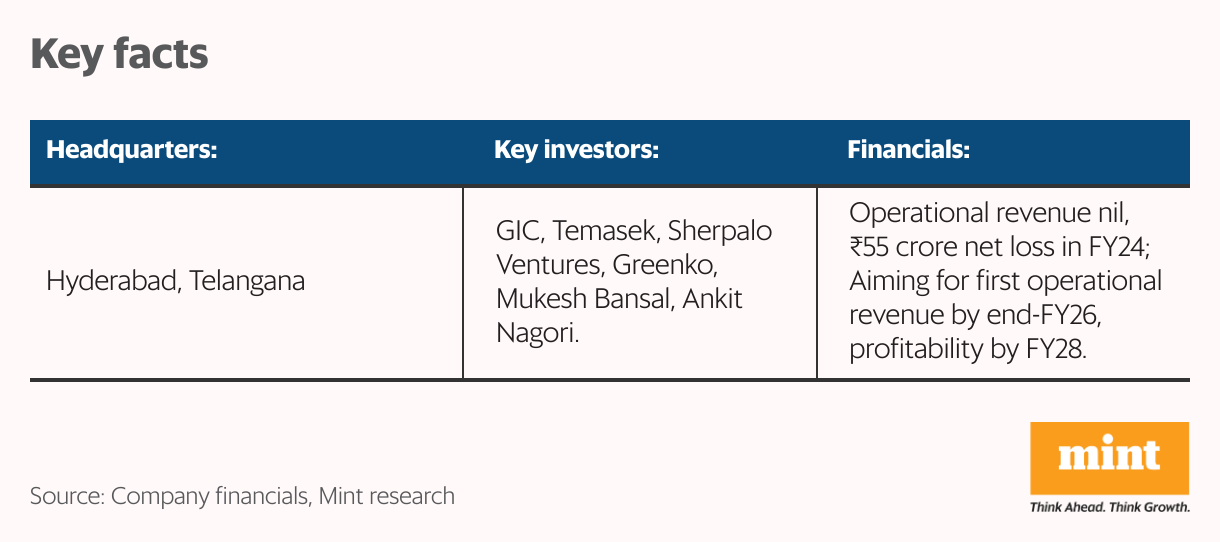
Founded in 2018, Skyroot Aerospace raised $95.5 million ( ₹850 crore in five tranches from investors including Singapore-based investment firm Temasek and the country’s sovereign wealth fund GIC).
Chandana, a graduate in thermal science and mechanical engineering from the Indian Institute of Technology-Kharagpur, started her space journey with Isro in September 2012. During his six-year mission there, he contributed to India’s heavy rocket launcher used in the Chandrayaan moon missions. Chandana met her co-founder Naga Bharath Daka at Isro.
The duo reunited in July 2018 to found Skyroot, as Daka left Isro for a three-year stint at US semiconductor design firm Xilinx.
Skyroot became India’s first space venture to demonstrate a rocket launch by sending a smaller version of its satellite vehicle from Sriharikota in Andhra Pradesh in November 2022.
At the time, Chandana told Mint that Skyroot was aiming to launch a rocket every two months by 2025. However, the company has only conducted a single suborbital launch since then; This means that although Skyroot was the first private company to launch a rocket from Indian soil, the demonstration mission did not go beyond earth orbit and enter space.
Chandana explained that creating custom technology takes time. “… We are the world’s only active small rocket that has a fast turnaround time and is capable of carrying up to five different payloads that need to be injected into five different levels of earth orbit. At our size and scale, we are the only company in the world with such a capability.”
Skyroot is one of the three companies producing indigenous rockets, along with Chennai-based Agnikul Cosmos and Hindustan Aeronautics Ltd’s customized version of Isro’s Small Satellite Launch Vehicle.
Agnikul carried out its suborbital test launch in May last year, 18 months after Skyroot. So far, it has raised $41 million in funding from investors such as Pi Ventures, Mayfield India and Celesta Capital.
Delays and difficulties
But Skyroot’s seven-year journey was not without its challenges. In 2022, management predicted that the company would become profitable by 2026, with satellite launch missions every two months starting this year. But after engineering delays and other challenges, the company now expects to become profitable by March 2028.
“These delays are unnatural. There are multiple challenges in space; in many strategic cases, supply of raw materials takes months. There are also engineering challenges and we need to be absolutely sure that we have done all the calculations correctly to avoid any mishaps,” Chandana said. he said.
“Perfecting engineering and manufacturing is a challenge because any failed move will negatively impact the company and the industry. It is the high level of safety and accuracy that takes time to get to the right level,” he added.

View Full Image
Chandana is not at fault. Musk’s SpaceX started in March 2002 with a grant from the US’s Defense Advanced Research Projects Agency. It took SpaceX four years to develop its first rocket, the Falcon 1, and it failed at all launch attempts between mid-2006 and mid-2008. SpaceX finally achieved success in July 2009 when it correctly placed the Malaysian satellite into orbit on its fifth attempt.
Today, SpaceX is the world’s most successful space services company. A total of 138 launches took place in 2024; this averaged more than twice a week. The company is one of the most heavily funded companies in the world, generating approximately $6.2 billion in revenue.
According to estimates by the Ministry of Space, which manages Isro, there are at least 200 space-related startups in India. At least half a dozen of these startups, including Agnikul, Pixxel and Digantara, have grown by more than 2,000. ₹100 crore from investors.
India’s space sector is expected to grow from around $8 billion currently to $44 billion by 2033 if the government’s privatization drive is successful, Union secretary of state for Space Ministry Jitendra Singh said at the India Mobile Congress event earlier this month.
Billion dollar opportunity
While Skyroot generates a small revenue of approx. ₹50 lakh since its suborbital launch in 2022, with no operating income in 2023-24, according to the company’s financial statements filed with the ministry of corporate affairs and accessed through business intelligence platform Tofler.
Chandana expects this to change in the ongoing fiscal year with the company’s first satellite launch mission (Skyroot has not disclosed its FY25 financials).
“Our hope is that as soon as we start generating operating income, we will begin to take steps towards profitability. Our goal is to get there as quickly as possible, but certainly within the next two fiscals…” he said.
In October 2023, a ten-year vision released by the Indian National Space Promotion and Authorization Center (In-Space), India’s space support agency, said India’s space launch services providers will generate $3.5 billion in annual revenue by 2033.
Surbhi Patni Dalmia, India president and director of space consultancy firm Novaspace, said, “The most well-known name in space worldwide is SpaceX, and when it comes to space, the first thing that comes to people’s mind is rockets. This is also true for India, and the first company in India that is mentioned together with SpaceX and rockets is Skyroot.”
“This is because the founders have excellent pedigree and have run the business with basics like control of technology and ‘phase’ testing. Looking at Skyroot’s launch fee, the company has every descriptor to suggest it will become a multi-billion dollar space venture from India in the not too distant future.” added Dalmia.
Chandana is not immediately seeking additional capital for the company’s upcoming rocket launches. “We have good funding for at least the next two to three launches and beyond that we’ll think about it. But for now, we’re not looking at an immediate round of funding and it’s too early to think or talk about public listings,” he said.
Chandana is the main promoter of Skyroot Aerospace and owns around 56% of the company, followed by Daka, who owns 28% stake.
“We missed global opportunities”
Chaitanya Giri, a space researcher at global think tank Observer Research Foundation, said Skyroot’s delays so far represent “missed global opportunities.”
“India does not have the kind of demand for rocket launches that companies have envisaged so far. As a result, most of the demand is expected to come from abroad. But this demand will not come from the US, Russia or China, which are most active in space and have large domestic capacity.” [It] It will come from Iran, Israel and similar countries, which create great demand for small satellite launches. [But] Given current geopolitics, it’s hard to imagine space companies like Skyroot could have such demands. [had] a few years ago,” Giri said.
According to him, France’s Dassault Systèmes SE and the United States’ Lockheed Martin Corp. India’s private space companies, such as China and Boeing Co, also need to be able to diversify into defense and military-related services. “Even SpaceX is on the verge of becoming a source of military launch vehicles,” Giri said.
Narayan Prasad Nagendra, space industry veteran and chief operating officer of European satellite services company SatSearch, said from an engineering perspective, Skyroot will need to prove its reliability and consistency once it reaches scale. From an operations perspective, he said the company needs to find enough demand to run one launch every month to achieve operational profitability.
“All of this will prove whether Skyroot can realize its true potential,” Nagendra said. “Although projections exist, current geopolitical [divisions] It means international collaborations for critical technologies are not what they used to be.”


