Inside El Mencho’s arsenal: high-powered arms, 400 gunmen, land mines
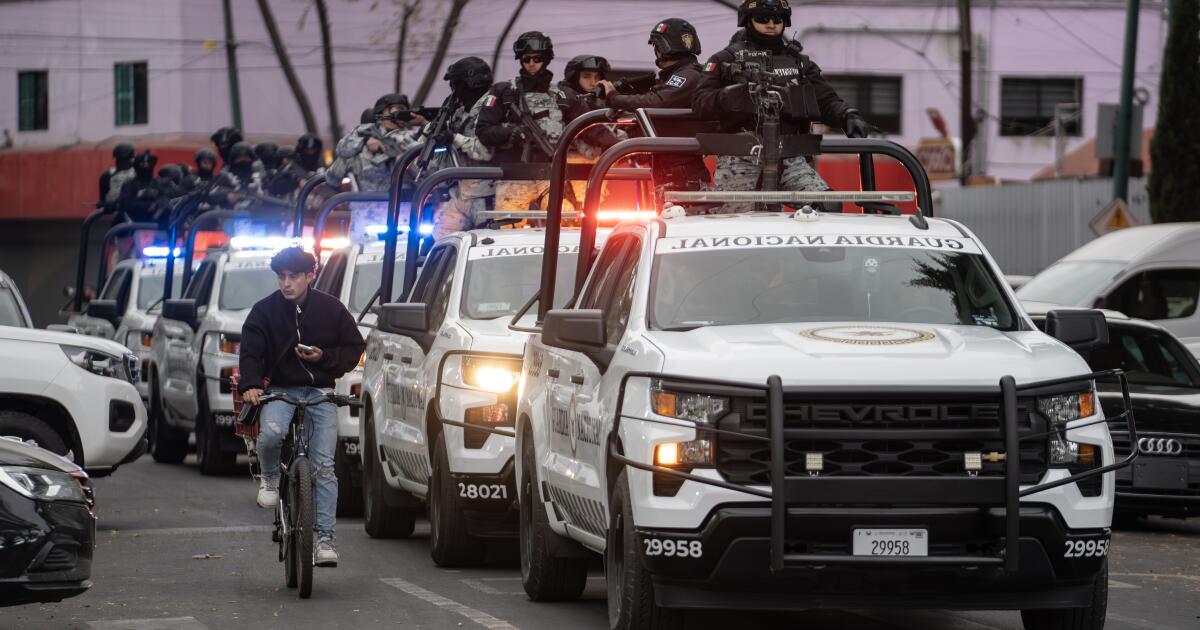
MEXICO CITY — “El Mencho,” the powerful drug lord killed by the Mexican military in a daring raid, created what security experts say is one of the most sophisticated security operations designed to protect a cartel boss. Its system relied on high-powered weapons, around 400 armed men, bomb-dropping drones and sometimes land mines.
Nemesio Rubén Oseguera Cervantes, 59, who was fatally wounded when special forces raided a shelter in the state of Jalisco on Sunday, took extraordinary measures, according to sources familiar with his operations who asked not to be named because they were not authorized to speak publicly.
Oseguera rarely allowed a phone near him, fearing its GPS signal might reveal his location.
Although Oseguera was flanked by bodyguards who exchanged fire with the Mexican military on Sunday, he appeared slightly outside his usual protective bubble that night, sources said.
He was tracked with the help of U.S. intelligence obtained in part through Predator drone surveillance, sources said.
Oseguera was an elusive capo and was considered Mexico’s most feared and powerful drug lord. Very few photographs of him have been made public, and he had a security apparatus modeled after military special forces teams. Highly trained forces moved with him wherever he went, according to sources familiar with his operations.
“He lived so secretly that very few people outside his circle knew what he looked like,” said Arturo Fontes, a former FBI agent who spent decades tracking some of Mexico’s leading drug traffickers, including Oseguera.
The founder of the Jalisco New Generation cartel had a fleet of souped-up, tank-style vehicles equipped with six-barreled Gatling guns that could destroy a small car and shoulder-fired rocket launchers that could shoot down helicopters.
The Jalisco cartel is known for its terrorist tactics. Last year, cartel forces drone bombed a prosecutor’s office in Tijuana and shot and killed Carlos Manzo, a prominent mayor in the state of Michoacán who spoke out against the cartels. And in 2020, they attacked then-Mexico City Police Chief Omar García Harfuch, who is now security minister.
Soldiers clear roadblocks on the road to Tapalpa, Mexico, on February 23, 2026, a day after the Mexican army killed Jalisco New Generation cartel leader Nemesio Rubén Oseguera Cervantes, known as “El Mencho.”
(Marco Ugarte / Associated Press)
For protection, sources say Oseguera purchased anti-drone radar jammers and recruited a bank of young hackers to infiltrate military mainframes to track military and Mexican government intelligence.
Hundreds of armed men controlled every road leading to Oseguera’s main compound in the state of Jalisco, forming concentric guard rings around his hideout. The routes were covered with mines for miles, according to people familiar with their operations. Personnel in each circle knew only the location of mines in their area; they did not know where the next round of mines began and ended.
For months, Mexican Cabinet officials discussed the difficulties of capturing Oseguera and considered the possible violent consequences of his arrest, said a person familiar with the talks who requested anonymity to discuss internal matters. The source said officials believe President Trump could launch a unilateral raid on Mexican territory if President Claudia Sheinbaum’s administration does not act.

Mexican President Claudia Sheinbaum and Navy Secretary Raymundo Pedro Morales Ángeles arrive at the National Palace in Mexico City on February 23, 2026.
(Cristopher Rogel Blanquet/Getty Images)
Sheinbaum and other Mexican officials called such a raid unacceptable and a violation of Mexico’s sovereignty. But US experts have been providing intelligence to Mexican officials and training Mexican personnel for years. The threat of attack by U.S. forces prompted Mexican officials to take action, the source said.
The capture of Oseguera has been one of the high-priority scenarios over the past six months during routine training of Mexican soldiers by U.S. special forces, a person familiar with the exercises said.
Sources described a series of steps that led to Oseguera’s capture. They spoke on condition of anonymity to share sensitive information.
In early February, Mexican law enforcement arrested a public official suspected of having close ties to the Jalisco cartel.
He provided leads to people close to Capo, and Mexican law enforcement conducted a series of raids based on information he provided, according to people familiar with the operations. This helped intelligence officials pinpoint Oseguera’s whereabouts, these people said.
While other capos rarely slept in the same place twice to stay ahead of the law, Oseguera had advanced kidney disease and required daily dialysis, which limited his movements, people familiar with his activities said.

A soldier serves near a vehicle destroyed in cartel-by-cartel violence in Cointzio, Mexico, on February 22, 2026, following the death of the drug lord known as “El Mencho.”
(Armando Solis / Associated Press)
In the days before the raid, a Predator surveillance plane flew at an altitude of 20,000 feet over the southwestern states of Colima, Nayarit and Jalisco, gathering intelligence on cartel agents and zeroing in on Oseguera.
Mexican intelligence officials found Oseguera’s girlfriend two days before the raid and began tracking her, Mexican Defense Secretary Ricardo Trevilla said at a news conference Monday.
They tracked him to a location in central Jalisco, about two hours south of Guadalajara. The CIA and FBI reported El Mencho’s exact location to Mexican military intelligence, a person familiar with the operations said. A day later he left and Oseguera remained.
A Predator drone used to bomb Islamic State militants in Iraq and Afghanistan in the early 2000s flew continuously over the region, tracking Mencho’s activities and the movements of his forces, a person familiar with the operations said.
Before sunrise Sunday morning, an army helicopter dropped more than a dozen Mexican special forces near Oseguera’s hideout in the town of Tapalpa, according to sources familiar with the operations. These people said he had hosted a party at his home the night before and his security team was not on high alert. Sources said this house was not his main residence and the area was not riddled with land mines.
Trevilla said special forces approached Oseguera’s home and a shootout broke out. The army said six aircraft, including warplanes capable of carrying missiles, were involved in the operation.

A body lies next to a vehicle full of bullets in the town of Tapalpa, Jalisco state, where the Mexican army killed “El Mencho” on February 23, 2026.
(Marco Ugarte / Associated Press)
Trevilla said Oseguera had a small, tight security detail at his home that night and had several military-grade weapons with him, including two anti-tank rocket launchers. However, it was no match for the army’s air strike.
Mencho’s close security team, known for their elite training in former Colombian special forces, opened fire on a helicopter providing air support, forcing it to make an emergency landing at a nearby army base. Just over a decade earlier, in another raid to capture Oseguera, his men had shot down an army helicopter using a shoulder-fired rocket launcher, killing all nine people on board.
Special forces killed eight gunmen as they stormed Oseguera’s home early Sunday morning.
Trevilla said he fled into the woods with two members of his security team. Special forces said they found Oseguera, seriously injured, hiding in the bushes along with two of his crew members.
An army landing party landed by helicopter, picked up Oseguera and his two sicarios and took off within minutes, according to a person familiar with the operation. The helicopter departed for a medical center in Jalisco. Oseguera died on the way.
This article was published in collaboration with Puente News Collaborative, a nonprofit bilingual newsroom covering stories from Mexico and the U.S.-Mexico border.