European nations to begin major talks on ECHR migration rule changes

Dominic CascianiHome and Legal Reporter
 BBC
International talks that will revolutionize the way the European Court of Human Rights handles migration cases will begin on Wednesday.
The British government is calling on partners to modernize the way states tackle the continent-wide illegal migration crisis.
The talks are a key sign that international human rights law could be reinterpreted to make it easier for states to target human trafficking and set up ‘return centres’ to hold people who have no right to be in Europe.
Writing ahead of the big meeting in Strasbourg, Sir Keir Starmer and Danish Prime Minister Mette Frederiksen said other nations should rethink their human rights laws to make it easier to protect borders.
Critics say the ECHR is preventing the deportation of more illegal immigrants, while supporters say claims about the ECHR’s role in immigration are exaggerated.
The BBC understands that the aim is for member states to reach a political declaration by spring that will set out how the European Convention on Human Rights will apply in migration cases.
If such an agreement were reached, it would be one of the most significant reforms in how human rights law is applied in the convention’s 75-year history.
The meeting at the Council of Europe, the political body that adopted human rights laws that were later implemented by the court, followed months of pressure on immigration.
Nine members of the human rights body, led by Italy and Denmark, called for reform earlier this year.
Britain did not sign the open letter but has been lobbying behind the scenes for reform talks.
Membership of the Convention has become increasingly controversial in the United Kingdom in recent years.
Both the Conservatives and the Reform Party have said they will leave the party if they win the next election.
Kemi Badenoch he said Secession was not a “magic bullet” but a necessary step to “protect our borders, our veterans, and our citizens.”
Liberal Democrat leader Sir Ed Davey said he would oppose such a move, saying the convention “supports our freedom” and would “do nothing to stop the boats or fix our broken immigration system”.

 EPA
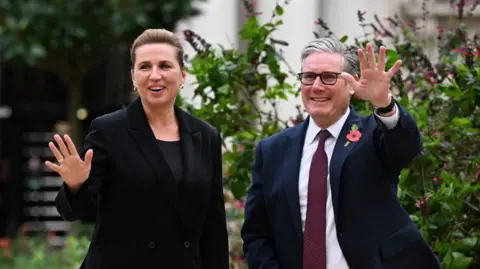
He writes in the Guardian newspaper Ahead of the talks, Sir Keir and his Danish counterpart Mette Frederiksen said member states meeting on Wednesday needed to “go further in tackling” the “shared problems” of “uncontrolled migration”, which they said was undermining public trust in governments.
The leaders said, “Europe has faced great challenges before and we overcame them by acting together. Now we must do it again.”
“Otherwise, the forces trying to divide us will become stronger.
“So our message is this: as responsible, progressive governments, we will deliver the change people are crying out for.
“We will control our borders to protect our democracies and make our nations stronger than ever for years to come.”
The British delegation that will participate in the negotiations will be headed by Deputy Prime Minister David Lammy.
He is expected to say at the meeting that the UK remains committed to the ECHR, but that the interpretation of this convention should not hinder the fight against human trafficking.
Britain’s already announced domestic plan It includes legislation restricting how the right to respect for private and family life is implemented in deportation cases.
The BBC understands that if the meeting in Strasbourg is successful, authorities will begin working with member states on a political declaration to clarify how human rights laws should be applied to migration issues, with the final text due by next May.
The talks are expected to cover some of the most difficult issues, including tackling migrant smuggling and how to create human rights-compliant ‘return centres’ – centers outside Europe where migrants can be forcibly housed if they are not returned to dangerous countries.
The talks are also expected to discuss the complex rules of Article 8, the right to family life, and Article 3, the prohibition of inhumane treatment, which are seen in many immigration cases.
In October, European Council President Alain Berset told the BBC: ‘Absolutely ready’ to discuss human rights reforms.
The olive branch extended to member states follows months of diplomatic talks that paved the way for Wednesday’s meeting.
“The European Convention on Human Rights provides the framework we need to address these issues effectively and responsibly,” Berset said ahead of the meeting.
“Our task is not to weaken the Convention, but to keep it strong and valid, to ensure that freedom and security, justice and responsibility are kept in balance.”


