Mid-East refineries and gas fields shut, tankers wait

US and Israeli attacks on Iran and Tehran’s retaliation have led to precautionary shutdowns of oil and gas facilities in the Middle East, resulting in increased energy prices.
Qatar has halted liquefied natural gas (LNG) production and QatarEnergy is preparing to declare force majeure on LNG shipments, a knowledgeable source told Reuters.
This development follows the suspension of most oil production in Iraqi Kurdistan and some major Israeli gas fields and the restriction of exports to Egypt.
Saudi state television reported that Saudi authorities captured Iranian drones attacking the Ras Tanura oil refinery near Dammam and that the refinery was closed as a precaution.
Dutch and British wholesale gas prices have risen by almost 50 per cent but the European Commission does not expect the widening conflict in the Middle East to have a direct impact on the security of the European Union’s oil and gas supply, a spokesman said.
When asked about gas supplies, the spokesman said: “We are not taking any emergency measures or anything like that. There is no gas shortage, no emergency. Gas imports are quite diversified.”
The EU’s oil coordination group will meet within 48 hours to assess the situation.
Earlier on Monday, the Qatari government said an energy facility owned by QatarEnergy was attacked by two Iranian drones and authorities were assessing the damage.
Qatar LNG production is equivalent to approximately 20 percent of global supply. The Gulf country is the world’s second largest LNG exporter after the United States and plays an important role in balancing the needs of the Asian and European LNG market.
Oil prices rose as much as $13 a barrel on the day to above $82 ($A116) a barrel, the highest since January 2025, as fighting in the Strait of Hormuz, through which a fifth of global oil supplies flows, came to a near standstill.
Insurance companies are canceling war risk coverage for ships in the Gulf, where at least four tankers were damaged, two sailors died and 150 ships were stranded around the Strait of Hormuz.
Shipping through the strait between Iran and Oman, which carries large quantities of gas as well as about a fifth of the oil consumed worldwide, has come to a near halt after ships in the region were hit as Iran retaliated against US and Israeli attacks.
Oman said a bomb-carrying drone boat crashed into a Marshall Islands-flagged oil tanker in the Gulf of Oman on Monday, killing a sailor.
Iran threatens ships approaching the Strait of Hormuz and is believed to have carried out several attacks.
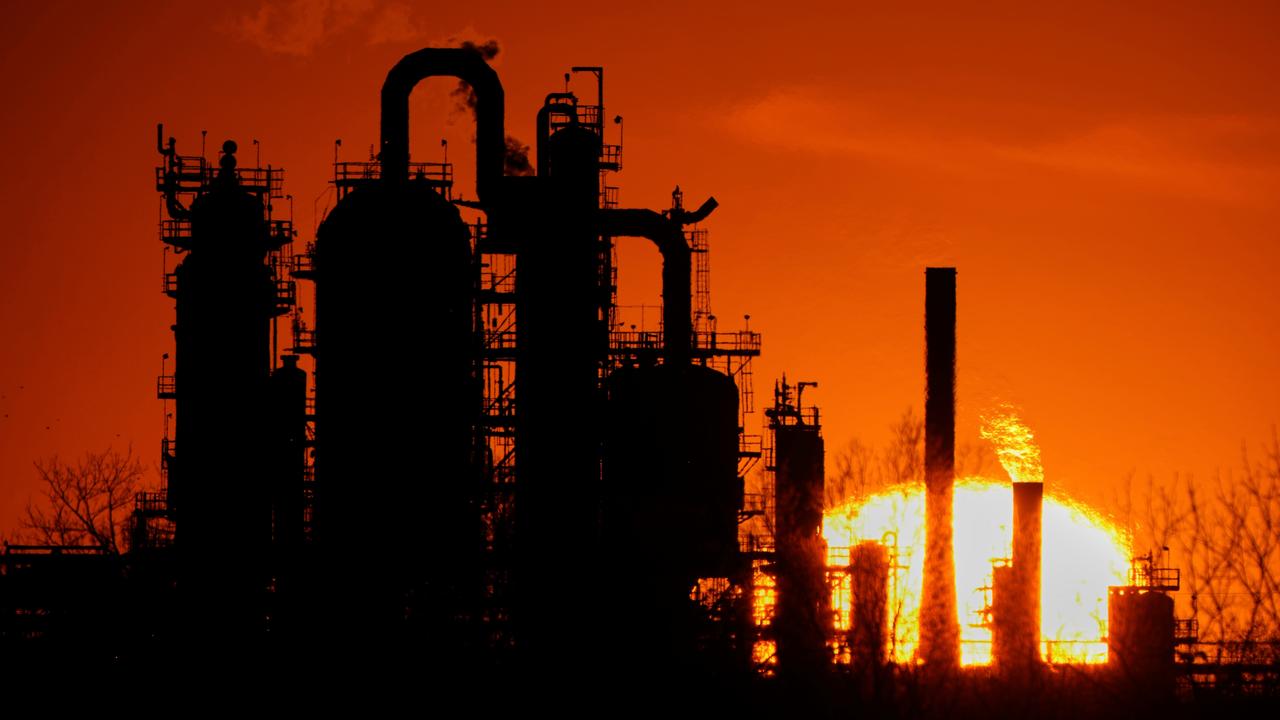
State oil giant Saudi Aramco’s 550,000 barrel per day (bpd) Ras Tanura refinery, which was shut down as a precautionary measure, is part of an energy complex on the kingdom’s Gulf coast that also serves as a critical export terminal for Saudi crude.
In Iraqi Kurdistan, which exported 200,000 barrels a day via pipeline to Türkiye’s Ceyhan port in February, companies including DNO, Gulf Keystone Petroleum, Dana Gas and HKN Energy halted production at their fields as a precaution before any damage was reported.
Iran, the third-largest producer in the Organization of Petroleum Exporting Countries, pumps about 4.5 percent of global oil supply. Iran’s production consists of approximately 3.3 million barrels per day of crude oil, as well as 1.3 million barrels per day of condensate and other liquids.
with agencies

The Australian Associated Press is the beating heart of Australian news. AAP is Australia’s only independent national news channel and has been providing accurate, reliable and fast-paced news content to the media industry, government and corporate sector for 85 years. We inform Australia.


