Palaniswami’s refusal to commit himself to Old Pension Scheme shows that it is unfeasible

Demographic data of retirees reveals that between 2017 and 2025, the number of retirees aged 80 and above increased by 1.7 times from 41,489 to 1,13,380. | Photo Credit: Getty Images
AIADMK general secretary Edappadi K. Palaniswami’s refusal to commit himself to the restoration of the Old Pension Scheme (OPS) for State government employees and teachers reflects the awareness that it is unsustainable in the long run.
Interacting with reporters in Salem on Pongal day (January 15), Mr. Palaniswami was asked whether he would return to OPS if his party wins the Assembly elections. His answer was that it would be decided “depending on the situation”. He added that his party would make “only promises that are possible.” He also criticized the ruling DMK for failing to fulfill its 2021 election assurance on OPS.
Chief Minister MK Stalin announced a few weeks ago that his government will implement the Tamil Nadu Assured Pension Scheme (TAPS), which is a mix of OPS, Union government’s Unified Pension Scheme (UPS) and Andhra Pradesh Guaranteed Pension Scheme (APGPS). By providing for monthly pension payments, TAPS retained the contribution element found in the Contributory Pension Scheme (CPS) or National Pension System (NPS). About 10 days ago, the Tamil Nadu government issued an order that the new scheme would come into force on January 1.
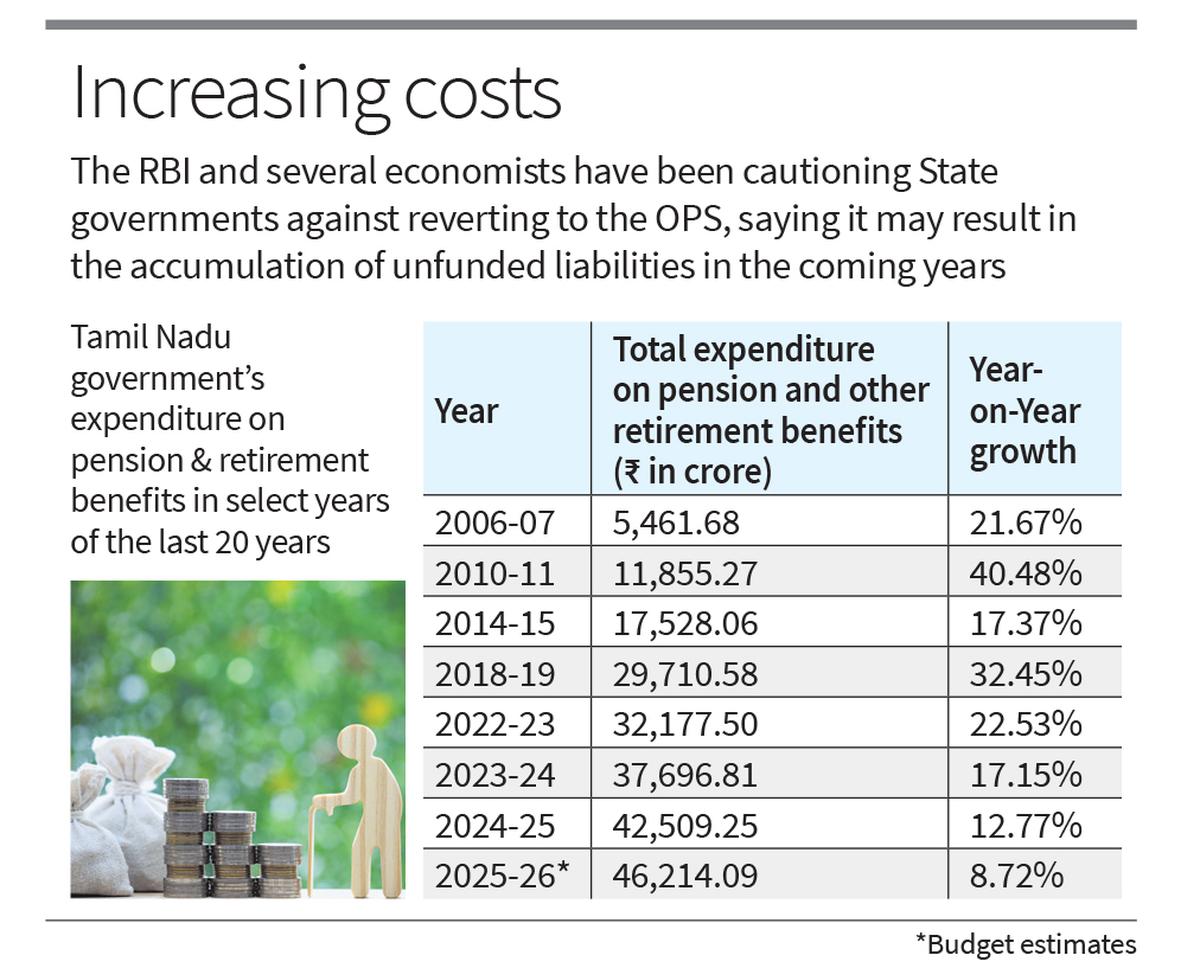
Over the last five years or so there has been a trend among some States to return to OPS. States like Rajasthan, Jharkhand and Chhattisgarh have announced that they will revert to OPS. But the Reserve Bank of India and many economists have generally warned state governments not to revert to the old plan, arguing that the move will lead to a build-up of unfunded liabilities in the coming years.
Moreover, as stated in the White Paper submitted by the Tamil Nadu government in August 2021, the government has resorted to borrowing in the past even for non-discretionary expenditure items, which include pension payment, which is one of the important components of the committed expenditure.
With increasing life expectancy, the number of pensioners and family pensioners in the state has been pegged at around seven lakh for a long time. Demographic data of retirees reveals that between 2017 and 2025, the number of retirees aged 80 and above increased by 1.7 times from 41,489 to 1,13,380. It is not surprising that annual growth in pensions and other retirement benefits is generally in double digits.
It was published – 17 January 2026 12:21 IST


