SIR in Uttar Pradesh | The first cut is the deepest

In early 2000, Vimarsh Bajpai moved from Lucknow, the capital of Uttar Pradesh, for professional reasons. Over the years, he has moved across India for work and now lives in Delhi, although he has a home in Lucknow.
His Electoral Photo Identity Card (EPIC), issued in 1995, a year after he turned 18, shows that he was registered at Arya Nagar in Lucknow. He was also registered as a voter in his ancestral village of Mohammadpur in Unnao district, where he owned property, but had no idea whether he was still on the electoral rolls there.
When the Election Commission of India (EC) announced the special intensive revision (SIR) of electoral rolls in Uttar Pradesh, the communications professional could not fill the enumeration form as he did not know where to get it.
Apoorva Snehil Katayayan moved houses in Lucknow from Lucknow East to Lucknow Cantonment Assembly seat. He contacted the last landlord and the Booth Level Officer (BLO) for the enumeration form but the 40-year-old businessman was asked to fill out Form 6 to register as a new voter from his new address.
Ayush Mehrotra and his father Rajeevdas Mehrotra, residents of Lucknow West Assembly seat, could not find their names in the draft list despite filling the enumeration form. BLO stated that the error was caused by technical glitches on the website. The fact that Rajeevdas is the brother of Samajwadi Party MLA Ravidas Mehrotra created a minor political storm.
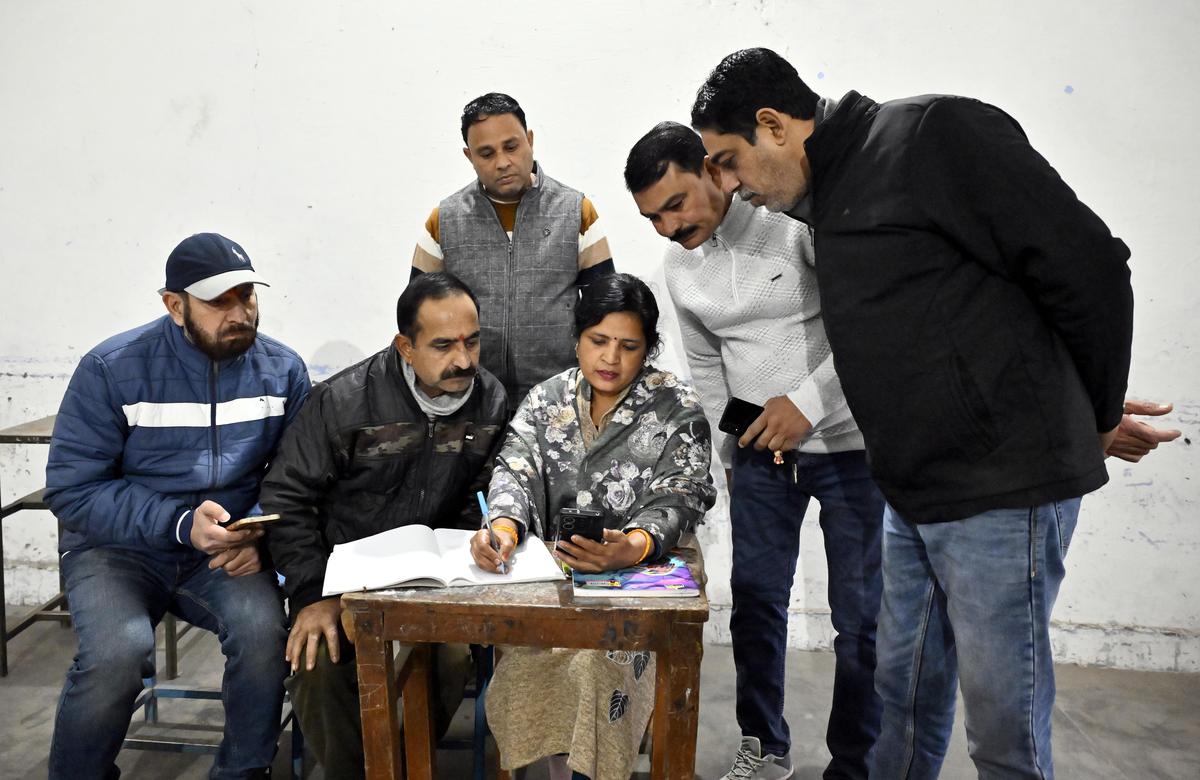
BLO Amita Gupta, along with political workers BLA 2, Ajay Khatana, Gaurav Rastogi, booth head 448 Rajiv Sharma and Jasvir Singh Mogha, at Satyug Ashram Model Inter College in Mangal Nagar area of Saharanpur district of Uttar Pradesh on January 7, 2026. | Photo Credit: Shiv Kumar Pushpakar
At 2.89 crore, the number of deleted names in UP is the highest in absolute numbers for any State or Union Territory where SIR has been conducted so far. In terms of percentage, it ranks second after the Union Territory of Andaman and Nicobar islands with 18.7%.
Approximately 14% of those deleted are listed as either permanently moved or not found during the verification process.
Urban areas were hit the hardest; Lucknow tops the list, followed by Ghaziabad, an urban center adjacent to the National Capital Region. In the SIR process, more than 12 lakh names out of almost 40 lakh voters were deleted from Lucknow’s 2025 voter rolls, the highest number for any district in UP
home matter
More than 500 kilometers from Lucknow, in Delhi-adjacent Gautam Buddha Nagar, Kalpana Halder, a domestic worker serving in the city’s high-rise apartments, has registered her name in Noida as well as in her hometown in West Bengal’s Murshidabad district. His name was established in both places when the SIR process began. He chose Jalangi Assembly constituency in West Bengal.

While 30% of names were deleted in Lucknow, Ghaziabad was deleted by 28%, Kanpur by 25%, Prayagraj by 24% and Gautam Buddha Nagar by 23.5%. A voter in booth 412 of SAM Inter College in Saharanpur Assembly constituency, who did not want to be named, says he is registered both in the city and in his ancestral village Harora in Saharanpur district. When SIR was announced, he decided to keep voter registration in his village instead of the city.
Ground-level political party workers worry that their carefully calibrated views of different voting bases may be distorted as many city dwellers register themselves in their villages. “Many people want to vote in the Gram panchayat elections because even one vote counts there. Sometimes they or their family members become candidates,” says Gaurav Garg, district media in-charge of the BJP in Saharanpur. Another reason is that many people associate the right to vote in a particular place with owning property in that area; but these two are not related to each other. Under European Commission rules, people have the right to vote where they live, not where they own property.
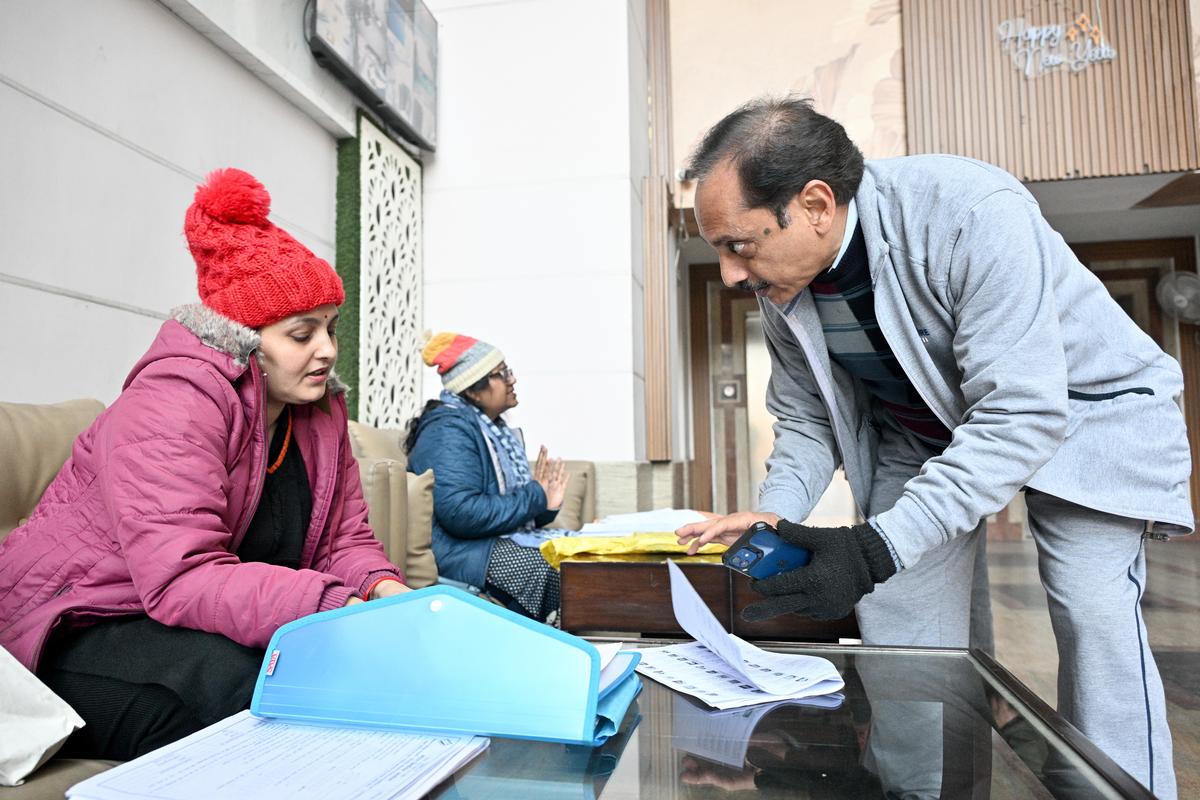
A man searches for names in the draft voter list following special intensive revision (SIR) of voter rolls at a housing society in Ghaziabad, Uttar Pradesh, on January 11, 2026. | Photo Credit: Shiv Kumar Pushpakar
Various BLOs appointed by the EC as well as booth level representatives (BLAs) appointed by political parties say that many duplications are due to the fact that a large proportion of people are migrant workers. Many from Bihar and West Bengal rent rooms in numerous urban villages in Delhi’s suburbs of Noida and Ghaziabad and UP’s major cities of Lucknow and Kanpur.
Voter list data for ballot box no. For example, 2 in Harola village in Makanpur, Noida, shows that 148 out of 1,148 names have duplicate voter registration from outside the State. Voters chose to keep registrations at their own locations. A total of 25.47 lakh voters (1.65%) were registered at more than one place.
Congress leader Gurdeep Singh Sappal and his family moved to Noida from Ghaziabad in Sahibabad Assembly constituency a year ago. He says all his documents are ready and their names are in the 2003 voter list. But they were still left out and now asked to fill out Form 6.

Form 6, used for new voter registration, includes a declaration that the voter is not registered in any other Assembly constituency of the country. Any attempt to register at two places is an offense that may result in an FIR being filed at the police station.
“The system is flawed,” Sappal says. “While the EC is accepting Form 8 for correction of entries in the current voter lists, it is not accepting it for change of residence. On one hand they are linking presence in the 2003 rolls to citizenship, on the other they are forcing me and my family to delete our old voter records,” he says, adding that he plans to approach the court in this matter.
Voter indifference to filling out forms
BLOs in urban centers complain about voter apathy during the counting phase. They say they had to visit people’s homes multiple times to fill out census forms. Officials say that this does not apply to rural areas, adding that regions where minorities are in the majority do not face this problem.
Residents of towns with a large Muslim population, such as Deoband, say the citizenship bogey created by SIR has the community worried. In the city known for its Darul Uloom Islamic seminary, special camps have been set up by various NGOs and local community leaders to help people fill out the forms.
The EC maintained that if voters were not matched with the last SIR in 2003, they should produce the documents required by it to prove their identity and citizenship.
Mohd sits in his elegant living room, a few meters away from Darul Uloom in Deoband. Wajahat Shah, a retired teacher from a primary school, says he has spent months since the SIR was announced helping people link their names to the 2003 voter lists, get their documents in order and then fill out census forms.
While Shah sees 100 percent of those who filled out census forms covered in the draft list, he argues that the real battle begins when uncharted voters are called to the hearing. Hearings are held at various locations in each Assembly constituency where people can prove their identity and citizenship.
Sardhana in Meerut district is approximately 70 km from Deobandh. Below the narrow, dusty lanes of the sugarcane belt of western Uttar Pradesh, in a suddenly opened field, stands the majestic and stunningly pristine white structure of the Basilica of Our Lady.
The more than 200-year-old structure, built by Begum Samru, the ruler of the period who converted from Islam to Christianity, is one of the largest churches in northern India. The town is known for this church and the festivities held there throughout the year.
However, Mohd. Ali Shah, a scion of the erstwhile royal family of Sardhana, has only SIR on his mind. He sits in his living room and office, examining different EC forms, all spread out on a large center table. Ali Shah leads a 65-member team of local Samajwadi Party leaders, BLAs and youth volunteers who help people negotiate SIR-related paperwork.
Sardhana is part of Muzaffarnagar Lok Sabha seat, which witnessed large-scale communal violence in 2013. The Sardhana Assembly seat was represented by BJP’s Sangeet Som for two terms in 2012 and 2017. However, he lost to Samajwadi Party MLA Atul Pradhan in the 2022 Assembly polls.
Now, with the counting phase over and the draft voter list being published on January 6, Ali Shah’s team has shifted its focus to those who could not be matched with the 2003 voter lists when the final SIR was implemented and are likely to be notified and summoned for hearing.
He patiently explains to a voter the ins and outs of filling out the registration form for his spouse. The IT professional-turned-businessman says his team started raising awareness about the entire process and its related documents from the day the SIR was announced in October.
As part of the awareness campaign, he shot and uploaded videos on social media and went to the streets of Sardhana with a loudspeaker to explain the process of filling out the forms and receiving the documents in order.
A local EC official, who asked not to be named, said the documentation was particularly challenging for women. Early social mobilization helped, he says.
What’s ahead
More than 100 km away from Sardhana in Saharanpur city, local BJP workers gathered at SAM Inter College, a polling booth. BLO Amita Gupta sits next to the recently released draft electoral rolls released earlier this week. Some of the workers say they will focus on getting the names of genuine voters left out for various reasons included in the final list by helping them fill out Form 6.
According to the new calendar announced by the EC after the SIR process was extended three times, the period for receiving requests and objections will remain open from January 6 to February 6, and the final lists will be published on March 6.
Meanwhile, the District Election Office in Ghaziabad is preparing officials to prepare for the document-collection scramble during the hearings. In the first round of SIR held in Bihar in mid-2025, the EC had mandated that documents should be collected at the counting stage in case of voters who could not be matched with the last SIR held two decades ago.
However, in the second round, the poll body said that in case of unmapped voters, documents will be collected only after the draft electoral rolls are published, when notifications will be issued and voters will be summoned for hearing.
A senior official at the EC office in Ghaziabad said additional Assistant Electoral Registration Officers (AERO) have been deployed. As of January 15-16, hearings of people who cannot be matched with the 2003 SIR list will begin. An AERO is expected to hold 50 hearings per day. However, sources in the office of the Chief Electoral Officer of Uttar Pradesh say that in many cases, BLOs may be asked to collect the necessary documents and send them to the AERO office. This may make the process easier for voters.
The SIR process in Uttar Pradesh took 62 days and was extended three times.
sreeparna.c@thehindu.co.in
Edited by Sunalini Mathew.


