Terror law used to ban Palestine Action being used too widely, report warns

A major review has found that counter-terrorism laws used to ban Palestine Action have been used too widely and the government’s counter-radicalisation plan is “not fit for purpose”.
The UK Independent Commission on Counter-Terrorism Law, Policy and Practice found that the current official definition of terrorism was too broad, creating “ambiguity and overreach in application”.
The three-year review, led by former judge Sir Declan Morgan KC PC and 14 commissioners, called for the definition of terrorism to be tightened.
In cases involving property damage, this should be limited to actions that “pose a serious risk to life, national security or public safety, or involve arson, explosives or firearms,” the commission said.
The report, published on Tuesday, also said measures used to ban groups such as Palestine Action should only be used to protect the public from terrorism and that the ban should expire after five years if not renewed.
The report stated: “When a group is banned, individuals may be subject to prosecution for becoming members, inviting or expressing support, or for wearing relevant symbols or uniforms.
“Funding a proscribed organization or using property linked to it may constitute a criminal offence, and any action carried out for the benefit of a proscribed group may be considered an act of terrorism.
“These far-reaching consequences can create confusion, deter lawful civic participation, and strain relationships with communities affiliated with affected organizations – particularly where banned groups are politically motivated.”
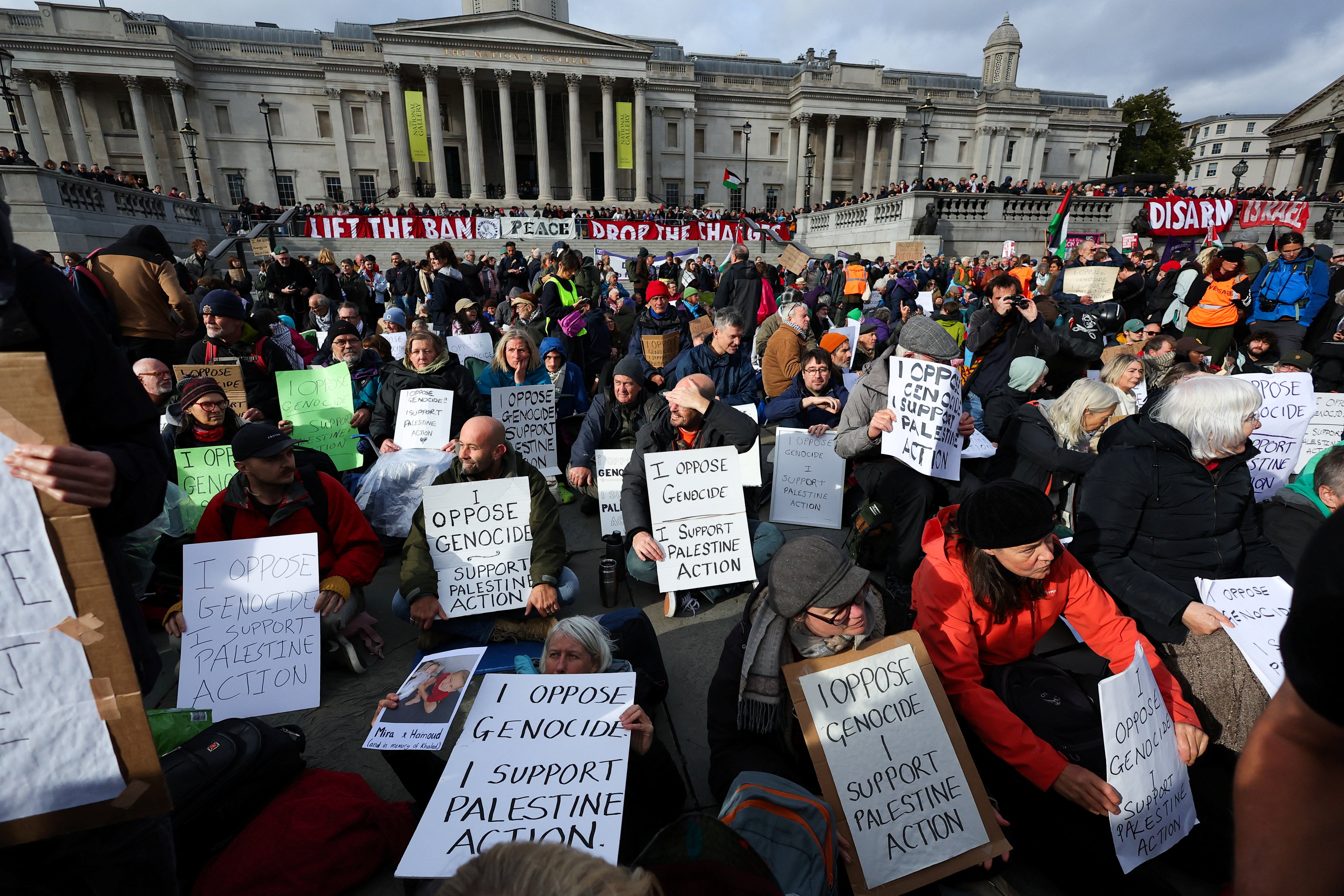
It comes after almost 2,000 people were arrested under the Terrorism Act during a series of protests in recent months over the decision to ban the direct action group.
The ban, which began on July 5, made supporting the group a crime punishable by up to 14 years in prison. It will be challenged in the Supreme Court later this month.
Hundreds of peaceful protesters were removed by police for holding signs reading “I am against genocide, I support Palestine Action.”

The commission called for increased parliamentary scrutiny of decisions to ban groups and for suspects to be charged only under sections 12 or 13 of the Terrorism Act, which covers support for banned groups “where there is a clear intention to commit an offence”.
Kneecap rapper Liam Og O hAnnaidh, whose stage name is Mo Chara, was charged under section 13 for allegedly carrying a Hezbollah flag at a concert before the case was dropped due to a technical error.
The commission also warned that too many cases were being referred to Prevent, the government’s counter-radicalisation programme.
It follows official figures published last week showing Prevent recommendations rose to a record high following the Southport attack in 2024, when three girls were killed in a mass stabbing at a dance class.
More than half of the cases flagged through March 2025 involved individuals who did not adhere to a particular ideology or belief system.
The report stated: “Rather than clear risks associated with terrorism, referrals increasingly need to include individuals experiencing complex vulnerabilities, including mental illness, social isolation or neurodivergence.
“This shift blurred Prevent’s purpose and expanded its jurisdiction beyond its original purpose.”

The commission said those involved in potential terrorist plots against the UK were “increasingly younger and may be driven by complex mixtures of ideology, grievance and personal sensitivity”.
The report said: “The Commission heard evidence that, without careful calibration, counter-terrorism powers risk being applied too broadly, i.e. to capture harmful but non-terrorist behaviour.
“This concern emerges most acutely in the Prevent programme, where the boundaries between protection, criminal justice and counterterrorism are increasingly blurred.”
It was stated that more than 90% of the 58,000 people who applied to Prevent since 2015 did not have concerns about fighting terrorism.
Commission chairman Sir Declan Morgan KC said: “The evidence we have suggests that the current approach to Prevent is not fit for purpose.
“Prevent should be integrated into the wider, local authority-led multi-agency safeguarding ‘front door’ of working with communities to mainstream the violence prevention work currently committed through Prevent into wider violence reduction strategies.
“We need to move away from the radicalization model and instead focus our resources on individual resilience and building trust and social cohesion in neighborhoods.”
The commission made a total of 113 recommendations, including more powers for the independent monitor of counter-terrorism laws and a national strategy to promote social cohesion.


