The Christian converts the US is deporting back to Iran

 Getty Images
On a Monday in mid-October, after a year in immigration detention in the United States, officers arrived unannounced at Majid’s cell in Texas.
They just told him to “pack up” — to move — even though an immigration judge had given him protection from deportation five months earlier. He was chained at his wrists, waist and ankles and taken overnight to a military airfield in Louisiana.
Majid – not his real name – fled Iran to the United States in October 2024, after being repeatedly detained and tortured, first for his involvement in the Mahsa Amini protests and then for his conversion to Christianity.
He recalls that when U.S. officials forced him to board a plane carrying more than 150 deportees bound for Managua, Nicaragua, he was the only non-Latino American on the plane. Hours later, the plane landed and authorities handcuffed him, denied his request for asylum, and directed him on a route to Iran via Venezuela and Türkiye; it was a journey he understood as a forced return.
Majid later managed to hide in Istanbul, fearing what awaited him in Iran. He is one of the Iranian Christians whose asylum claims were rejected last year, who spoke to the BBC out of fear of relatives in their home country. Their accounts point to inconsistencies in how U.S. officials assessed the risks facing returning Iranians and how sensitive religious information in asylum files was handled.
Their experiences also contrast with other elements of U.S. foreign policy; President Trump openly laments the plight of Christian persecution abroad and threatens to send troops “with firearms” into Nigeria if the government “continues to allow the killing of Christians.”
A White House official told the BBC that the asylum claims of all deported individuals were fully adjudicated before deportation. Recent deportations to Iran include people who have received final deportation orders or requested voluntary departure, the official said. They added that strict confidentiality rules prevent authorities from revealing whether a person has applied for asylum.
A rare deportation flight
As the United States continues its crackdown on illegal immigration, it has made unprecedented changes in its policy towards Iranian refugees. In late September, authorities arranged a charter flight to Iran via Qatar, the first of its kind in decades, given the lack of diplomatic ties and Iran’s human rights record. The flight represented an unusual example of cooperation between Iran and the United States.
It was reported that dozens of Iranians were chained and put on the plane. Sinai, who was deported, said that armed guards later accompanied the passengers on the Qatar-Tehran leg. They were questioned upon arrival about their time in the United States and their religious activities, but were not immediately arrested, they said in a video posted on a Persian-language YouTube channel.
Among the passengers was Ali’s wife, an Iranian Christian who now lives in the United States. He has since been contacted by Iranian intelligence and summoned.
“They deported my wife to Iran even though she was a Christian,” says Ali. The BBC gave him a pseudonym to protect his and his wife’s identity. “Now Iranian intelligence is after him and me.”
For Ali’s wife and others, what their lawyers said was a critical mistake further increased the danger.
Ali Herischi, a lawyer who represents Ali, his wife and another person deported from the September flight, said some of his clients have reported that sensitive information, including statements about religious conversion, political activities and reasons for seeking asylum, was not removed before deportation.
Why is it dangerous for those who converted to Christianity to go back?
Steve Dew-Jones of Article 18, a UK-based advocacy group that tracks abuses against Christians in the country, says converts from Islam make up a significant portion of Iran’s 800,000 Christian population.
Since officially recognized churches are strictly restricted, house churches began to appear across the country. But Dew-Jones says practitioners continue to face persecution.
Turning away from Islam is considered apostasy, and conversion is punishable by arrest, interrogation, and imprisonment.
The Iranian Center for Human Rights reported that arrests increased sixfold between 2023 and 2024. Dew-Jones adds: “Since the recent Iran-Israel conflicts, we have seen authorities use the term ‘Zionist Christianity’ even more aggressively. The state frames ordinary religious practices as a national security threat, branding converts as agents of Israel.”
While some Iranians seeking asylum abroad cite conversion as part of their claims, Iranian authorities accuse them of exaggerating or fabricating the conversion to strengthen their case.
But it’s unclear how many asylum cases in the US are exaggerated versus real fears of persecution.
“It is impossible to judge the sincerity of someone’s faith; there is no window into people’s souls,” says Dew-Jones. “Yes, the system can be abused, but we also see many legitimate converts whose testimonies and church records are not taken seriously by asylum courts.”
Life stands still for those left behind
Iranian asylum seekers and legal experts say asylum outcomes can vary sharply even within a single household.
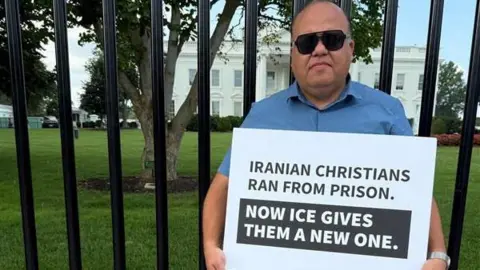
In late June, ICE officers arrived at Marjan and Reza’s home in Los Angeles. Video taken by their pastor shows Marjan passed out outside while agents detained her husband. She had called him a few minutes ago to ask for help. The couple, both Iranian Christians who had applied for asylum in the United States, were taken to separate detention centers. Weeks later, their cases diverged: Marjan was granted asylum in California, while Reza, who was being held in New Mexico, was ordered to be sent to a third country.
Following their arrests in June, the Department of Homeland Security said on account

 Sent photo
Pastor Ara Torosian, who filmed their arrest, disputes the Department of Homeland Security’s claim that the couple is in the United States illegally.
He said they entered legally through a humanitarian program and had work permits. “How can this be dangerous for the wife but not dangerous for the husband?” asks pastor Ara Torosyan, who himself fled Iran in 2010 after being detained on charges of Bible smuggling.
Majid, who managed to escape from the airport in Türkiye, has been living in limbo ever since and his lawyer has been following his case. His wife, whose asylum case is still ongoing, now lives in Los Angeles with their 1.5-year-old daughter, who has never met their father.
Ali lives in the United States with a friend from his church and hopes his own asylum request will be more successful than that of his wife, who was deported to Iran this year.
“If they grant me asylum, how can I stay here while my wife is in Iran? If they deport me, I could go to jail the moment I land.”
Unable to legally work or open a bank account. He first stayed with a distant relative “until my wife’s case was resolved,” but my wife was never released and was deported after nearly a year in detention. Later, a small church offered him temporary shelter.
“Every time they ask me to leave, I have to sleep in parks,” he says.
He awaits his immigration hearing but sees no good outcome. His wife received another call from Iranian intelligence.
“If they arrest him and ask me to return,” he says quietly, “I’ll have no choice.”


