Ukraine’s war robots are surging into the kill zone
KYIV REGION, Ukraine — A routine supply run near the front lines in eastern Ukraine could result in a death sentence.
Mines, cannons and drone saturated sky He expanded the killing zone by threatening soldiers carrying food or ammunition to troops in the trenches. “If you send a human driver to deliver these things, there’s a very high chance he’ll get killed,” Andrii Kushnierov, a platoon leader from Ukraine’s 59th Assault Brigade, told Business Insider.
So Ukraine is sending more and more robots instead.
These machines are no longer the simple bomb-laden, remote-controlled cars that appeared at the beginning of the war.
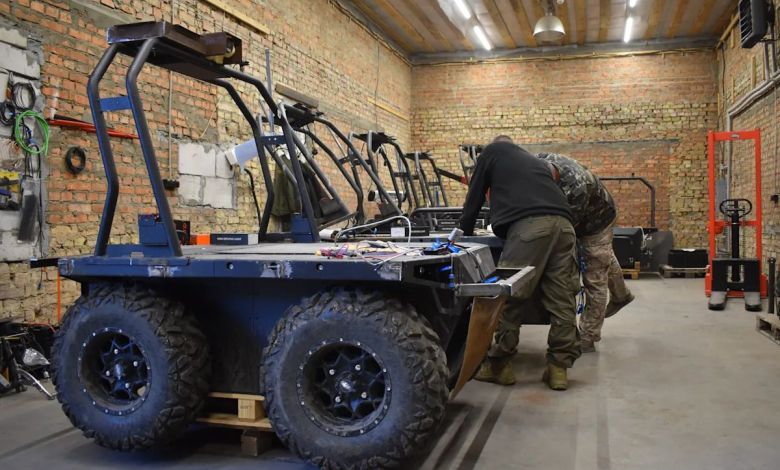
Business Insider broke into a factory in the Kiev region, far from the front lines, where workers are rapidly creating next-generation production systems. battlefield robots.
The vehicles rolling off the line inside the factory looked a bit like military-grade golf carts, except they had no seats or steering wheels.
They were not made for a soldier to board a ship and go into battle. They are designed to keep the driver out of the kill zone.
Remote control after workers fitted them with electronics, heavy-duty tires and sensors Ukrainian operators They will send them to the front lines, where they will carry ammunition, evacuate wounded troops, lay mines, launch other drones, attack Russian positions, and continue advancing under fire.
Many will not survive for long. Some can be destroyed within a few days of arriving at the front. For Ukraine, this is an acceptable trade-off. These machines can be easily replaced. A soldier cannot do this.
This also means that Ukraine will need much more of these vehicles. Factories across the country are racing to make up for losses on the battlefield and increase production; This offers an idea of what it takes to keep a war increasingly waged dominated by drones.
This is a wartime production race for cheap, robust machines that can be produced quickly, easily adapted, repaired where possible, and replaced when destroyed.
Land robots transform from explosive cars to battlefield workhorses
Taras Ostapchuk was producing street lamps before the war. He is now CEO Ratel Roboticsone of hundreds Ukrainian companies Making ground robots.
“The most important thing is to save the lives of our soldiers,” Ostapchuk told Business Insider.
Ukraine is replacing soldiers with robots for dangerous missions as the killing zone expands near the front lines.By Jake Epstein/Business Insider
Ratel produced its first ground robot in late 2023, producing a small machine. anti-tank mines and was designed to move towards and detonate Russian targets.
Currently, Ratel’s approximately 350 employees can produce hundreds of products. uncrewed land vehiclesor UGVs, one month. The robots cost between $2,000 and $40,000, depending on size and function, making prices much lower than similar European systems, Ostapchuk said.
“We know how to produce the cheapest combat-resistant robots,” he said.
Ukraine built most wartime defense industry under pressure, with limited resources and intense dependency external support. The same pressures are shaping the robotics industry, with companies racing to produce low-cost, adaptable machines for a war that is consuming equipment almost as fast as it can be produced.
War machines from Ratel’s factory Designed for jobs like Ukrainian soldiers are increasingly trying to evade: carrying hundreds of kilos of cargo or ammunition to the battlefield, laying mines, evacuating the wounded, launching FPV drones and attacking Russian outposts.
The company also develops launchable robots. interceptor drones for air defense missions and to conduct amphibious casualty evacuation, logistics and assault missions. Testing for the latter was scheduled to begin last month, with scale production expected to quickly follow to support operations in southern Ukraine.
Business Insider reporters traveled across Ukraine to document how new technologies, tactics, and industries are revolutionizing warfare.
Read more posts from Ukraine:
“We need to destroy Russian enemies on the left bank” of the Dnipro River, Ostapchuk said, referring to intense clashes near the Ukrainian city of Kherson.
Ratel’s operation is part of a broader national effort, with Ukrainian UGVs being sent into combat and tasked with unconventional and increasingly ambitious missions. Minister Volodymyr Zelenskyy recently said that robots captured Russian positions and forced the soldiers to surrender without direct infantry intervention.
Ukraine produces tens of thousands of ground robots and sends them to the killing zone
The push for more robots is growing rapidly. Ukraine signs contract for 25,000 ground robots in the first half of 2026 (twice as many as in all of 2025), and Zelenskyy wants 50,000 units produced by the end of the year.
Zelenskyy said in April that Ukrainian-made robots had entered More than 22,000 missions since the beginning of the year. By June, this number had risen to over 50,000.
In 2022, only a few Ukrainian companies were producing combat robots and their functions were limited. Andrii Hrytseniuk, CEO of the state-backed innovation platform, said that currently 550 different models produced by 280 companies deliver hundreds of tonnes of cargo to the front every week. Brave1. Ukraine’s defense ministry wants ground robots to perform 100 percent of battlefield logistics.

Ukraine’s ground robots are designed for logistics, casualty evacuation, assault and mine-laying operations.By Jake Epstein/Business Insider
“We should not put our soldiers at risk,” Hrytseniuk told Business Insider. “We are replacing everything that is possible to be replaced with drones with drones,” he said, referring to crewless systems in general.
Ukraine’s president and the country’s defense ministry praised the project life saving potential from UGVs. Soldiers say these robots do more than keep human soldiers out of harm’s way: They also strengthen Ukraine’s armed forces.
Grek, a UGV company commander with the 21st Unmanned Systems “Kraken” Regiment, told Business Insider that robots increase Ukraine’s “operational resilience” because they don’t tire out on missions like humans do. Equipped with cameras and sensors, these vehicles also provide troops with greater situational awareness than they would have on their own.
And like other screwless systems, they provide inexpensive mass. The rush to build UGVs points to an important lesson with implications beyond Ukraine. Future wars may require more than perfect systems that take years to produce and instead require large quantities of cheap robotic systems that militaries can afford to lose. Production speed and interchangeability may be decisive factors in future wars.
Ukraine thinks most of its war robots will not survive
Platoon leader Kushnierov said: near the front linesGround robots can only survive five to 10 missions before being destroyed.
This is Ukraine’s loss willing to absorb if it keeps the soldiers alive.

Ground robots generally have a short lifespan; It’s a trade-off Ukraine is willing to make to save its soldiers.By Jake Epstein/Business Insider
Although vehicle combat losses are expected, companies are taking steps to make UGVs more survivable. Ratel started the installation anti-shrapnel armor This year we are turning the robots into a kind of mini tank with extra protection. The company is also developing technology that would allow robots to cast webs as a defense against incoming Russians. first person perspectiveor FPV, drones.
They are already quite durable.
Video footage shot by UGV that Ostapchuk shared with Business Insider shows the uncrewed vehicle driving down a deserted road near the front lines when suddenly a munition hits from above, creating a small fireball and a cloud of smoke. The robot emerges from the smoke and continues moving.
Ratel’s combat robots are designed to keep going even when obstacles like widespread electronic interference try to hinder them. Operators can control them via starlinkmobile networks or radio, and Ratel is developing a feature that would allow a robot to automatically move back 100 meters along its route if it loses connection.
Multiple cameras provide operators with a 360-degree view of the battlefield, while some robots doorbell cameras, It allows UGV operators to talk to wounded troops while the machines move them away from the front.
But UGVs have a fundamental limitation: They view the battlefield from the ground. The Ratel instructor, who spoke on the condition of anonymity for security reasons, said soldiers use it frequently. aerial drones Mapping main and alternative routes for UGVs before sending ground robots forward. Pairing systems can maximize battlefield impact.

Ukraine has signed a contract for 25,000 ground robots in the first half of 2026 and wants 50,000 robots to be produced by the end of the year.Dmytro Smolienko/Ukrinform/NurPhoto
Ukraine looks to train soldiers for its expanding robot force
A short drive from the factory Business Insider visited, Ratel operates a training facility where soldiers can hone their driving skills on a dirt road covered with tires that resemble a motocross track. Last year, the company taught more than 500 operators the use of UGVs.
Driving a UGV is similar to driving a remote-controlled car; it’s just larger and usually armed or rigged to explode on a target. Ostapchuk said soldiers with FPV drone experience can learn to use the robots in a day. Those who didn’t I played video gamesHowever, for uncrewed systems, a training interval of close to a week may be needed, which is still a short training interval.
At Ratel, these machines are quickly moved from the factory to the training field and battlefield. On any given day, workers are assembling ground robots at one facility, soldiers are learning to drive them at another facility, and front line units they demand more because machines often don’t last long in front-line warfare.
More and more units are starting to use UGV, Kushnierov said. “Sending logistics with manned vehicles is now too dangerous.”
this is the essence Ukraine’s bet on UGVs. Robots coming off factory production lines may be built for tasks for which they are not expected to survive. But unlike the soldiers they back up, the machines are replaceable.
If you like this story, don’t forget to follow Business Content on Yahoo.