These are Some of the Worst Cars Ever Sold in America
The American automotive landscape has seen some incredible success stories, from the Ford Model T to the Tesla Model S. But for every triumph, there have been vehicles that taught the industry valuable lessons about what not to do.
These weren’t just cars with questionable styling or disappointing performance — these were vehicles that combined poor reliability with sales figures that reflected buyer disappointment. While bad cars with strong sales might fool consumers once, truly terrible cars struggle in both the showroom and on the road.
These vehicles remind us that building a car requires more than just good intentions: it demands engineering excellence, quality control, and respect for the customer. Let’s look at some automobiles that failed on both counts.
Yugo GV (1985-1992)
Image Credit: Chamelfo Ropatras, CC BY-SA 2.0/WikiCommons.
The Yugo GV holds a special place in automotive infamy as perhaps the most notorious car ever sold in America. Imported from Yugoslavia starting in 1985 at an incredibly low price of $3,990, it initially seemed like a bargain alternative to used cars.
Sales peaked at approximately 48,500 units in 1987, but quality problems quickly surfaced and sales plummeted to under 4,000 units by 1991. The car was based on outdated Fiat 127 technology and suffered from numerous reliability issues. Testers reported the Yugo took about 14 seconds to accelerate from 0-60 mph, achieved top speeds around 86 mph, and managed only 25 mpg despite its small size. Factory conditions were concerning, with inspectors observing workers smoking on assembly lines, drinking during breaks, and stepping into cars with dirty shoes and uniforms.
In total, more than 140,000 Yugos were sold in America from 1985 to 1991, but the brand’s reputation became so damaged it became the punchline of countless jokes.
Ford Pinto (1971-1980)

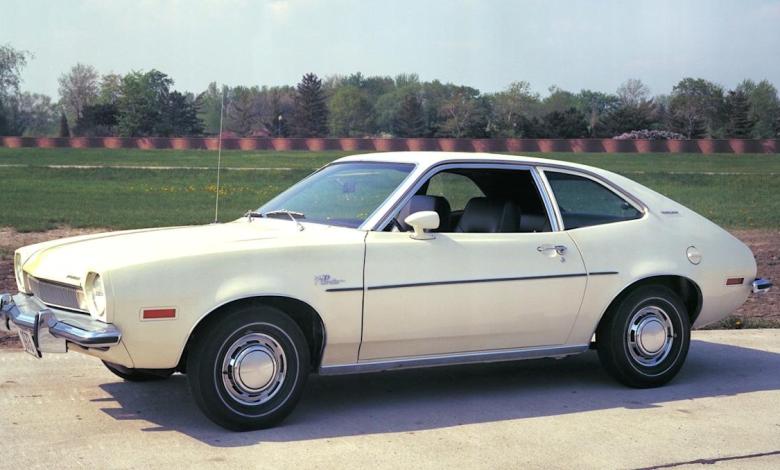
Image Credit: Vauxford – Own work, CC BY-SA 4.0/Wiki Commons.
The Ford Pinto represents one of the most controversial chapters in automotive history, combining commercial success with serious safety concerns. Over 3 million Pintos were produced during its ten-year run, with 1974 being the best sales year at 544,209 units.
The car was developed rapidly in just 25 months to compete with Japanese imports, but this rush to market had consequences. Due to insufficient structural reinforcement in the rear, the car was prone to fuel leakage and fires in rear-end collisions. The fuel tank was positioned directly behind the rear axle with minimal protection, making it vulnerable to puncture even in moderate-speed rear impacts. Once news of the fires reached headlines in the mid-1970s, sales tumbled by more than 50 percent to under 224,000 in 1975.
While the Pinto initially sold well, reliability issues and the fire controversy permanently damaged its reputation.
Cadillac Cimarron (1982-1988)

Image Credit: Greg Gjerdingen – CC BY 2.0/Wiki Commons.
The Cadillac Cimarron stands as one of the automotive industry’s most infamous examples of badge engineering gone wrong. Developed in just 10 months to compete with European luxury compacts, the Cimarron shared most of its design with the Chevrolet Cavalier.
First-year sales reached barely 26,000 units — one-third of projections — and by 1988, only 6,454 units were produced, with total sales around 132,000 over seven model years. The base engine was an underpowered 85-horsepower four-cylinder that felt painfully inadequate for a luxury car. Car & Driver recorded a 0-to-60 mph time of 13.7 seconds, whch is painfully slow. The 1986 Cimarron’s MSRP was $13,838, while the nearly identical Cavalier coupe with V6 cost just $7,316.
Even improvements like a V6 engine for 1985 couldn’t save it, and the Cimarron became a symbol of GM’s declining standards.
Chevrolet Vega (1971-1977)

Image Credit: MercurySable99 – Own work, CC BY-SA 4.0/Wiki Commons.
The Chevrolet Vega started with promise as GM’s answer to imported economy cars, but quickly became notorious for reliability problems. The aluminum-block engine suffered from numerous issue,s including overheating, warping, and excessive oil consumption.
Rust was another major problem, with bodies deteriorating rapidly even in moderate climates. The car used a unitized construction that was supposed to save weight, but quality control issues meant panels often didn’t align properly. Despite an attractive design and innovative engineering concepts, the Vega’s execution was deeply flawed. Owners reported frequent breakdowns and mounting repair bills that quickly exceeded the car’s value.
While GM sold over 2 million Vegas during its seven-year run, the damage to the company’s reputation for small cars lasted decades. MotorTrend called it General Motors’ worst car.
AMC Gremlin (1970-1978)

Image Credit: dave_7, CC BY-SA 2.0 / WikiCommons.
The AMC Gremlin is one of those cars where nostalgia goggles play a big role and to be fair, it earns some of that affection. Unlike the Yugo, the Gremlin wasn’t a hopeless disaster. It was cheap, easy to fix, reasonably durable when maintained, and it developed a real cult following. Plenty of owners still adore its funky personality, and many enthusiasts argue it was better than history suggests. They’re not wrong that it was an interesting American attempt to keep pace with the flood of imported subcompacts.
But nostalgia aside, the Gremlin had real shortcomings that kept it from becoming the small-car success AMC needed. The design was born from a cost-saving decision: AMC chopped a foot out of the Hornet’s wheelbase. That left the rear seat cramped, the weight distribution nose-heavy, and the handling compromised. The chopped-off rear end didn’t just look polarizing — it meant the Gremlin didn’t have a true hatch, only a small pop-up rear window that reduced cargo space and was prone to breakage.
Build quality varied, and many early cars suffered from carburetor troubles, electrical gremlins (appropriately named), rust, and steering that could feel vague and heavy. Features that were standard on foreign rivals were optional or unavailable, and as those rivals added front-wheel drive, five-speed manuals, better interiors, and more consistent reliability, the Gremlin quickly fell behind.
And yes — the Gremlin often gets unfairly piled on in “worst cars” lists. It sold reasonably well early on, it was affordable to own, and it brought new buyers into AMC showrooms. But judged purely on reliability, refinement, and competitiveness, the Gremlin wasn’t as strong as the cars it was meant to rival. It remains a quirky, lovable oddball — just not a well-executed one.
Chrysler TC by Maserati (1989-1991)

Image Credit: Mesatrooper – Own work, CC BY-SA 3.0/Wiki Commons.
The Chrysler TC by Maserati was an ill-fated attempt to create an Italian-American grand tourer that satisfied no one. Developed by Lee Iacocca and Alejandro De Tomaso, the TC was essentially a LeBaron redesigned by Maserati and assembled in Italy.
What killed it was a mix of poor styling, mundane performance, and expensive pricing, with critics noting it looked too similar to the far more affordable LeBaron GTC convertible. Chrysler sold only 7,300 TCs over three model years, with Bob Lutz later revealing the project cost Chrysler almost $600 million—about $80,000 per car produced. The car arrived years late to market, missing its intended window of opportunity.
By the time it appeared in showrooms, buyers could get similar performance from other Chrysler products for far less money, making the TC’s premium pricing impossible to justify.
Oldsmobile Diesel Engines (Various Models, 1978-1985)

Image Credit: order_242, CC BY-SA 2.0 / WikiMedia Commons.
While not a specific car model, Oldsmobile’s diesel engines deserve mention for damaging an entire category of vehicles and harming diesel’s reputation in America for decades. The diesel engines were based on gasoline engine blocks, meaning the head bolts weren’t strong enough for diesel operation, leading to notorious unreliability and poor performance.
These engines were installed in Oldsmobiles, Cadillacs, Buicks, and Chevrolets across GM’s lineup. The problems included head gasket failures, fuel injection pump failures, and general unreliability that left countless owners stranded. Cars equipped with these engines sold poorly as word spread about their problems. According to Popular Mechanics, the “unrelenting awfulness” of these diesels had perhaps the longest-reaching effect on consumer preference, with modern diesel skepticism partially traced to this failure.
GM’s decision to rush a diesel to market without proper engineering created problems that extended far beyond the vehicles themselves.
Subaru 360 (1968-1970)

Image Credit: TTTNIS, Public Domain Image/Wiki Commons.
The Subaru 360 holds the distinction of being one of the first Japanese imports to thoroughly fail in America. Consumer Reports tested the 360 and declared it “unacceptably hazardous,” noting it took 37.5 seconds to reach 60 mph and was dangerously deficient in a 30 mph crash test.
The magazine stated the bumpers were “virtually useless against anything more formidable than a watermelon” and ended the review by saying it “was a pleasure to squirm out of the car, slam the door and walk away”. The tiny two-cylinder microcar was imported by Malcolm Bricklin, who hoped its low weight would exempt it from safety regulations. After the scathing Consumer Reports review, imports ceased in 1970, and unsold 360s remained in stock for years.
Despite this disaster, Subaru of America persevered and eventually found success with better products.
Dodge Journey (2009-2020)

Image Credit: Stellantis.
The Dodge Journey represents a more recent example of a vehicle that struggled with reliability despite its practical packaging. The model has a weak engine, underwhelming handling, disappointing cabin quality with cheap plastics, and offers almost no advanced safety features beyond a rearview camera and rear parking sensors.
The 2009 model year accumulated nearly 1,600 complaints and eight recalls, with electrical problems being particularly widespread. Common issues included water leaks, engine overheating around 78,000 miles, head gasket problems, and transmission difficulties. While the Journey offered three-row seating at an affordable price point, the reliability problems meant frequent repair visits. The electrical system proved especially troublesome, with owners reporting everything from malfunctioning locks to complete electrical failures.
Why is it so hated? One driver answered: “It’s just low quality and low effort compared to a lot of its competitors, from a company that really should know better by now, but doesn’t care.”
By the time production ended in 2020, the Journey’s dated design and reliability reputation made it a tough sell.
Fiat 500L (2014-2020)

Image Credit: Sue Thatcher/Shutterstock.
The Fiat 500L took the charming 500 city car and stretched it into an awkward tall wagon that pleased few buyers. The 500L wagon hit the market with the 2014 model, and the 2020 model marked the end of its run.
The car suffered from numerous reliability complaints, particularly with the dual-clutch transmission that jerked and hesitated. Owners reported electrical gremlins, suspension problems, and build quality issues that seemed unacceptable for a modern vehicle. The turbocharged engine felt underpowered for the vehicle’s size, and the tall proportions created handling that felt ungainly. Interior materials felt cheap, and road noise was excessive. Consumer Reports gave it poor reliability ratings throughout its run. Sales in America were dismal, with most buyers preferring the original 500 or looking elsewhere entirely.
The 500L’s failure contributed to Fiat’s eventual exit from most of the American passenger car market.
Chrysler 200 (2011-2017, Second Generation 2015-2017)

Image Credit: Zoran Karapancev / Shutterstock.com
The Chrysler 200 midsize sedan faced significant reliability challenges despite decent styling. Common complaints included excessive oil consumption and transmission failure, with costly repairs and low owner satisfaction making it a poor choice.
The nine-speed automatic transmission in later models proved particularly problematic, with rough shifting and hesitation that software updates couldn’t fully resolve. Engine problems included stalling, oil leaks, and premature wear. Electrical issues plagued many examples, and the vehicle’s resale value plummeted quickly. Low resale values and frequent complaints about mechanical reliability were common problems.
Despite a complete redesign for 2015 that brought modern styling, the reliability problems persisted. Production ended in 2017 as Chrysler shifted focus to crossovers and SUVs, leaving 200 owners with vehicles that depreciated rapidly and required frequent repairs.
Conclusion

Image Credit:dave_7 from Lethbridge, Canada – 1987 Yugo GV Sport, CC BY 2.0/Wiki Commons.
These vehicles remind us that success in the automotive industry requires more than clever marketing or an attractive price point. Each of these cars failed because they prioritized speed to market, cost-cutting, or corporate politics over engineering excellence and customer satisfaction.
The Yugo proved that “cheapest” doesn’t mean “best value,” while the Pinto showed that rushing development creates consequences that last decades. The Cimarron demonstrated that badge engineering without substance fools no one, and Oldsmobile’s diesels proved that inadequate testing can poison an entire technology’s reputation. These failures taught valuable lessons that shaped better vehicles to come. Modern cars benefit from the mistakes made by these automotive cautionary tales, with improved safety standards, quality control, and engineering practices that came partly from learning what happens when manufacturers cut corners.
While these cars may have disappointed their owners, they helped create the more reliable and safer vehicles we drive today.