Trump Seeks To Justify Iran War, But Stated Objectives Shift

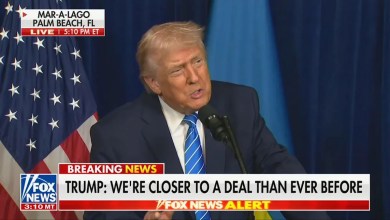
WASHINGTON, March 2 (Reuters) – U.S. President Donald Trump sought to justify a broad, open-ended war against Iran on Monday, offering his most comprehensive public comments yet on an operation whose stated aims and timeline have changed since it began over the weekend.
Trump, who is back in the White House after the weekend he spent in Florida, said that the US and Israeli air strikes, which started on Saturday, are expected to last four to five weeks, but could last longer. During the military operation, Supreme Leader Ayatollah Ali Khamenei was killed, at least 10 Iranian warships were sunk and more than 1,000 targets were hit.
“We’re already significantly ahead of our time estimates. But whatever the time is, that’s OK. Whatever happens,” Trump said at his first public event since the conflict began.
He made no mention of regime change, saying the fight was necessary to prevent Iran from developing nuclear weapons (which Tehran denies wanting) and its long-range ballistic missile program.
“An Iranian regime armed with long-range missiles and nuclear weapons would be an unacceptable threat to the American people as well as to the Middle East,” Trump said.
The remarks followed days of sometimes contradictory statements from the president, who discussed the attacks in two short videos and one-on-one interviews with prominent journalists over the weekend but did not address the nation on television as is customary during moments of military action.
White House Press Secretary Karoline Leavitt pushed back on suggestions that the administration’s messaging about the operation was confusing.
In X, Leavitt said Trump has set out “clear goals,” including preventing Iranian proxies from launching attacks and halting the production of roadside bombs like those used against U.S. forces after the 2003 invasion of Iraq.
DIFFERENT MESSAGES
In announcing the attacks, Trump on Saturday called on the Iranians to “take back your country” and hinted at a goal of regime change.
On Sunday, Trump told The Atlantic that he was open to talks with whoever would lead Iran, and he told the New York Times that his January operation to capture Venezuelan President Nicolas Maduro was a model for Iran’s future.
In the case of Venezuela, Maduro’s former ally Delcy Rodriguez emerged as the new leader and cooperated with Washington. In the case of Iran, Trump said, U.S. and Israeli attacks eliminated most of those who could step in to seize power.
The timeline for Trump’s Iran operation has also changed since its inception. He first told the Daily Mail it “could take four weeks or less,” then told the New York Times it could take four to five weeks. In separate statements on Sunday and Monday, he left open the possibility that the operation could continue for longer until its goals are met.
Trump did not provide a timeline in his notification to Congress regarding the Iran attacks obtained by Politico.
“While the United States desires a swift and lasting peace, it is not possible at this time to know the full scope and duration of military operations that may be necessary,” Trump wrote.
Jon Alterman of the Center for Strategic and International Studies, a State Department official focused on the Middle East, said Trump deliberately left the final outcome of the war unclear.
“I’m not sure they’re committed to a particular outcome,” Alterman said.
When Trump ordered a much more limited strike against Iran during Israel’s 12-day war in June, he immediately gave a formal speech flanked by senior officials. Following the Maduro operation, Trump held a press conference at his Mar-a-Lago club in Florida within hours, and officials appeared on television multiple times to explain the move.
This time, senior administration officials skipped the Sunday demonstrations to avoid conflicting narratives and keep Trump as the main anchor, a White House official said. The public framework of the operation is still being discussed, the official said.
A second official said top aides were in secure rooms all day attending national security meetings and coordinating with Republican lawmakers scheduled to appear on White House television shows. The official disputed suggestions that messaging was still being developed and said talking points had already been distributed by Saturday.
(Reporting by Nandita Bose, Humeyra Pamuk, Simon Lewis and Trevor Hunnicutt; Additional reporting by Ryan Patrick Jones and Steve Holland; Editing by David Ljunggren, Colleen Jenkins, Nia Williams and Michael Perry)