US pushes critical minerals trade bloc to counter China

US Vice President J.D. Vance has unveiled plans to steer allies into a preferential trading bloc for critical minerals as Washington steps up efforts to loosen China’s grip on materials vital to advanced manufacturing.
China has at times used its leverage over the processing of many minerals as geoeconomic leverage by restricting exports, suppressing prices and undermining other countries’ ability to diversify sources of materials used to make semiconductors, electric vehicles and advanced weapons.
“We want to eliminate the problem of people flooding our markets with cheap critical minerals to undercut our domestic manufacturers,” Vance told a meeting of visiting ministers in Washington, without mentioning China.
“We will establish reference prices for critical minerals at all stages of production… and for preferred zone members, these reference prices will operate as a protected floor through adjustable tariffs to maintain pricing integrity,” Vance said.
President Donald Trump’s administration has stepped up efforts to secure U.S. supplies of critical minerals after China shocked top officials and global markets by withholding rare earth elements needed by American automakers and other industrial producers in 2025.
Trump on Monday launched a US strategic critical mineral stockpile called Project Vault, backed by US$10 billion ($14 billion) in seed financing and US$2 billion ($2.9 billion) in private financing from the US Export-Import Bank.
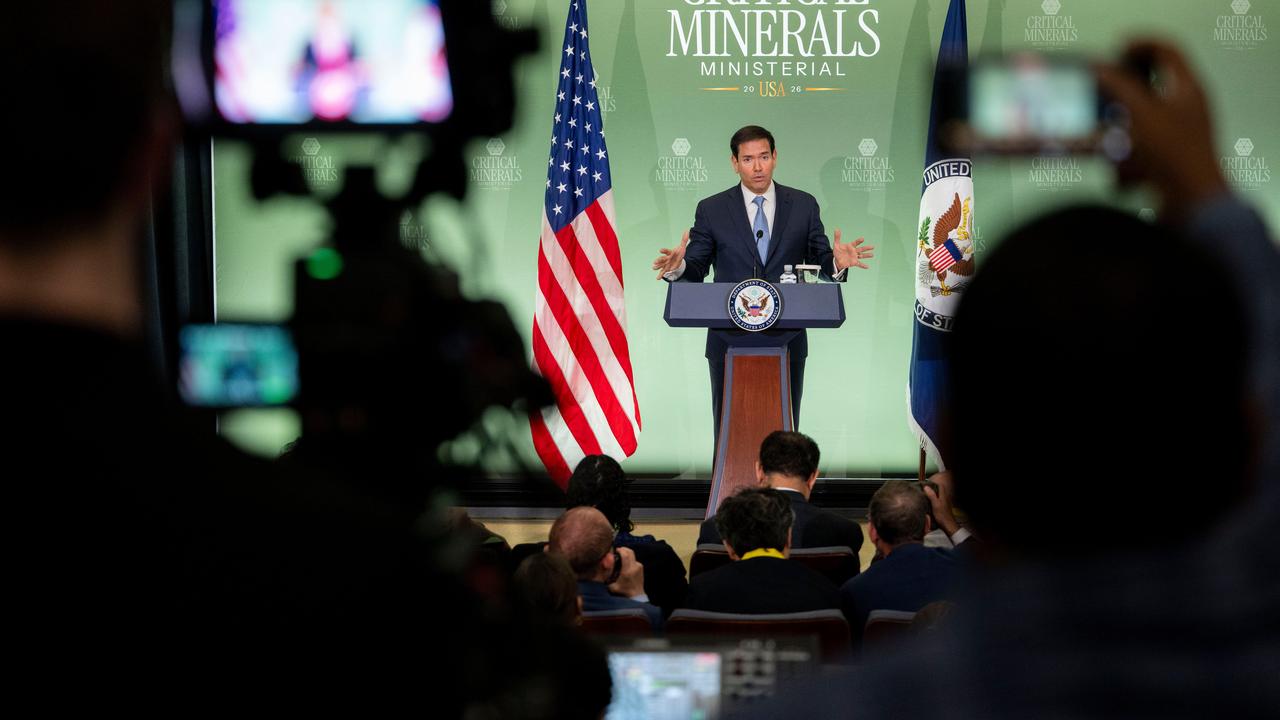
Secretary of State Marco Rubio said that 55 countries, including South Korea, India, Thailand, Japan, Germany, Australia and the Democratic Republic of Congo, participated in the talks in Washington with different refining or mining capabilities.
Without referring to China, Rubio said the mines are “largely concentrated in the hands of a single country,” adding that the situation has become “a tool of leverage in geopolitics.”
At the meeting held on Wednesday, local time, US Trade Representative Jamieson Greer announced a bilateral plan with Mexico and a tripartite agreement with the European Union and Japan to strengthen critical mineral supply chains and lay the groundwork for a broader agreement with other allies.
The plans aim to explore specific measures to stimulate production, such as price supports, market standards, subsidies and guaranteed purchases.
The US, EU and Japan also said they would pursue other avenues, including discussions within the Group of 7 and the Minerals Security Partnership.
The multi-country effort to set price floors for critical minerals is the Trump administration’s latest move to assert control over the private sector.
In addition to chipmaker Intel, the White House has also taken stakes in various mining companies and struck deals with drugmakers for lower prices.
By guaranteeing minimum prices through coordinated trade rules, Washington hopes to pave the way for private investment in mining and processing projects that have struggled to compete with cheaper Chinese supply.
The approach could reshape global supply chains for materials needed for electric vehicles, semiconductors and defense systems, while also increasing costs for manufacturers in the short term and escalating trade tensions with Beijing.
“China has long played an important and constructive role in keeping global industrial and critical minerals supply chains safe and stable, and is willing to continue making active efforts in this regard,” China’s embassy in Washington told Reuters when asked about the meeting. he said.

Australia’s Associated Press is the beating heart of Australian news. AAP is Australia’s only independent national news channel and has been providing accurate, reliable and fast-paced news content to the media industry, government and corporate sector for 85 years. We inform Australia.


