George Washington letter accepting British surrender to go on display for the first time in London

The letter signed by George Washington, accepting the surrender of the British and symbolizing the beginning of the end of the American War of Independence, is exhibited in London for the first time.
Written in October 1781, after the British defeat at Yorktown, Virginia, it is part of the exhibition ‘Revolution 250: The Story of American Independence, 1763–1783’ at the National Archives at Kew.
The document opened negotiations for the 1783 Treaty of Paris, in which Britain formally recognized the independence of the United States. The letter, given to British Lieutenant-General Charles Cornwallis, remained at his home at Audley End in Essex until it was lodged with the Public Record Office in 1880.
Curator of Revolution 250, Dr. Sean Cunningham said: “For such a short, concise and to the point message, this memo has tremendous implications for future generations.
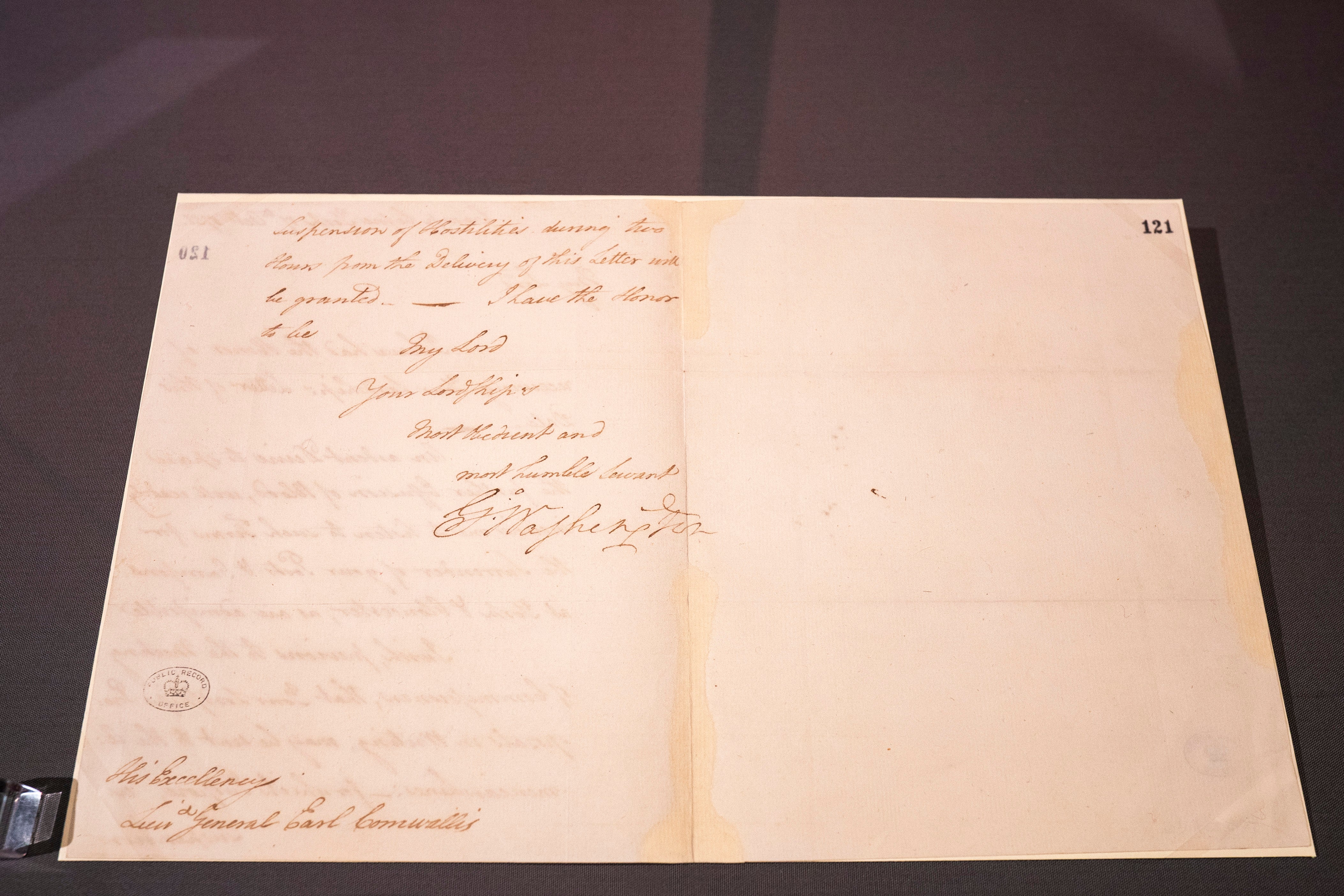
“This is the moment when the British realized they would have to give up the 13 colonies that would become the United States of America; the moment when Britain finally accepted the reality of the declaration of independence drafted five years earlier.
“Seeing Washington accept Britain’s surrender up close is a powerful encounter, a turning point in history.
“But we also highlight voices and perspectives that challenge familiar narratives and show how deeply contested and consequential this conflict really is.”
The exhibition will trace the birth of the United States through documents from both sides of the Atlantic.
Highlights include the Stamp Act and the Tea Act, which fueled unrest in the American colonies, as well as accounts of the Boston Tea Party protest and a copy of the Declaration of Independence.
In April, the State Department said it was preparing a limited release of commemorative U.S. passports celebrating America’s 250th birthday featuring a photo of President Donald Trump, who would be the first living president to appear on a travel document.
The concept of a special passport featuring Trump’s stern-looking face was considered for months before it was finally approved late Monday.
Passports will initially be issued only to applicants at the Washington DC passport office and only upon request. Authorities said that applicants who do not want a souvenir passport can choose a standard passport.
“These passports will feature customized artwork and enhanced imagery while retaining the same security features that make the U.S. passport the most secure documents in the world,” State Department spokesman Tommy Pigott said.


