Inside Dinnergate and the ABC’s stoush with Peter Costello
The federal election of November 2007 was greatly anticipated. After the long years of the Howard government, there was a mood for change. Kevin Rudd was successfully presenting himself as a safe alternative to an increasingly tired-looking Howard. Within the ABC, the likely change of government had a particular significance, not least because its relationship with Peter Costello, Howard’s likely successor, was increasingly toxic. There was an expectation — unsupported by any firm commitments — that Labor would be kinder to the ABC than the Howard government had been.
The determining election issue, however, was industrial relations. Howard had introduced WorkChoices legislation, reducing workers’ rights with the aim of increasing employment and economic performance. Rudd had promised to abolish the changes, and the Australian Council of Trade Unions was campaigning hard on “Your Rights at Work”.
In this context, the ABC scheduled Bastard Boys, a miniseries about one of the most divisive industrial events in Australia’s history, the waterfront dispute of 1998. Patrick Corporation, headed by Chris Corrigan, had sacked its 1,400 waterfront workers and replaced them with non-union workers. It quickly became clear that the government had played a role in preparing the ground for the dispute.
It had been a tumultuous time — picket lines on the docksides, mass protests, High Court challenges and constant headlines. Now, with an election just months away, Bastard Boys could hardly be more provocative. Liberal senator Concetta Fierravanti-Wells described it as “another example of wasteful spending by the ABC being used to drive an anti-government, pro-Left agenda, conveniently timed to appear during an election year”.
Promotions for Bastard Boys began just days before what was to be the last budget of the Howard government. The ABC had hopes for that budget. Scott, after months of lobbying, had been led to expect funding for a new digital television channel for children. But when the budget was brought down on May 8, there was little in it for the ABC. The rumour within the ABC was that Costello saw the promotions for Bastard Boys as the budget papers were about to go to print and was so upset that he ripped out the children’s channel funding.
Others who were close to the process say that the main reason the funding was not announced in the budget was that Howard wanted to save the announcement for the election campaign. But there is no doubt Costello was furious about Bastard Boys, as was the rest of the government. Howard described it as “one of the most lopsided pieces of political propaganda I’ve seen on the national broadcaster in years”. Whatever Costello’s views, Howard remained committed to the children’s channel. He and communications minister Helen Coonan announced funding for the idea in November 2007, in the dying days of the election campaign.
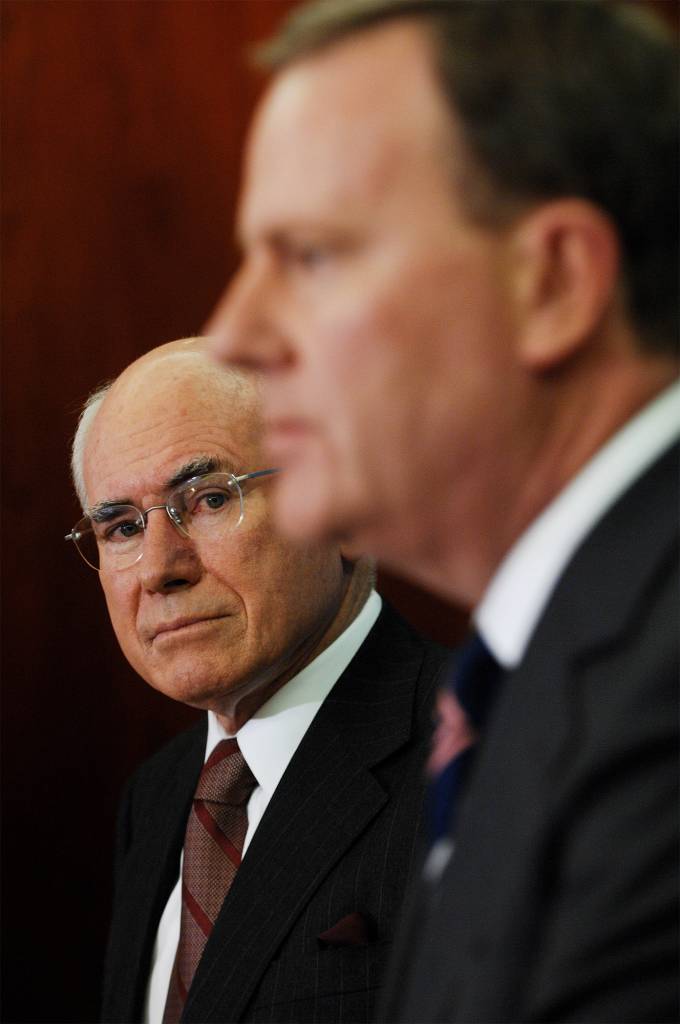
The anger over Bastard Boys had not subsided when, in August 2007, another controversy placed the ABC directly in Costello’s firing line. It became known as Dinnergate. The story had started years before, in June 2005, when there was constant speculation that Costello would challenge Howard for the prime ministership. Costello went to dinner with three senior political journalists — Paul Daley and Tony Wright from The Bulletin, and Michael Brissenden, political editor of 7.30 Report. All three journalists believed the discussion they had with Costello was “on background”.
As the affair was to reveal, although dealing with confidential sources is central to journalism, terms such as “on background” and “off the record” are rarely explicitly defined. There is confusion even within the profession about their meanings. However, in the Canberra press gallery, “on background” usually meant that the substance of the conversation could be reported but the source not disclosed. “Off the record”, on the other hand, meant the information must not be used at all. An off-the-record conversation might steer the journalist’s research in fresh directions, but it could not be acknowledged to have happened.
What Costello said over dinner was a hell of a story. He said he believed Howard could not win the 2007 election. If Howard did not agree to retire, Costello would challenge for the leadership. He did not expect to succeed immediately, but he would go to the backbench, where he would build the numbers for another challenge, which he expected to win.
Had Costello’s words been published at the time, it would likely have triggered a political storm, making it hard for him not to follow through with a challenge. Australian political history might have been different — although there are good reasons to suspect that Costello would never have had the numbers to succeed.
All three reporters intended to write the story without naming Costello. They claim that Costello told them to “write what you like”, and his media adviser, who was at the dinner, said nothing that night to suggest they were not free to do so.
All that changed the next day, when Costello’s media adviser rang the journalists, claiming that the conversation had been off the record. The journalists conferred with each other, and Brissenden discussed the decision with Kerry O’Brien, anchor of 7.30 Report. Brissenden thought he was entitled to publish the story as intended. O’Brien reflected later in his memoir that it was “a complicated issue”, and that “as the man on the spot who would have to live with the decision, it was [Brissenden’s] call to make”.
The journalists decided not to publish. Costello did not challenge, and Howard remained prime minister. Australian voters were none the wiser.
Related Article Block Placeholder
Article ID: 1269329
But the issue festered, not least because over the months that followed, it became clear that Costello was saying similar things to other reporters. Paul Daley eventually referred to the conversation, without attribution, in a piece published in 2006. Then, in August 2007, Daley reported that Costello had said the words: “[Howard] can’t win. I can. We can, but he can’t.” He attributed this revelation to “confidants” of Costello. Asked about the article, Costello poured scorn on Daley. He said he didn’t know where The Bulletin had got it from, but “certainly not from me”.
Costello’s denial was false, and the three journalists were prepared to attest to it. They decided to publish. The key issue was not the enmity between Costello and Howard, since that was well known by this time. It was the significance of Costello’s “calculated lie”, as O’Brien puts it, “casting doubt on his character as a potential future prime minister”.
That night, Brissenden went to air with the story. In the context of an election, with the government trying to appear unified, it was dynamite. As election day approached, leadership stories continued on almost a daily basis. By early September, Howard was asking Alexander Downer to sound out their cabinet colleagues to see if they thought he should step down. Most of them did, but they also thought it was too close to the election, and they were not prepared to force him out against his will.
Meanwhile, the journalists’ decision to publish had set off a firestorm. Although The Age had also published the story, the fury was concentrated on the ABC. Costello was ringing Mark Scott and at least two members of the ABC board. All of the board except for Scott thought the breach of confidentiality was unforgivable. Scott understood that the off-the-record convention was a fundamental principle of the press gallery. He could see both sides — including the view that it was not in the public interest for Costello to get away with a lie. Now he had to defend Brissenden in particular.
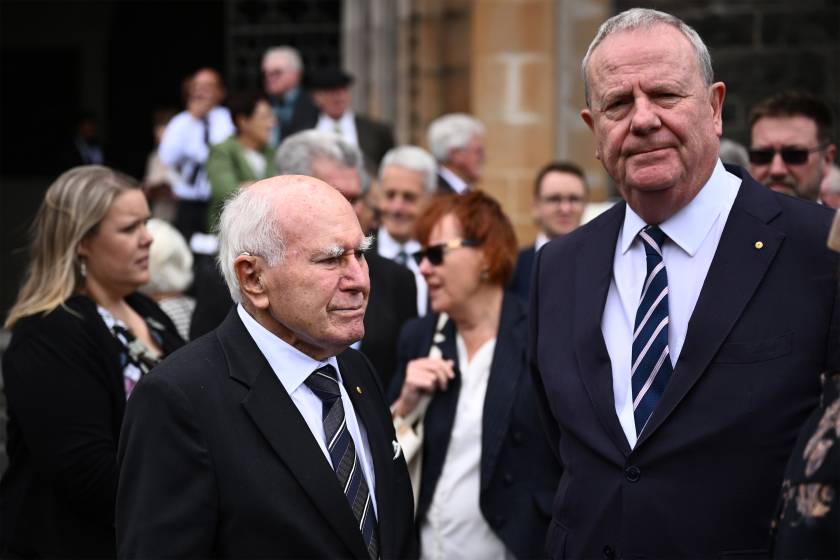
The pressure on Scott was intense. Newman recalls that Scott argued before the board that the ABC could not sanction their chief political reporter during an election year without causing significant problems. Brissenden would inevitably be backed by O’Brien and the rest of the news division. It would cause a massive controversy. Frustrated, Newman waited until after the election and then raised the matter again. Skala and Newman did not let the issue go. Every time Brissenden’s name came up, for years afterwards, there would be questions about why he still worked for the ABC.
Brissenden knew Costello and his allies were putting pressure on the ABC. He knew Costello was ringing board members. He had one discussion with Costello himself. “He made it pretty clear that … he was very upset by what happened. I made it very clear that I was very upset by the way he handled it.” In Brissenden’s view, it was a “huge crisis” for the ABC because the government had bullied the public broadcaster, and not the other news organistions involved.
Partly to manage the pressure and partly because he thought the principles involved needed clarification, Scott referred the issue of confidential sources to Chadwick for review. Chadwick was not required to pronounce on whether Brissenden had done the right thing, but he probed the general implications of the ABC making a binding promise to keep a source confidential, and of breaking such a promise.
In his report, he pointed out that every time a journalist chose to keep the identity of a source confidential, they compromised their commitment to truth-telling by omitting relevant information — the identity of their source. “The implications — ethical and legal — are such that, in my view, no such promise should be made or broken without the relevant staff first referring upward the decision to a level of executive responsibility commensurate with the seriousness of the decision.”
Chadwick said that confidential conversations that formed the basis of a report should be upwardly referred before broadcast or publication.
7.30 Report had not upwardly referred the decision beyond O’Brien and Hawke. O’Brien, in comments provided, said that he and Hawke were the appropriate people to make the decision, and he would have been “surprised and deeply disturbed” if either Scott or Cameron had wanted to overrule it. This issue was a constant at the ABC. Journalists saw the appropriate level for upward referral as being within their own programming units. More senior management was sometimes regarded with suspicion.
Related Article Block Placeholder
Article ID: 1265938
Chadwick’s report led to a new editorial policy that still exists. It mandates that if the ABC proposes to broadcast a report based on information from a source who has been promised confidentiality, an “appropriately senior ABC person” must approve it in advance. Journalists can have off-the-record and on-background conversations without seeking such approval, but any report based on them, and any decision to break confidentiality, must be approved.
In retrospect, both Brissenden and O’Brien believe that their mistake was agreeing not to publish details of the conversation in the first place, back in 2005. Having made that initial mistake, there was no good way out.
Scott says that at the height of the controversy, just months before the 2007 election, he took a call from Costello. He recalls: “Costello was furious. Absolutely furious … He said to me that he would watch very carefully what happened as a consequence of this to Brissenden. And he would keep that in mind next time Maurice Newman and I came and asked him for money for the ABC.”
Scott did not argue with him: “He was venting. I just let him vent. But I think it was about the only time in my experience that a politician directly linked funding to unhappiness over editorial content. There were other politicians who would joke about cutting us, but it was just banter. There was no doubt in my mind, Costello was serious.”
Scott says nothing ever came of this conversation. Within months the Howard government lost office and Costello left politics.
Costello declined to be interviewed, and did not respond to an email seeking his response to this specific allegation.
This is an extract from Going Digital: The Transformation of the ABC by Margaret Simons (La Trobe University Press, $39.99, out 3 November)


