Inside the Herzog protest inquiry police wanted kept secret
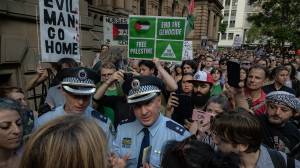
Thousands gathered at Sydney Town Hall on February 9 to protest Israeli President Isaac Herzog’s visit to Australia in the wake of the Bondi terrorist attack. The protesters, who pointed to accusations against Herzog of inciting genocide in Gaza, intended to march to parliament. Police stood in their way.
The footage that emerged showed officers punching protesters, pepper-spraying crowds and dragging away Muslim worshippers while they prayed. NSW Premier Chris Minns and Police Commissioner Mal Lanyon defended the operation. The images, the public was told, did not tell the whole story.
About 30 protesters were charged with offences including assaulting, resisting and hindering police. At least 11 people have since had their charges withdrawn. The protest restriction law introduced after Bondi was later struck down as unconstitutional, although police maintain that separate major-event powers applied.
Four days after the protest and following a flood of complaints against police, the Law Enforcement Conduct Commission (LECC) announced an investigation. When its hearings opened in October, the independent head of the LECC inquiry offered an account at odds with the initial official defence by police, with the evidence reviewed suggesting protesters were largely peaceful in the early stages, with limited physical violence on their part.
Much of the evidence would be heard out of public view. Commissioner Lanyon had sought entirely private hearings, securing five weeks of closed examinations, with police witnesses up to and including inspector rank granted pseudonyms. Senior commissioned officers are to give evidence publicly.
Protesters facing charges have been fighting for camera footage that captured what occurred behind the scenes: what police planned, what officers were told and what passed between police and government.
That fight continued at the Downing Centre Local Court on Friday. Commissioner Lanyon had already lost his bid to block access to categories of material, including drone footage, police operational documents and communications involving government and police, as he claimed they would not assist the defence. He was now seeking to withhold some material on public interest grounds.
‘Deeply concerning’
Though the exchanges in court were civil, the events behind them were not. For some of the defendants in attendance, it was clear February 9 remained a painful memory.
Among them was Jace Turner. In person, I was struck by his slight frame — I had watched footage, seen below, of officers holding him on the ground and punching him repeatedly.
Now he was in the courtroom, facing a charge of assaulting police, specifically biting an officer’s hand during their alleged assault of him. When I spoke to him after the hearing, Turner described an anxiety that has outlasted his bruises; a subsequent police visit to his home for a welfare check had triggered an anxiety attack.
“At least 20,” was the number Turner gave me when I asked him how many times he estimates an officer punched him in the head while another pinned him down.
He told me he is autistic. With his autism affecting his speech, I wondered what officers had recognised of his vulnerability and how it had informed their response.
“It is deeply concerning that such a degree of force was used against anyone as vulnerable as Jace,” said Imogen Yang of Legal Observers NSW, who also attended Friday’s hearing.
The consequences for the protesters facing charges extend well beyond the courtroom. One protester, speaking anonymously, described an enduring sense of trauma compounded by the belief that officers had escaped accountability.
“The vicious, police-inflicted violence and the repercussions occurring as a result has changed my life irrevocably,” they said.
Their statement also described the distress of witnessing officers apparently taking pleasure in violence against protesters. Separate body-worn camera footage captures an officer boasting: “I f**king pumped that c***.”
“Then I punched him in the head when he was down,” he says. A female officer laughs and responds: “I saw that.”
NSW Police has previously declined to comment on that footage, citing the ongoing LECC investigation.
‘It’s pretty much impacted like every area of my life’
For Siena Hopper, the records being sought could offer something beyond evidence for her defence: an explanation.
The 26-year-old law student and paralegal attended the February 9 rally after work. She had been attending pro-Palestine demonstrations for about five years and described a consistently peaceful experience: speeches, a march and people dispersing.
“Usually you see quite a few prams, even,” she told me, describing gatherings attended by children, elderly people and families.
The February 9 protests against Herzog’s visit were different, she said: the evening became a succession of confusing directions, blocked exits, and encounters with police that left people frightened and struggling to leave.
“I don’t recall seeing anyone be violent in the crowd,” she said. “But I have a very vivid memory of seeing someone getting pulled from the crowd by their neck by police officers while it was still daylight.”
As police directed people through the streets, Hopper said she struggled to work out where she could go.
“I remember myself switching directions, probably three to five times, because we didn’t actually know where we were supposed to be going,” she said.
Around her, people sought medical help after being pepper-sprayed, while fellow protesters used water bottles to flush their eyes. As police pushed the crowd, she said, attendees tried to stop people falling onto those ahead of them.
Hopper was later arrested. She said three male officers tackled her to the ground, even as her sister screamed that she had a disability and a chronic health condition. Siena Hopper is 5ft 6in. With her arm caught in her handbag strap beneath her, she alleges officers continued to yank it until a female officer finally intervened.
An Instagram video shared by @stand4palestineaus showing Siena Hopper being restrained by police on February 9 during the protests against Israeli President Isaac Herzog’s visit to Australia (Video: Supplied)
At Surry Hills police station, Hopper alleges her requests for medical assistance went unanswered. Released at about 1am, she visited her GP later that morning and was directed to an emergency department. She has pleaded not guilty to a charge of assaulting a police officer and is awaiting the hearing scheduled for July next year.
The uncertainty about the court proceedings has impacted her plans for a legal career. Nearing the end of her studies, she worries about what they could mean for her admission to practice.
“It’s pretty much impacted like every area of my life, I’d say.”
There is another disparity she finds difficult to accept: who has been publicly identified, and who has been afforded protection. Hopper said her name, age and where she lives, along with the details of other people arrested, appeared in the media online within 24 hours. She described the experience as being doxed, and does not know how the information became public.
“We haven’t been afforded privacy, even though we’re private citizens,” she said. “The people who are supposedly public servants are the ones getting to remain anonymous.”
Hopper also wants answers about the police operation. “Having some sort of understanding with the situation would, I think, definitely help a lot of people process it, and hopefully lead to some accountability,” she said.
For Yang, the concerns extend beyond any one arrest.
“The evidence we’ve seen in the courtroom in recent weeks raises serious questions about police judgment, restraint and proportionality,” she said.
“From the hundreds of complaints made by members of the public, we know these are not isolated incidents affecting women, disabled people, and the elderly and frail on February 9.”
‘Stalling tactics’
The hearing I attended concerned a tranche of records currently sought by lawyers for 17 defendants whose cases are being heard together. They wanted to establish how the operation was planned, what officers were told and what passed between police and government.
Commissioner Lanyon had tried to block access to disputed categories of records, arguing they would not help the defence. The court rejected that argument on October 19, and Friday’s hearing considered his remaining claims that some material should be withheld to protect sensitive police information.
Watching counsel for Lanyon, I had the impression of a man both on edge and on the back foot. As defence lawyers pressed for the records, he sought further instructions and more time.
Related Article Block Placeholder
Article ID: 1239864
“Stalling tactics,” someone murmured behind me.
The defence opposed another adjournment. The magistrate wanted documents produced.
When I spoke to solicitor Nick Hanna afterwards, his account of what followed carried a note of amusement: “They then miraculously were able to turn around and actually produce most of the documents that we’d asked for,” he said.
By the end of the day, Hanna said, police had also agreed to provide almost everything else the defence wanted. According to Hanna, this included communications between government and police, drone footage and the manual governing officers’ use of body-worn cameras.
For several charges, prosecutors must establish that officers were acting in the execution of their duty. The defence argues the records could help establish unlawful police conduct and undermine the cases against Hanna’s clients.
That argument remains untested. Hanna had only just received the documents when we spoke and had not yet reviewed their contents. He also said restrictions governing their use prevented him from disclosing specifics.
‘The police just kettled us’
Former Greens candidate Hannah Thomas, who is not a defendant in this case and did not attend Friday’s hearing, went to the February 9 protest carrying saline, first-aid supplies and safety goggles.
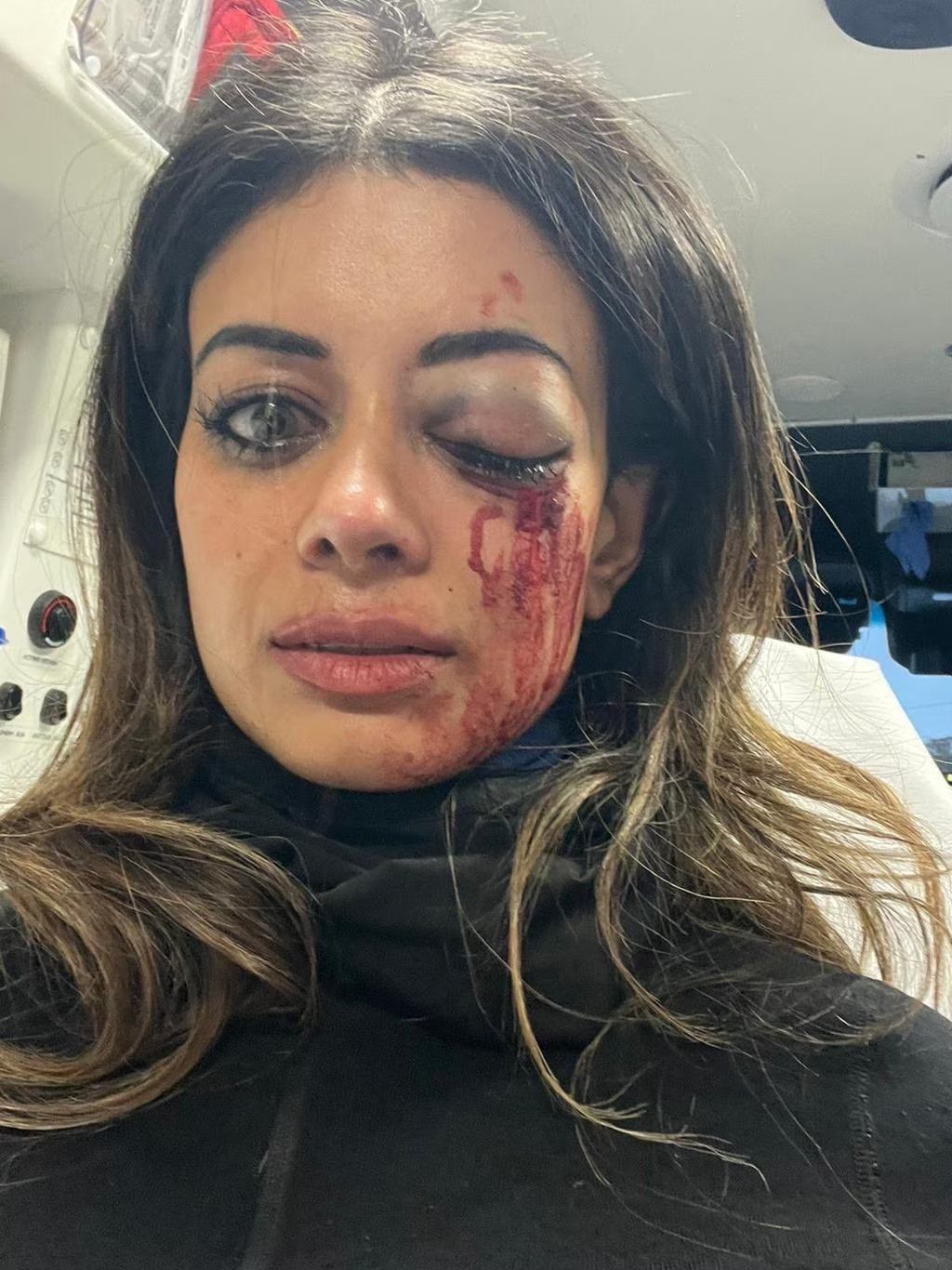
Thomas suffered a serious eye injury during her arrest at a separate pro-Palestine protest outside SEC Plating in Belmore in June last year. The charges against her were later dropped, and an officer was charged over the incident. In her civil case, the state has since admitted that an officer punched the 5ft 1in Thomas in the eye while holding a police torch.
Thomas did not want to discuss the current state of her injury while awaiting further expert reports. But she knew what it meant to need help at a protest, and wanted to provide it to others.
“I’ve experienced how much it helps when people are around to do that,” she told me.
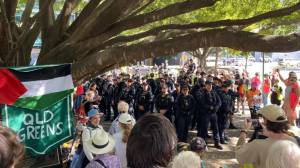
At the Herzog protest, she described a “pressure cooker environment” as the crowd waited and Greens MPs negotiated with police over whether a march could proceed.
“When there was an attempted march, the police just kettled us; they rode horses into us,” she said. “We were all just inhaling so much OC spray.”
Thomas said she tried to help people affected by the spray, wearing safety goggles to protect her injured eye.
When police charged down the street, Thomas said, she and about nine others sought refuge inside a 7-Eleven. The person running the store locked the door and refused a riot officer’s request to open it. Inside, the group administered first aid while, Thomas said, the officer and a colleague watched in a manner she described as “menacing”.
“It felt like they were at war with us,” she said.
After an officer was charged over her own injury, Thomas had hoped the scrutiny would deter further police violence. Instead, she believes the Bondi attack and the Minns government’s response emboldened officers. She accused the government of falsely linking the pro-Palestine movement to the attack.
“I thought it would have a deterrent effect on police violence, but that has definitely ended,” she said. “They feel emboldened.”
She described the night as traumatic, but said withdrawing from protest would carry its own cost.
“It’s really important that it doesn’t stop us from turning out.”
‘We’re giving them more weapons’
On Sunday, two days after I watched lawyers argue over access to the records of one police operation, NSW Police launched another: the Armed Response Command.
Its officers will carry rifles and patrol crowded public spaces, major events and places of worship. Established after the Bondi terrorist attack, the command is intended to deter threats and respond rapidly to armed offenders. Police describe its purpose as preserving life.
Related Article Block Placeholder
Article ID: 1248465
Whether those officers will appear at protests is less settled. In October, Commissioner Lanyon indicated he did not envisage it. On Sunday, NSW Police Minister Yasmin Catley would not rule it out and rejected calls for regulations defining deployment. Commander Andrew Evans has also left open the possibility of rifle-carrying officers being stationed nearby if intelligence identifies an armed threat.
There is a gulf between protecting a gathering and policing it — who decides when one becomes the other? At the Downing Centre, defendants were still seeking the instructions behind what had happened to them in February. They now have much of that material. The LECC investigation continues. Neither process has yet supplied the answers they want.
When I asked Thomas about the new command, her answer was blunt.
“Instead of trying to rein them in, we’re giving them more weapons,” she said.
The government is asking the public to trust police judgment. In the courtroom, and in the conversations that followed, I met people still living with its consequences.


