Ohio House child care bills take aim at fraud, providers say state is solving for lack of a problem
Child care providers and local officials have cited challenges posed by two Ohio House bills focused on how to investigate allegations of child care fraud and monitor attendance at individual child care centers.
Ohio House Bill 647 and House Bill 649 were introduced by Republican co-sponsors in response to allegations of child care fraud made by a right-wing social media influencer in Minnesota, which made national headlines and led the Trump administration to freeze federal child care funding for that state and other Democratically run states.
Ohio officials and child care providers have also stood behind their system, but four lawmakers agreed to introduce bills that would change the primary authority in child care fraud investigations and propose new methods to verify children’s attendance at facilities that accept state funds for Publicly Funded Child Care. HB 649 raised concerns from lawmakers and child care providers when it included a provision requiring photos of children entering facilities rather than parents or guardians.
“I am completely opposed to facial recognition or photographing children,” said Karen Lampe, owner and operator of a child care facility, who also spoke on behalf of the Ohio Child Care Providers Association. “There’s a privacy issue there.”
SUBSCRIBE: GET MORNING HEADLINES DELIVERED TO YOUR INBOX
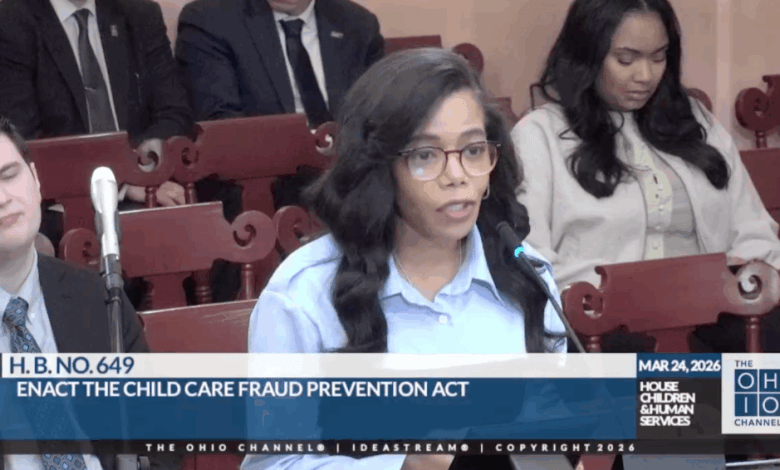
At the March 24 committee hearing, an amendment was added to the bill that prohibits the storage of photos or videos taken at facilities and only allows images of the facility and those checking in from devices specifically provided by the Ohio Department of Children and Youth.
State Rep. Gary Click, R-Vickery, said during the committee hearing: “I don’t think there is broad support for (child photography or videography) to remain in the bill.”
Lampe and other child care providers also told the committee that HB 647’s provisions limiting “retroactive check-in” — allowing a child to retroactively check in for a day on which the check-in was missed — could cause problems and more administrative hurdles for providers. The legislation would shorten the current period for recording a child’s absence from 30 days to seven days.
“While providers fully support accountability and timely documentation, this change is operationally unfeasible and would inadvertently harm families, providers, and the system it is intended to strengthen,” Lampe said.
Child care providers already have a system in place to remind parents to check in on their children and staff specifically tasked with contacting parents who have not yet added previous attendance records.
The process can be challenging even on the day of check-in, especially for those with more than one child and facilities with a limited number of electronic check-in stations. According to Lampe, the measures in HB 647 will only add to delays at the start of the day for parents with other issues.
“This is the reality of letting go and taking,” Lampe said. “My mom is late for work, she has three kids, one kid is screaming, the other kid is having a tantrum. There’s someone else standing at the (check-in) machine, she’s taking the kids to class, she goes out, there’s someone else standing by the tap machine, she has to go to work, she’s gone. That’s the problem.”
As for HB 649, Franklin County Commissioner Erica Crawley came to the committee to speak, following comments specifically mentioning Franklin County at a previous hearing on the bill.
Franklin County District Attorney Shayla Favor spoke at the previous committee meeting; Here, Click talked about accusations he heard that commissioners were delaying the child care fraud investigation. Favor denied the allegations, saying commissioners had no role in such investigations, and Crawley also defended commissioners.
“Despite allegations made before this committee last week, the Franklin County Board of Commissioners and its agencies have no role in investigating these centers, and we have not intervened in such investigations,” Crawley said.
The commissioner is also a former state legislator who said she worked on child care issues during her time as a state representative and tried to improve the system statewide. “We haven’t really moved the needle” in his time and since, he said, and said the questions the legislature asks about child care should center around making that care more affordable and accessible and supporting providers who are “the workforce behind the workforce.”
“This is not a fraud issue, this is not an education issue, this is an economic infrastructure issue,” Crawley said. “We know that if child care providers continue to close, at the end of the day our economy will collapse.”
Child care facility leaders who attended the March 24 hearing also expressed concern about the potential closure of facilities in a state already struggling with child care “deserts.”
“If we continue to carry more and more burden on this system, we may have to consider some programs that are not serving students (Publicly Funded Child Care) just because of the amount of work that would go into it.”
Most Ohioans who spoke about the two bills said the measures seek to create a solution without a problem to be solved.
“Ohio already operates one of the strongest and most advanced child care fraud detection systems in the country,” Lampe said. “We believe that if improvements need to be made to this system, it is adjustments to this already robust system, not an atomic bomb on low-income families and the fragile provider system that serves them.”