The gavel over Gulmarg’s hotels

The cool weather has already started in Gulmarg, a tourist center that is one of the winter wonders of India, located 2500 meters above sea level. Located in the Baramulla district of north Kashmir, the green tabletop meadow is spread over an area of three square kilometres, with the majestic peaks and slopes of the Pir Panjal range of the Himalayas to the west and the vast expanse of Srinagar and its surrounding mountain peaks to the east.
Lupines and hollyhocks are beginning to fade at the two-story Nedous Hotel, the first inn on the meadow. The 137-year-old chalet, with a façade made of well-crafted deodar tree bark, has been sealed with a white tape and official stamp since August 2 this year.
The hotel was the first rental structure to be taken over by the Gulmarg Development Authority (GDA) from the Nedous, the first hotelier family. GDA officials said Nedous’ lease expired in 1985 and the family did not renew it. In 2015, the J&K High Court rejected the renewal petition. This year, the GDA declared the Nedous family as “unauthorised occupants under the J&K Public Premises (Eviction of Unauthorized Occupants) Act, 1988”. However, many local hoteliers regret this decision and fear for their future. There is no privately owned land in Gulmarg; It all belongs to the state.
The winter sports destination will witness its first auction of existing hotels after J&K Lieutenant Governor Manoj Sinha implements the J&K Land Grant Rules in 2022, replacing the 1960 J&K Land Grant Rules. It angered local hoteliers. “There is no manufacturing industry in Kashmir. The hotel industry has created a strong upper-middle class here,” says Amjad Khan (name changed). He is one of 10 hoteliers who have challenged the rules before the J&K High Court on the grounds that they are “discriminatory”.
Abdul Ahad Bakshi, owner of the now popular Bakshi Restaurant in Gulmarg, says, “It hurts my heart to see the Nedous Hotel sealed. Until the 1970s, there was no hotel in Gulmarg other than the Nedous. I worked at the bar of the Hotel Highlands Park, which was then a part of the Hotel Nedous. Kashmir’s tourism industry owes everything to Nedous.”
As the Gulmarg lease case reaches its final stage and goes to hearing on October 27, the future of 52 buildings, including 32 hotels and 20 cottages spread over an area of 38 acres, will be redetermined. Of the 2,300 beds in Gulmarg, the rental property has 614 rooms or 1,200 beds. Around 2,000 staff and service providers are expected to be affected by the auction, as the government has no proposal to retain them. “If the elected government does not intervene and ensure that leases are not canceled on this scale, staffing is doomed to disaster,” says Bakshi.
Gulmarg hotels, many of which can be auctioned. | Photo Credit: Imran Nissar
Establishment of tourism in Gulmarg
Bakshi witnesses the transformation of Gulmarg in his late 70s. He has vivid memories of serving former Prime Minister Indira Gandhi and her family. “Mrs Gandhi often traveled to Gulmarg and had last visited with her family, including Rahul and Priyanka, in 1983. They would always stay in Nedous. I had the privilege of feeding the young Gandhis during their stay. Mrs Gandhi enjoyed visiting local temples and always followed local customs when she entered,” he says.
He says Gulmarg opened its doors to new hoteliers in 1908. “The then government wanted the locals to invest in Gulmarg and it became a part of Kashmir’s tourism story. Gulmarg today feeds people from three nearby districts by employing young and old as sled drivers, skiers and guides from Baramulla, Sangrama and Tangmarg,” says Baskshi.
In 1888, European Michael Adam Nedou chanced upon the meadows of Gulmarg. Under the instructions of the then Dogra rulers, Nedou established the first hotel catering to Europeans and royalty. This was Nedou’s second property after he built the Nedous Hotel in Lahore in the 1870s.
“We were the pioneers of tourism in Jammu and Kashmir. Thanks to Nedous, the tourism industry boomed and emerged on the global stage. It took some effort to ensure that the structure retained the heritage look and feel passed down to us from our great-grandfather,” says Aqil Nedou, who works as operations and sales manager at the hotel.
“Why was our hotel targeted first?” says Nedou, who is related to the Abdullah family that leads the ruling National Conference (NC). Neudo’s eldest son, Harry Nedou, married Mir Jaan, a Rajput Gujjar woman from Gulmarg. Their daughter Akbar Jahan later married NC founder Sheikh Muhammad Abdullah.
At that time, tourists started traveling to Gulmarg on horseback. St. Mary’s Church was built in 1902 and as more local tourists started arriving, Mohinishwar Shivalaya Shiv Mandir came along in 1915 during the reign of Dogra ruler Maharaja Hari Singh. All three structures (Nedous Hotel, church and temple) are located on three plateaus within a bowl-shaped meadow surrounded by pine and deodar trees.
Abdul Rehman Mir, in his late 70s from Baramulla’s Khawar area, joined the hotel in 1973 as a room service attendant. “I have five daughters and a sick wife. They all depended on my salary, which was safe until the police came and sealed the hotel. I have no memories other than the corridors of the hotel. I am currently unemployed,” says Mir.
Sheikh Amin, 48, a resident of Baramulla’s Sultanpora, was working as the manager of the hotel. His daily routine of traveling from his humble village to this luxury hotel also came to an end after 17 years. “The evacuation came suddenly. We had a staff of 55 people. They were all laid off at once, without any notice,” says Amin. The hotel’s visitor log is still full of praise for Amin and his team. “I have served many high-profile guests at the hotel, but I have the most vivid memories of (actor) Shabana Azmi’s stay,” says Amin.
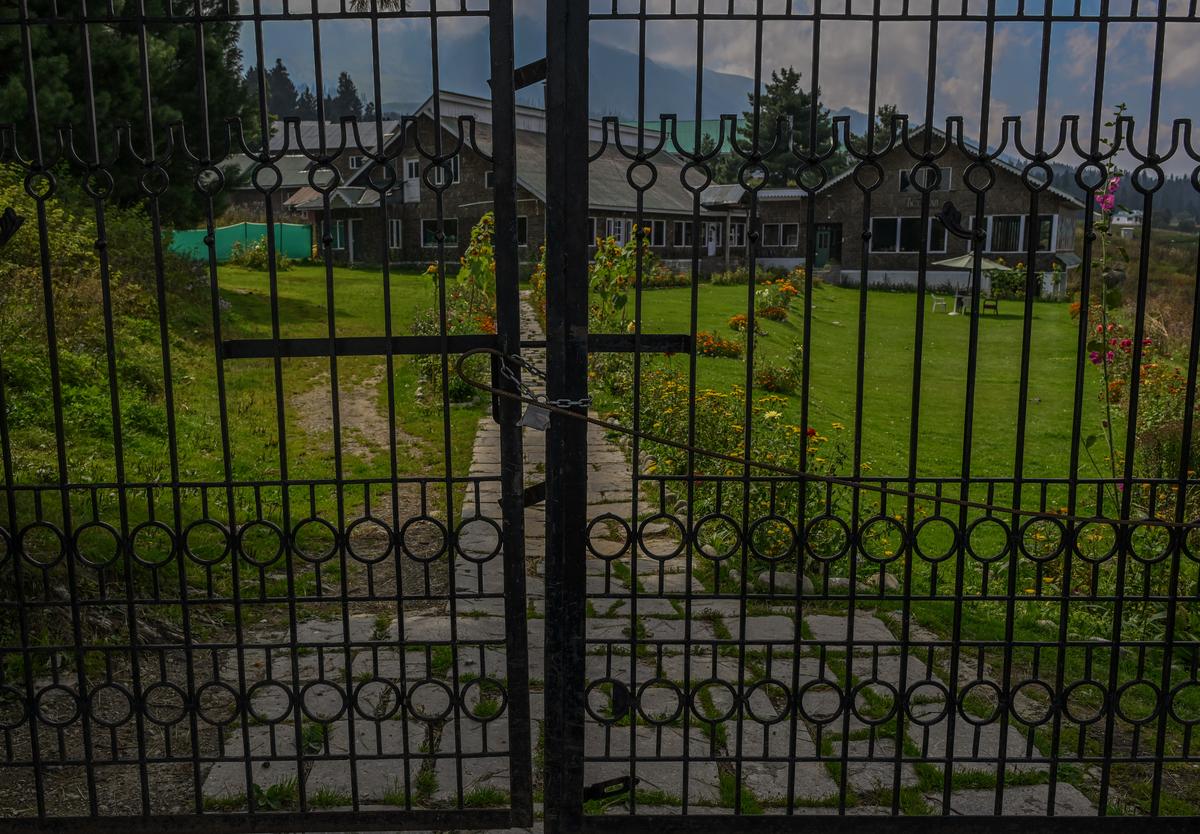
Nedous Hotel in Gulmarg, 55 km from Srinagar, Kashmir, was closed due to the introduction of new rules regarding properties on government land. IMRAN NISSAR | Photo Credit: Imran Nissar
Rules and pushback
According to official figures from Gulmarg Development Authority, lease holders pay ₹6 per person channel (0.125 acres) land in Gulmarg; this has not been revised for decades. Gulmarg generates only ₹ 4 crore in revenue from these rental properties. According to reports, Gulmarg Ropeway, a government-run ropeway that runs 3.2 kilometers for tourists to take in the view of the mountains from above, has earned over ₹ 100 crore in 2023-24.
If the new rules are followed, all existing leases will end. The new lease period will be reduced to 40 years, unlike the previous 99-year lease period. These rules also recognize that a person or entity in default under the 1960 Act is ineligible to participate in the auction. This makes almost all existing tenants uncompetitive.
According to officials in the tourism department, the use of the land through the auction will be diversified for education, healthcare, agriculture, tourism, skill development and development of traditional arts, crafts, culture and languages. The new provisions allow land in Gulmarg to be reserved for self-employment or for housing of ex-servicemen, war widows and families of persons killed during military service.
Gulmarg is the main destination for Kashmir’s tourism industry. According to tourism department figures, the meadow attracted 15.4 lakh tourists in 2022, 16.25 lakh in 2023 and 13.05 lakh in 2024. Figures show that more than 75% of tourists traveling to Kashmir visit Gulmarg, the Valley’s only ski resort that matches the snow quality of the Swiss Alps.
For the first time, those without resident status can also apply for land lease, opening up Gulmarg to big tourism players. Locals see this move as a death knell for Kashmiri investors. Most of the local hotel owners argued that the brand building effort, investment and challenges were ignored while opening up Gulmarg.
Niyaz Ahmed’s (name changed) grandfather, in his 40s, bought a plot of land at auction in Gulmarg for the construction of a hotel in 1978. “Our family took a loan from J&K Small Scale Industries Development Corporation Limited (SICOP) to invest in Gulmarg and build a 32-room hotel. We started repaying the loan in the 1980s and militancy started in the 1990s. Kashmir faced turmoil and we saw losses till 2010 and now our hotels are being taken away from us while tourism is picking up,” he says.
He says it has been difficult to gain the trust of tourists, but now that he has developed relationships with guests from Russia, Austria, New Zealand and Tibet during the ski season, he has been asked to give up the property he manages. “What will happen to the 45 personnel? No Kashmiri can compete in the auction,” he adds.
There were six hotels up for auction in the 2000s as Kashmir’s militant situation showed signs of improving. These will also be put out to tender.
confronting loss
Hotels in Gulmarg are categorized as ‘A’, ‘B’ and ‘C’. Most of their livelihood depends on categories B and C, the middle and lower rung hoteliers. There are 23 B class hotels for rent and 13 C class hotels in Gulmarg. “I lost my husband a few years ago. My two children inherited this hotel from their father. They are currently studying abroad. If the hotel is taken over by the government, I may have to ask them to return,” says Shazia Shah, who runs a C-class hotel.
He questions Gulmarg’s pickling of the rent issue. “Around 6,000 leases have expired across J&K. In Jammu state, around 1,662 expired leases include hotels, petrol pumps and commercial properties. Most of the properties auctioned in 1978-79 were for a lease period of 90-99 years, renewable after 40 years. The first 40 years expired in 2019, but the Land Grant Rules (2022) are currently applicable retroactively,” he says Shah.
A senior government official said that the elected government has suggested setting up a committee to look into Gulmarg issues and review the rules adopted by the LG government. Most hoteliers say they are willing to pay rent based on current market value.
Nedou wants the elected government to have a new lease renewal policy to implement. “Like the rest of the country, existing leaseholders should have the first right,” he thinks. He hopes the government intervenes “so that Gulmarg remains a cultural bridge between the Valley and the outside world.”


