Netanyahu says ceasefire doesn’t include Lebanon. Then 50 Israeli jets drop 160 bombs
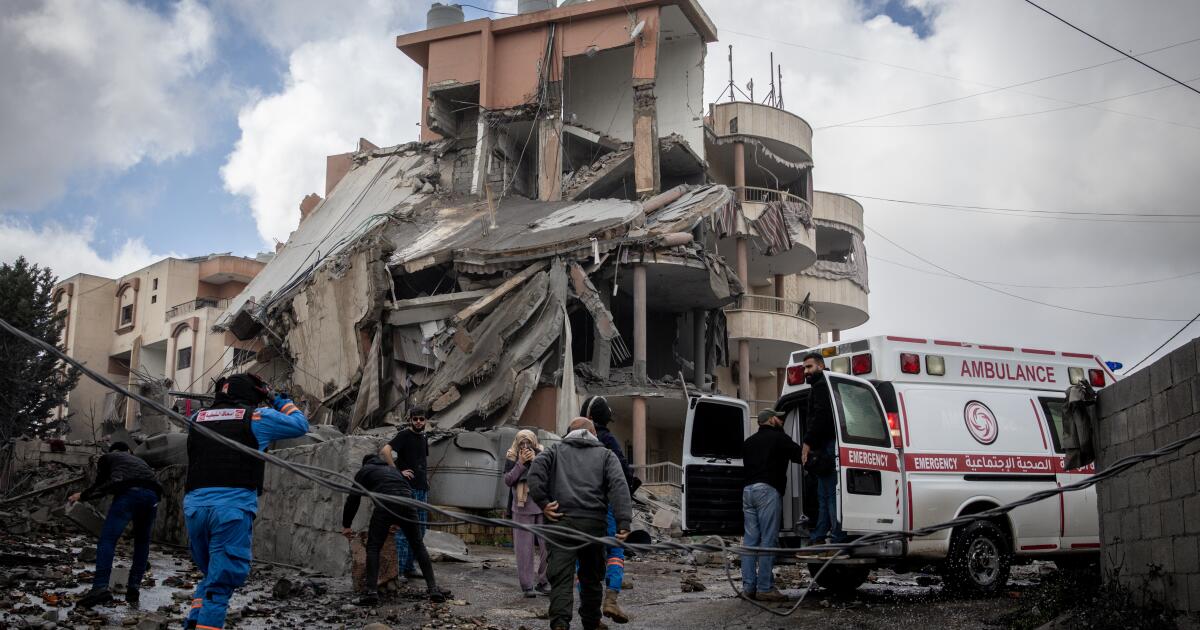
AMMAN, Jordan — While a fragile ceasefire between the United States and Iran appeared to remain in place on Wednesday, warplanes carried out the biggest wave of strikes across Lebanon since the start of current hostilities with the Lebanese Shiite militant group, as Israel insisted it would continue operations against Hezbollah.
In response to Israeli attacks, Iran has once again sealed the Strait of Hormuz, the vital waterway at the heart of the ceasefire agreement, Iranian state media reported.
In Israel, Prime Minister Benjamin Netanyahu’s office issued a statement on Wednesday welcoming the 14-day suspension of hostilities with Iran. However, he added that the agreement did not include Hezbollah.
Israel has been locked in an all-out war with Hezbollah since March 2 after it launched missiles into northern Israel in solidarity with Hezbollah’s long-time supporter Iran and in revenge for more than 10,000 violations of a ceasefire signed in November 2024.
Firefighters try to extinguish the fire that broke out after the Israeli attack on Beirut’s Corniche al-Mazraa neighborhood on April 8.
(IBRAHIM AMRO/AFP via Getty Images)
Netanyahu’s statement contradicts Pakistani Prime Minister Shehbaz Sharif, who said the ceasefire would extend to Lebanon.
Just hours after Netanyahu’s announcement, an armada of 50 Israeli warplanes dropped nearly 160 bombs on 100 targets in 10 minutes, hitting Hezbollah-held areas in southern and eastern Lebanon and near the capital, according to the Israeli military. Some neighborhoods in Beirut where Hezbollah was not present were also hit.
The dam, which occurred during rush hour shortly before 15:00, caused great panic, while drivers and pedestrians tried to escape from the debris.
Regarding the chaos triggered by the strikes, the Lebanese Red Cross stated that it mobilized 100 ambulances to transport the injured, while hospitals called for blood donations and called on all doctors to go to health centers to treat the injured.
Lebanese health officials said that according to initial findings, there were 112 dead and more than 830 injured. Lebanon’s civil protection unit stated that at least 250 people had been killed (92 of them in Beirut alone), raising the death toll significantly.
Safa Bleik, assistant medical coordinator of Doctors Without Borders, said that there was a “huge influx of dead” in Rafik Hariri Hospital, Lebanon’s largest public hospital, after Israel’s attacks.
“Here in the emergency room, we encounter a lot of injured people, including children,” Bleik said in an audio recording shared on the medical charity’s social media account.
“People are coming in with shrapnel wounds and bleeding profusely,” he said.
Before Wednesday’s attacks, Lebanese health officials said more than 1,500 people had been killed in Israeli attacks since March 2.
Lebanese president Joseph Aoun condemned Israel’s latest attack and said it added to the country’s “dark record”.
“These barbaric acts of aggression, which recognize no rights and respect no agreements or commitments, have repeatedly demonstrated the complete disregard for all international laws and norms,” Aoun said in a statement. he said.
Israeli Defense Minister Israel Katz said the strikes targeted “hundreds of Hezbollah operatives at headquarters in Lebanon with the greatest concentrated impact.” He warned Hezbollah Secretary General Naim Kasım that “his turn will come”.
Hezbollah also condemned the attacks and added in a statement that it had “the natural and legal right to resist the occupation and respond to its attacks.” However, there were no reports of missiles being fired at Israel from Lebanon.
Israel’s move puts further pressure on the fragile ceasefire, already troubled by a lack of clarity on its terms, implementation and endpoint.
Hezbollah entered the war in support of Tehran, with the aim of tying its fate to any ceasefire agreement with its powerful benefactor. But Israeli officials say they will continue to hit Hezbollah until it protects northern Israel from further attacks.
In a phone interview with PBS News Hour’s Liz Landers, President Trump said the conflict between Israel and Lebanon is a “separate conflict” from the war with Iran.
“Yes they are [Lebanon] “It was not included in the agreement,” he said. When asked why, he said, “Because of Hezbollah.”
“They were not included in the agreement. That too will be taken care of. No problem,” he said.
But Iran said otherwise, and the country’s foreign ministry issued a statement warning of the “terrible consequences” of Israel’s “criminal actions.”
“The cessation of hostilities in Lebanon is an integral part of the agreement with the United States,” the statement said, and “the crimes of the Zionist entity are a clear violation of this.”
Israel’s operation in Lebanon triggered exodus from the south of the country and other areas dominated by Hezbollah, forcing approximately 1.3 million people, mostly Shiites, to flee. Meanwhile, Israel has threatened the Lebanese that anyone who harbors displaced Shiites or allows Hezbollah to operate in their areas will see their areas bombed.
This put pressure on Lebanon’s delicate sectarian balance; some communities expelled displaced Shiites or did not allow them to arrive in the first place for fear of being targeted by Israel.
Israeli officials further stoked those fears on Wednesday; Israel’s Arabic-speaking spokesman, Avichay Adraee, accused Hezbollah of moving beyond its traditional strongholds of support in the capital’s southern suburbs and establishing itself in northern Beirut and mixed neighborhoods.
“To the Lebanese people: Don’t get me wrong, the destruction Hezbollah has brought to the suburbs will move with it,” he said, adding that the group was spreading “destruction throughout Lebanon at your expense.”
“Don’t let this happen, don’t let Hezbollah bring destruction upon you.”