The US backs a South Africa project to extract rare earths despite a diplomatic clash
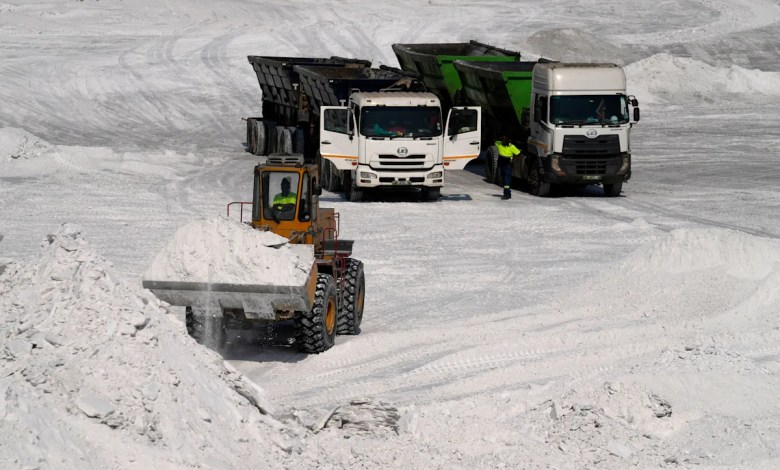
PHALABORWA, South Africa (AP) — Two massive sand-like dunes at a former chemical processing plant in South Africa are at the center of a U.S.-backed exploration project to extract the highly sought-after mineral rare earth elements from industrial mining waste.
Phalaborwa Rare Earth Project has US support through government capital investment of $50 million International Development Finance Corporation Part of stepped-up U.S. efforts Reducing dependence on economic rival China for minerals that are vital in the construction of electronic devices, robotics, defense systems, electric vehicles and other high-tech products.
Countries have identified dozens of minerals, including copper, cobalt, lithium and nickel, as critical because they are needed for new technologies. The 17 rare earth elements are a subset of these.
President Donald Trump has made expanding U.S. access to critical minerals, including rare earths, a key policy. counter china. The Trump administration has said it will spend about $12 billion this year to create its own facility. strategic reserve.
Project continues despite diplomatic dispute
DFC was established during the first Trump administration and has committed its investment to the Phalaborwa project in 2023 under former US President Joe Biden.
The current Trump administration has moved forward with the project despite the odds. major diplomatic rift Relations with South Africa began when Trump returned to office and issued an executive order last February to halt all financial aid to the country.
But the administration has shown that some economic concerns come first. DFC supported its participation in the Phalaborwa project as part of an effort to unlock Africa’s mineral potential while “advancing U.S. strategic interests.”
The Phalaborwa project is being developed by Rainbow Rare Earths. DFC’s investment is being made through partner TechMet, which says it is focused on securing critical mineral supplies for the West. The South African government has no direct stake in the project.
Rainbow Rare Earths CEO George Bennett told The Associated Press they hope to supply mainly to the United States and said his interest in the project was largely related to defense systems.
The company announced that it aims to supply neodymium, praseodymium, dysprosium, terbium and other rare earth elements from the South African project. They are used in high-performance magnets in wind turbines, electric vehicles, defense, and emerging applications including robotics.
The Phalaborwa project aims to start extracting rare earths from two massive dunes in 2028. The dunes consist of 35 million tonnes of phosphogypsum, a byproduct of mining waste and processing of phosphate rocks for acid and fertilizer production.
Rainbow Rare Earths said the project is expected to operate for 16 years. The $50 million injection from DFC will only be used when Rainbow Rare Earths begins construction of its processing plant in Phalaborwa, which is scheduled for early 2027.
Rare earths are relatively common but are often found in low concentrations and are difficult to separate, making them costly to mine.
Benchmark Mineral Intelligence research manager Neha Mukherjee said the Phalaborwa project was unique, its potential unknown through an experimental surface mining process.
“It seems like a pretty low-cost asset in terms of operating costs,” he said. “Even the capital requirement isn’t too high… that’s a good sign.”
Mukherjee added that the project is important because “we do not have enough projects to meet all the demand outside China.”
USA ‘trying to catch up’
Rainbow Rare Earths says mining the dunes would use up to 90% renewable energy and be significantly cheaper than typical rare earth mining.
Bennett said Phalaborwa would be a low-cost producer comparable to Chinese manufacturers.
“(The old owners) crushed it, they ground it, they put energy into it, they put heat into it, all this to make phosphogypsum, which is needed to make rare earths,” said Alberto Bruttomesso, Rainbow Rare Earths project director, referring to the processes the waste had previously gone through. “Heating is the most expensive part of the process. It’s the part that costs the most money.”
Trump administration also invested Critical mineral mining in the USA and has made agreements to secure access to these minerals abroad. in Ukraine. of greenland rare earths These are one of the reasons why Trump wants to buy the Arctic island.
The Phalaborwa project is one of several mining projects in Africa in which DFC has invested.
The United States is “trying to catch up in terms of mining investment” on the African continent, where China is the dominant player in mining, said Patience Mususa, a mining expert at the Scandinavian Africa Institute in Sweden.
In February, the U.S. Trade and Development Agency signed a formal agreement to provide $1.8 million for a feasibility study of the Monte Muambe rare earth project in Mozambique.
In Africa, the Trump administration also continues US financial support. Lobito CorridorA Biden administration initiative to build 800 miles (1,290 kilometers) of rail link Congo’s mineral-rich regions and from Zambia to the Atlantic coast of Africa.