Trump maintains blockade as Iran’s factions struggle to unite
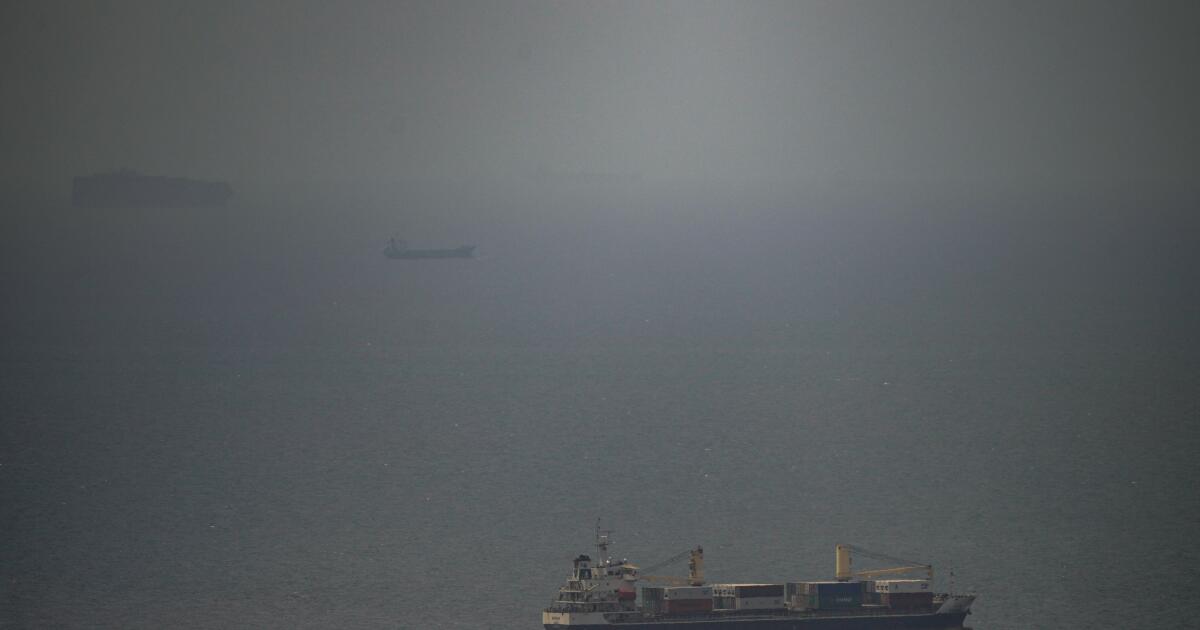
WASHINGTON— Iranian forces attacked three merchant ships in the Strait of Hormuz on Wednesday, adding to already tense tensions in the Persian Gulf as a U.S. naval blockade strains Tehran’s economy and pressures the divided leadership to return to peace talks.
The Islamic Revolutionary Guard Corps (IRGC) claimed responsibility for the attack, saying two ships were seized and a third damaged after the ships “ignored repeated warnings.” British maritime observers confirmed the incidents, reporting that one cargo ship was disabled in the water and another suffered heavy damage to its bridge.
In the statement made by the Iranian Naval Forces Command, it was said: “Disrupting order and security in the Strait of Hormuz is seen as a red line for Iran.”
In a post on Truth Social, he wrote that President Trump had confirmed hours earlier that he would maintain the naval blockade of the gulf, but agreed to give Iranian leaders additional time to agree on a new peace proposal.
“Based on the fact that the Government of Iran is seriously fragmented, it is not unexpected and upon the request of Field Marshal Asim Munir and Prime Minister of Pakistan Shehbaz Sharif, We were asked to continue our attack In his letter on Tuesday, Trump stated that negotiations on Iran will continue until its leaders and representatives put forward a common proposal.
On Wednesday, the Pentagon announced that Navy Secretary John Phelan “is leaving the administration, effective immediately.” Pentagon spokesman Sean Parnell said Navy Undersecretary Hung Cao will be the acting Navy secretary.
No reason was given for Phelan’s sudden departure.
More than a dozen American warships have blocked exports from Iranian ports since peace talks in Islamabad collapsed earlier this month. The tactic greatly restricted Iranian oil exports, 90 percent of which pass through the Strait of Hormuz, and contributed to increased inflationary pressure.
The restrictions could wipe out about $435 million in daily economic activity, according to Miad Maleki, a senior fellow at the Foundation for Defense of Democracies. Oil exports, Tehran’s primary source of income, have stopped. At the same time, Iran cannot import food and industrial products. As a result, the blockade is expected to drain Iran’s war chest and sharply accelerate inflationary effects on the Iranian people.
Shiite clerics gather at the Tomb of Imam Ali in the Old City of Najaf on April 22, 2026.
(Qasim al-Kaabi/AFP via Getty Images)
Trump believes this strategy will force Iran’s fragmented negotiating team, which appears divided between moderates in parliament and hardliners within the Revolutionary Guard, to agree on a “unified” peace proposal.
White House press secretary Karoline Leavitt said Wednesday that the president has extended the ceasefire agreement to allow Iran to “act together,” and emphasized that Trump has not yet given Iran a “firm deadline” for its response.
“President Trump will ultimately determine the timeline and do so when he feels it is in the best interest of the United States and the American people,” Leavitt told reporters.
Although Leavitt declined to specify who the administration is negotiating with in Iran, he said the president “generously offered some flexibility” to the regime so they could come up with a unified response.
“This is a battle between pragmatists and hardliners in Iran right now,” Leavitt told reporters at the White House.
The divide emerged earlier this week when plans for a second round of talks collapsed in Islamabad after Iranian officials disapproved of participation and imposed new preconditions under pressure from hard-line groups.
Iranian Parliament Speaker Bagher Galibaf initially signaled his willingness to participate in the talks, but was overshadowed by Islamic Revolutionary Guard Corps Commander Major General Ahmed Vahidi, who insisted that the United States lift the blockade before the talks began. A report by the Institute for the Study of War said Vahidi was trying to derail negotiations rather than provide meaningful economic relief.
“One of the challenges in the ongoing negotiations is the divided nature of Iran’s negotiating team,” the report said, adding: “[Trump’s] “The reference to a ‘unified’ proposal seems to imply that the previous proposals were somehow not unified.”
While hardliners continue their attempts to derail diplomacy with continued demands and attacks on the strait, moderates in Iran continue to press for peace.
This week, leading Sunni cleric Moulana Abdol Hamid said the only viable way forward was a “fair deal” and warned that those who wanted to block talks would bear responsibility for the “destruction in the homeland”.
Benjamin Radd, a political scientist at UCLA who studies Iran, said the dispute is a sign of a larger power struggle for control of Tehran’s government.
“There are clear divisions within the leadership,” Radd said in an interview. “It’s the Revolutionary Guard group that has all the power right now. They have weapons, they have weapons. What they don’t have is diplomatic contacts and experience with the United States.”
Radd pointed out that the economic cost of the US blockade is the main factor of tension within Iran.
“They are facing a huge internal crisis,” he said. “They cannot meet their own needs. Nothing can enter or leave the country. They cannot earn money.”
The results of the U.S. strategy could push more moderate Iranian leaders to reach an agreement on nuclear enrichment or reopen the strait in exchange for the U.S. lifting the blockade, Radd said.
“This will start to rebuild some kind of trust,” Radd said. “Then we see the IRGC basically standing firm and refusing to do any of this.”
With at least three people killed in renewed Israeli attacks in Lebanon on Wednesday despite a 10-day ceasefire agreement, Iranian leaders are preparing for the possibility of a complete failure of negotiations with the United States.
“Iran has prepared for a new phase of the war,” the Revolutionary Guard’s Tasnim News Agency said this week, citing military deployments and updated target lists.
Meanwhile, Iranian Judiciary Chief Gholam Hossein Mohseni Ejei warned that new attacks by the United States or Israel were likely. Iranian Foreign Ministry spokesman Esmaeil Baghaei made a similar statement at a press conference on Wednesday. He announced that the country’s armed forces were on “high alert” and ready to defend against any threat, while also being open to Pakistan’s mediation efforts.
He did not confirm whether the government would participate in the second round of talks.
“Diplomacy is a tool to ensure national interests and security, and when we conclude that the necessary and logical grounds exist for the use of this tool to realize national interests, we will take the necessary steps.”
Until then, it looks like both Washington and Tehran will continue the conflict in the strait.
On Wednesday morning, the IRGC released a statement confirming that it had seized two cargo ships and confirmed that they were MSC Francesca and Epaminondas. He claimed that MSC Francesca had ties to Israel and accused both of them of “endangering maritime safety by operating without the necessary permits and tampering with navigation systems”.
The third ship, Euphoria, sailing under the Panamanian flag and owned by a United Arab Emirates-based company, was fired upon as it headed east through the Strait of Hormuz early Wednesday, according to maritime intelligence firm Vanguard.
Euphoria then continued her voyage towards the Gulf of Oman, according to Lloyd’s List.
In Lebanon, Amal Khalil became the fourth journalist killed by Israeli fire since clashes with the Lebanese Shiite militant group Hezbollah intensified on March 2.
Khalil’s body was reportedly found under the rubble of a house where he and freelance photographer Zeinab Faraj were sheltering, according to colleagues.
Khalil and Faran were in the southern Lebanese town of Al-Tayri and were following developments there when an Israeli attack targeted the vehicle in front of them, killing its occupants.
According to the statement made by the Lebanese Ministry of Health, the two journalists later took shelter in a house but were once again exposed to Israeli fire.
Red Cross teams, who rushed to the area to rescue stranded journalists, were targeted with sound grenades and machine gun fire.
The Israeli army said it did not prevent rescue teams from reaching the area and that the incident was under investigation. He acknowledged targeting a vehicle that he said had emerged from a structure used by Hezbollah and was heading towards Israeli troops.
The Red Cross reached the house in the early evening local time and rescued Faraj, whose condition was reported to be stable after surgery for a head injury, according to his colleagues.
Times writers Ana Ceballos in Washington and Nabih Bulos in Beirut contributed to this report.


